
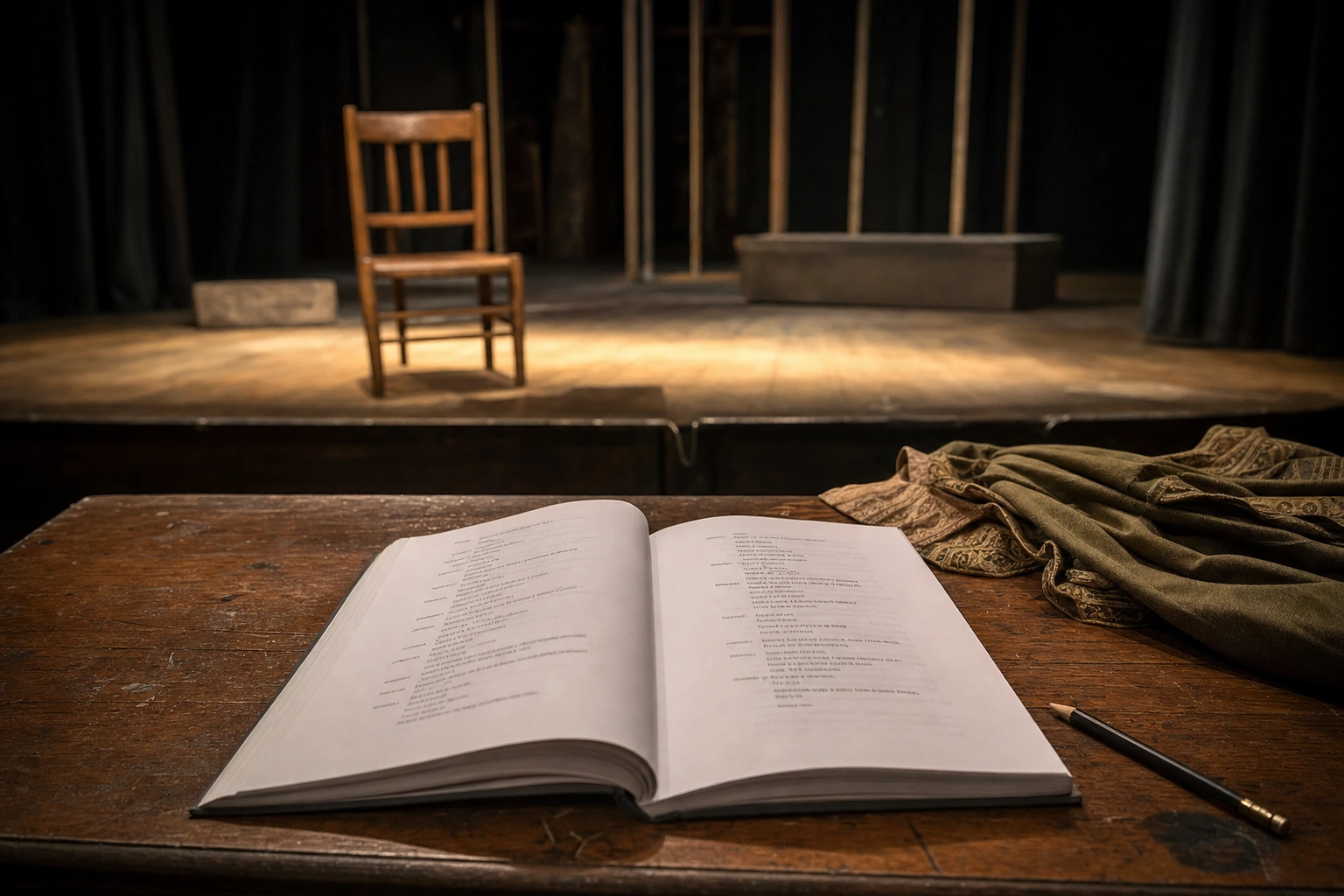
When reading a play, it is easy to concentrate on dialogue and treat everything else as secondary. Yet the words spoken by characters are only one part of dramatic meaning. Stage directions help transform written language into action by indicating where a scene takes place, how characters behave, when the mood changes and what the audience may see or hear.
Understanding stage directions is therefore important for students of drama, actors, directors, teachers and anyone who wants to interpret a play accurately. They are not simply technical notes for a theatre crew. They can reveal character, create tension, establish symbolism and shape the audience’s response. In some plays, stage directions are brief and practical; in others, they are detailed, poetic and central to the work’s meaning.
What Are Stage Directions?
Stage directions are instructions in a dramatic text that explain how a play should be performed or presented. They may describe the setting, entrances and exits, gestures, facial expressions, tone of voice, pauses, lighting, sound, props or movement across the stage.
Unlike dialogue, stage directions are usually not spoken aloud by the characters. In a printed play, they are often distinguished from dialogue through brackets, italics, indentation or a different layout. However, formatting varies between playwrights and editions, so readers should not rely only on appearance. The meaning and position of the words also matter.
For example:
Amina enters carrying a rain-soaked folder. She pauses at the doorway before looking towards the empty chair.
This direction gives several kinds of information. It tells us that Amina enters, shows that the folder has been affected by rain, creates a pause and draws attention to the empty chair. It may suggest that the chair belongs to someone important, absent or recently lost. The direction does not explain all of this directly, but it gives performers and readers clues from which meaning can be developed.
The Main Types of Stage Directions
Stage directions can be grouped according to the kind of information they provide. These categories often overlap, but they offer a useful way to study a dramatic text.
Setting and environment
Setting directions establish the place and time of a scene. They may identify a room, street, classroom, village compound, office or public space. They can also describe the condition of the environment, such as whether it is crowded, neglected, brightly lit or threatened by bad weather.
A setting direction can immediately influence the audience’s expectations. A scene set in a carefully guarded office may suggest authority and secrecy, while one set beside a busy market may suggest movement, negotiation and public observation.
Setting is not limited to physical location. It may also establish historical period, season, time of day or social atmosphere. A direction such as “early morning, before the town has opened its shops” creates a different dramatic possibility from “late at night, after the last bus has gone”.
Entrances and exits
Entrances and exits show when characters appear or leave the performance space. Their timing can affect suspense, rhythm and relationships.
An entrance may interrupt an argument, reveal a character unexpectedly or change the balance of power in a scene. An exit may indicate anger, fear, defeat, secrecy or a refusal to continue a conversation. The reason for an exit is sometimes more important than the movement itself.
Consider the difference between these directions:
- Joseph leaves.
- Joseph reaches the door, waits for an apology, then leaves without looking back.
The second version gives the actor a clearer emotional situation and helps the reader understand what has not been said. It also creates a question: will the apology come too late?
Movement and positioning
Directions may tell performers where to stand, sit, walk or turn. They can indicate whether a character remains close to another person, keeps a physical distance or moves towards an important object.
Positioning can communicate relationships without direct explanation. A character who stands behind a desk may appear to control access or information. Someone seated apart from a family group may seem excluded. If two characters repeatedly move closer and then separate, their physical behaviour may reflect trust, conflict or uncertainty.
Modern productions do not always follow every movement literally. A director may adapt the blocking to suit the stage, audience arrangement or interpretation. Nevertheless, the original movement can still reveal what the playwright wants the audience to notice.
Gesture, facial expression and physical behaviour
Some stage directions describe a character’s body language: a clenched fist, a lowered head, a forced smile, a sudden turn or a hand that trembles while holding a cup. These details can contradict spoken words.
For instance, a character may say, “I am perfectly calm,” while the direction states that she folds and unfolds the same piece of paper. The contrast suggests that the words are unreliable or that the character is trying to hide anxiety.
Physical directions should not be treated as decoration. They help actors explore motivation and help audiences interpret subtext: the meaning beneath the literal words.
Voice, pace and silence
Stage directions may describe how a line is delivered. Words such as “quietly”, “sarcastically”, “with hesitation” or “shouting” influence interpretation. They may also indicate pace, interruption, laughter, crying, a pause or silence.
Silence is especially significant in drama. A pause can show that a character is choosing words carefully, hiding information, processing a shock or waiting for another person to respond. A long silence after a question may communicate avoidance more powerfully than a direct answer.
Readers should ask whether a direction changes the meaning of the line. “You came” can express welcome, accusation, surprise or disappointment depending on the voice, pause and physical action attached to it.
Lighting, sound and technical effects
Some directions address the production team rather than the actors. They may call for a change in lighting, music, thunder, a bell, a phone ringing, a vehicle approaching or an offstage voice.
Technical effects can establish place and time, but they can also create symbolic meaning. A blackout may mark a sudden transition or conceal an event. Repeated sounds may become associated with fear, memory or approaching danger. A narrowing pool of light may isolate a character from the rest of the stage.
Props and costumes
Props are objects used in performance, such as letters, tools, books, food, bags, keys or mobile phones. Directions may identify when an object is picked up, hidden, broken, offered or taken away.
Objects often carry dramatic importance. A key may represent access or control; a family photograph may connect a character to memory; a missing document may drive a conflict. Costume directions can similarly indicate occupation, social position, cultural identity, age, wealth, change or disguise. A character appearing in an unexpectedly formal outfit may signal an important appointment or an attempt to impress others.
How Stage Directions Create Meaning
They reveal character
Stage directions can show qualities that a character does not admit. A person who speaks confidently but avoids eye contact may be insecure. A character who tidies objects during every difficult conversation may be using routine to manage discomfort. Repeated actions can become a pattern through which the audience understands personality.
Directions can also reveal development. At the beginning of a play, a character may enter cautiously and remain near the exit. Later, the same character may cross the stage decisively and address others directly. The change in movement can represent growing confidence or a new willingness to challenge authority.
They shape relationships and power
Physical distance, eye contact and control of space often communicate power. Who sits while others stand? Who occupies the centre? Who is forced to wait outside? Who turns away during an important confession?
These questions are useful when analysing scenes about family, work, politics, education or community leadership. In a school or community performance, for example, a character who controls the only chair may appear to control the conversation. A director can make that power visible even before the character speaks.
They build atmosphere and tension
Atmosphere is the emotional quality of a scene: tense, joyful, threatening, mournful, chaotic or uncertain. Stage directions create atmosphere by combining setting, sound, pace, lighting and movement.
A quiet room, a flickering light and a character who repeatedly checks the doorway can create suspense without an explicit statement that danger is near. In contrast, overlapping voices, rapid movement and bright activity can make a scene feel celebratory or overwhelming.
They provide subtext
Subtext is what characters mean, feel or intend beneath their spoken words. Stage directions are one of the clearest ways a playwright supplies subtext.
Imagine this exchange:
MARY: You can stay if you want.She begins gathering his coat from the chair.DAVID: I thought you wanted me to stay.
The spoken invitation is contradicted by the action. Mary may be asking him to leave while avoiding a direct confrontation. David recognises the conflict between her words and behaviour. The stage direction makes the relationship more complex than the dialogue alone would suggest.
How to Read Stage Directions Critically
A strong analysis does more than list the directions. It explains what they cause the audience to notice and how they contribute to the play’s meaning. The following process can help.
- Identify the direction. Note whether it concerns setting, movement, voice, silence, sound, lighting, costume or an object.
- Describe its immediate effect. Ask what the audience sees or hears at that moment.
- Connect it to the character. Consider what the action reveals about emotion, intention, fear or change.
- Compare it with the dialogue. Does the action support the words, contradict them or add information that the words omit?
- Consider relationships and power. Examine who controls space, who approaches, who withdraws and who is ignored.
- Look for patterns. Repeated objects, sounds, gestures or entrances may become motifs that develop across the play.
- Evaluate the audience’s response. Decide whether the direction creates humour, sympathy, suspense, discomfort, surprise or reflection.
For example, if a character repeatedly removes her shoes before entering a particular room, do not stop at “the character removes her shoes”. Ask why this action is repeated. It might show respect, fear, cultural practice, obedience or preparation for a private ritual. The surrounding dialogue and context should guide the interpretation rather than allowing one gesture to carry an unsupported meaning.
Stage Directions and Performance Choices
Stage directions are valuable, but they do not remove the need for artistic judgement. Actors must make the actions believable, and directors must decide how to realise the written instructions within a particular performance space.
A direction saying that a character “crosses to the window” may be performed differently on a large theatre stage, in a classroom or in an outdoor community performance. The essential purpose may be to show the character seeking distance, looking outside or avoiding another person. The exact route can change while the dramatic function remains.
Directors may also interpret ambiguous directions in different ways. If a character “laughs”, the laugh could be warm, nervous, cruel or disbelieving, depending on the scene. The actor should study the character’s circumstances, relationships and objectives before choosing a delivery.
Good performance does not mean adding random movement. Every gesture, pause or sound should serve a clear dramatic purpose. Too much movement can weaken a moment that requires stillness, while ignoring an important direction can remove essential meaning.
Common Mistakes When Studying Stage Directions
- Ignoring them completely: Focusing only on dialogue produces an incomplete interpretation of the play.
- Paraphrasing without analysis: Saying that a character “walks away” is not enough; explain what the departure suggests.
- Treating every direction as fixed: Some instructions are essential, while others invite creative interpretation.
- Assuming one emotion automatically: A gesture such as laughter or silence can have several meanings depending on context.
- Separating technique from theme: Lighting, sound, space and props can express ideas about memory, authority, identity or conflict.
- Forgetting the audience: Stage directions are designed for actions that can be seen or heard, so consider their theatrical impact.
Applying This in Practice
Choose a short scene from a play and create a two-column working note. In the first column, record the exact stage directions. In the second, explain their possible dramatic effects. Include questions such as:
- What does the direction make the audience notice first?
- What does the character want at this moment?
- Does the physical action agree with the spoken words?
- How does the use of space show closeness, conflict or authority?
- What would change if the direction were removed?
Then test the scene in performance. Read the dialogue once without acting the directions, and read it again while following them. Compare the two versions. You may discover that a pause changes the meaning of a sentence, that an entrance interrupts the emotional rhythm or that a simple prop gives the scene a clear focus.
For writers, this exercise also encourages restraint. Include a direction when it helps communicate an important action, rhythm, relationship or visual idea. Avoid explaining every emotion if the actor can express it through purposeful behaviour. A useful direction gives performers a playable action rather than an abstract instruction such as “show that he is deeply conflicted”. “He reaches for the letter, then hides it beneath the book” gives the performer something concrete to do while suggesting conflict.
Key Takeaways
- Stage directions guide action, sound, movement, setting and performance beyond the spoken dialogue.
- Entrances, exits and positioning can reveal relationships, power and changes in character.
- Gestures, pauses and silence often communicate subtext or contradict what a character says.
- Props, costumes, lighting and sound can establish atmosphere and carry symbolic meaning.
- Analyse a direction by identifying its immediate effect, connecting it to character and comparing it with the dialogue.
- Performance choices may adapt the exact movement while preserving the direction’s dramatic purpose.
No comments yet.