
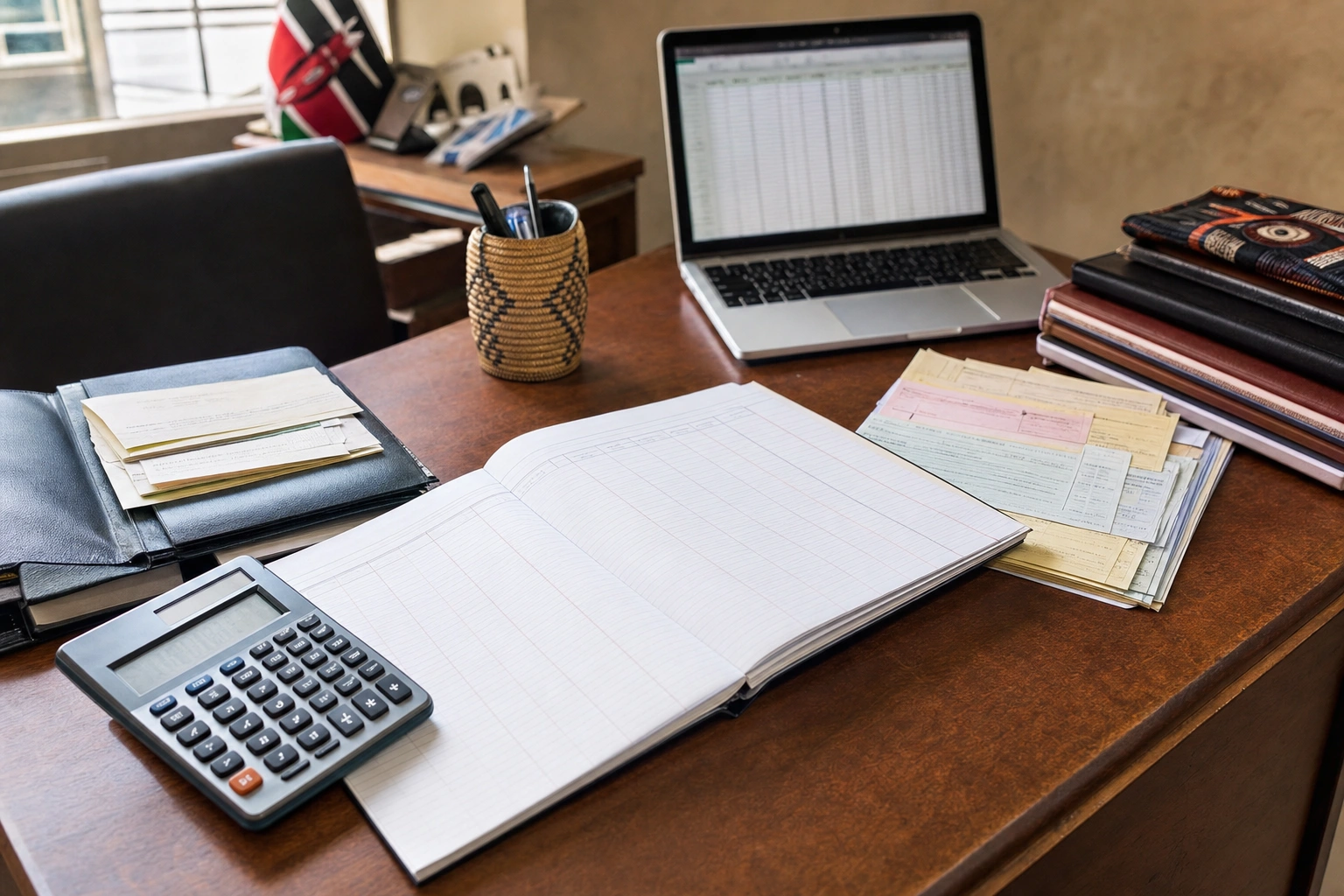
A cash book is one of the most practical records in accounting. It helps a business track money received, money paid out, cash held on the premises and transactions passing through a bank account. Because it records both sides of cash movement, it is useful for daily decision-making as well as formal bookkeeping.
Whether you run a small shop in Kisumu, manage a consultancy in Nairobi, work as a finance officer, or operate a community organisation, understanding the cash book can help you answer important questions: How much money came in today? Which payments have been made? Does the recorded balance agree with the actual cash and bank position? Are customers paying on time, and are expenses being properly authorised?
What Is a Cash Book?
A cash book is an accounting record used to record cash and bank transactions in chronological order. It serves two purposes: it is a book of original entry because transactions are first recorded there, and it is part of the ledger because its balances are used in preparing financial statements.
The cash book is divided into two broad sides:
- Debit side: records money received by the business.
- Credit side: records money paid out by the business.
In a traditional layout, the debit side is on the left and the credit side is on the right. Each transaction normally includes the date, a description or particulars, a reference, and an amount. More detailed cash books may include separate columns for cash, bank and discounts.
The word “cash” can sometimes cause confusion. In accounting, a cash book may record physical notes and coins as well as transactions made through a business bank account. It does not usually record sales or purchases made entirely on credit until money is actually received or paid.
Why the Cash Book Matters
A well-maintained cash book gives a business a current view of liquidity. Profit is important, but a profitable business can still struggle if it does not have enough cash available to pay suppliers, wages, rent, taxes or loan instalments when they fall due.
The cash book supports several important activities:
- Monitoring liquidity: It shows the amount currently available in cash and bank accounts.
- Controlling expenditure: Regular entries make unusual or unnecessary payments easier to identify.
- Checking completeness: Receipts and payment records can be compared with invoices, receipts and bank statements.
- Preparing accounts: The information feeds into the trial balance and financial statements.
- Reducing misuse: Independent checks and supporting documents make unauthorised transactions more difficult to hide.
- Planning payments: Managers can see whether upcoming commitments are affordable.
For a small enterprise, this record may reveal that sales are healthy but cash is being absorbed by stock purchases or customer credit. For a professional service firm, it may show that several clients have paid late while recurring expenses continue to leave the bank account.
Common Types of Cash Book
Single-column cash book
A single-column cash book has one amount column on each side, usually for cash. It is suitable for a very small operation that receives and pays mainly in physical cash and does not need to record bank transactions in the same book.
For example, a market trader might record daily cash sales on the debit side and payments for packaging or transport on the credit side. At the end of the day, the recorded balance should be compared with the physical cash remaining.
Two-column cash book
A two-column cash book commonly includes separate columns for cash and bank. This allows the business to distinguish between money held physically and money held in a bank account.
If a customer pays KSh 25,000 directly into the business bank account, the amount is recorded in the bank column, not the cash column. If the owner withdraws KSh 5,000 from the bank for business use, the bank balance decreases and physical cash increases.
Three-column cash book
A three-column cash book includes cash, bank and discount columns. The discount columns are used when a business allows or receives discounts connected with settlement of debts.
For instance, a supplier may allow a business to pay less than the amount originally owed if payment is made promptly. The amount actually paid is recorded in the cash or bank column, while the reduction is recorded as a discount received. A discount allowed to a customer is recorded separately from the cash received.
Discount accounting can vary according to the bookkeeping system being used, so the business should apply one consistent method and follow the requirements relevant to its reporting arrangements.
Important Terms and Entries
Receipts and payments
A receipt is money coming into the business. Examples include cash sales, customer payments, capital introduced by the owner, loan proceeds and interest received. A payment is money leaving the business, such as rent, stock purchases, wages, electricity, transport or supplier settlement.
Every entry should have a clear explanation. “Cash received” is not sufficiently informative on its own. “Cash sales for 12 March” or “Payment from Akinyi Traders against invoice 104” gives a better audit trail.
Contra entries
A contra entry records a transfer between cash and bank accounts belonging to the same business. It affects both the cash and bank columns but does not represent income or an expense.
Suppose a business withdraws KSh 10,000 from its bank account and keeps the money in the office cash box. The bank column is reduced by KSh 10,000, while the cash column increases by KSh 10,000. The transaction is a transfer of funds, not a new source of income.
Similarly, depositing physical cash into the business bank account reduces cash and increases bank. Contra entries are often marked with a “C” in the reference column so they can be identified easily.
Capital and drawings
When an owner puts personal funds into the business, the cash book records the money received. The corresponding accounting entry recognises the owner’s capital. When the owner takes business money for personal use, the cash book records a payment and the corresponding entry is treated as drawings, not as a business expense.
This distinction is especially important for sole traders. A personal withdrawal may reduce the cash available, but it should not be included among operating costs such as rent or advertising.
How to Record a Cash Book Transaction
Use a consistent process for every transaction. The following steps reduce omissions and make later checking easier.
- Identify the transaction: Decide whether money was received, paid, transferred between cash and bank, or connected with a discount.
- Check the source document: Use a receipt, invoice, payment voucher, deposit slip, bank notification or other appropriate evidence.
- Enter the correct date: Record the date on which the transaction occurred or the date required by the business’s accounting procedure.
- Write a useful description: Name the customer, supplier, purpose or account involved.
- Choose the correct column: Enter a cash transaction in the cash column and a bank transaction in the bank column.
- Record the amount accurately: Check the currency, decimal point and number of zeros.
- Attach or reference the supporting document: A reference number helps another person trace the entry.
- Update the balance: Recalculate the running balance after the entry where the system allows it.
Imagine a small stationery shop receives KSh 8,000 in cash sales, pays KSh 2,500 for delivery and receives KSh 15,000 directly into its bank account from a customer. The cash book would show KSh 8,000 on the receipts side in the cash column, KSh 2,500 on the payments side in the cash column, and KSh 15,000 on the receipts side in the bank column. The entries should be supported by sales records, a payment document and evidence of the bank deposit.
Balancing the Cash Book
Balancing means calculating the closing amount remaining after receipts and payments have been recorded. For the cash column, add the debit-side receipts and compare them with the credit-side payments. The difference is the cash balance. The same process can be applied to the bank column.
A simple formula is:
Opening balance + money received ? money paid = closing balance
If the cash book begins with KSh 20,000, receives KSh 35,000 and pays KSh 18,000, the expected closing cash balance is KSh 37,000. The business should count the physical cash and investigate any difference rather than changing the record without explanation.
A cash balance normally should not be negative because a business cannot physically pay out more cash than it holds. A negative bank balance may be possible where an agreed overdraft exists, but it should be clearly identified and monitored. A negative cash balance may indicate an error, an unrecorded receipt, a payment made from another source, or an entry posted to the wrong column.
Cash Book and Bank Reconciliation
The balance in the cash book bank column may differ from the balance shown on the bank statement. This does not automatically mean that one record is wrong. Timing differences and unrecorded items are common reasons for disagreement.
Examples include:
- Cheques or deposits recorded by the business but not yet processed by the bank.
- Bank charges appearing on the statement but not yet entered in the cash book.
- Standing orders, direct debits or electronic payments not yet recorded internally.
- Interest credited by the bank but not yet included in the business records.
- Errors in the cash book or on the bank statement.
Bank reconciliation involves comparing the cash book with the bank statement, identifying each difference, correcting internal records where necessary, and explaining timing differences. It is good practice to perform this regularly rather than waiting until the end of the financial year.
Digital payments require the same discipline as physical cash. A mobile-money transaction, card settlement or online transfer should be supported by a reliable record and assigned to the correct business account. If a proprietor uses a personal mobile-money wallet for business receipts, separating business and personal transactions can become difficult. A dedicated business account or clearly controlled business wallet usually makes recording and reconciliation easier.
Common Errors and How to Prevent Them
Cash book errors can arise from simple mistakes or weak procedures. Common examples include recording a receipt twice, omitting a payment, entering a transaction in the wrong column, reversing the figures, or confusing a business expense with an owner’s personal withdrawal.
To reduce these problems:
- Record transactions promptly instead of relying on memory.
- Use sequential receipt and payment references where appropriate.
- Keep business funds separate from personal funds.
- Require approval for significant or unusual payments.
- Compare the physical cash with the book balance regularly.
- Reconcile the bank column with the bank statement.
- Correct errors transparently with an identifiable adjustment rather than erasing the original record.
- Restrict access to accounting records and payment tools according to staff responsibilities.
A correction should preserve the audit trail. For example, if KSh 6,800 was entered instead of KSh 8,600, the business should record an appropriate correcting entry or follow the correction function in its accounting software. Quietly deleting the original entry can make later review more difficult.
Using a Cash Book for Better Business Decisions
The cash book becomes more useful when its information is interpreted, not merely recorded. Review the balance and recent transactions to identify patterns.
If cash is regularly low just before supplier payments, the business may need to change its purchasing schedule, negotiate payment terms or improve collection of customer debts. If bank charges are frequent, management may review the costs of its banking arrangements and payment methods. If physical cash consistently differs from the recorded balance, the problem may involve poor documentation, timing, theft or an unclear process.
For a project-based consultant, a cash book can show whether client deposits are sufficient to cover immediate project costs. For a small restaurant, it can help compare daily cash takings with sales records and track purchases of food supplies. For a non-profit group, it creates a record of funds received and payments made against an approved activity budget.
However, the cash book does not replace other accounting records. Credit sales, amounts owed by customers, amounts owed to suppliers, depreciation and non-cash adjustments require additional records and accounting treatment. A business may have a strong cash position while still carrying significant debts, or it may have valuable assets without enough cash for immediate bills.
Applying This in Practice
- Set up clear columns: At minimum, distinguish receipts, payments and the relevant cash or bank account.
- Choose a recording frequency: Daily recording is usually safer for a busy business; a low-volume operation may use another consistent schedule.
- Keep evidence together: Organise receipts, invoices, deposit slips and payment approvals so each entry can be traced.
- Review unusual items: Investigate large withdrawals, unexplained differences and repeated personal-looking payments.
- Balance regularly: Compare the calculated cash balance with actual cash and reconcile bank records.
- Use the results: Plan upcoming payments, follow up outstanding customer balances and adjust spending where necessary.
A simple weekly review can ask: What was the opening balance? What money came in? Which payments were essential? Which customer receipts are still outstanding? Does the recorded cash agree with the cash held? Does the bank balance agree after considering outstanding items? These questions turn the cash book into a management tool rather than a filing exercise.
Key Takeaways
- A cash book records money received and paid, including relevant cash and bank transactions.
- Receipts belong on the debit side, while payments belong on the credit side.
- Cash, bank and discount columns should be used consistently according to the business’s needs.
- Transfers between a business’s cash and bank accounts are contra entries, not income or expenses.
- Balancing the book and reconciling it with physical cash and bank statements help identify errors and control risks.
- Supporting documents, separate business funds and prompt recording make the cash book more reliable.
No comments yet.