
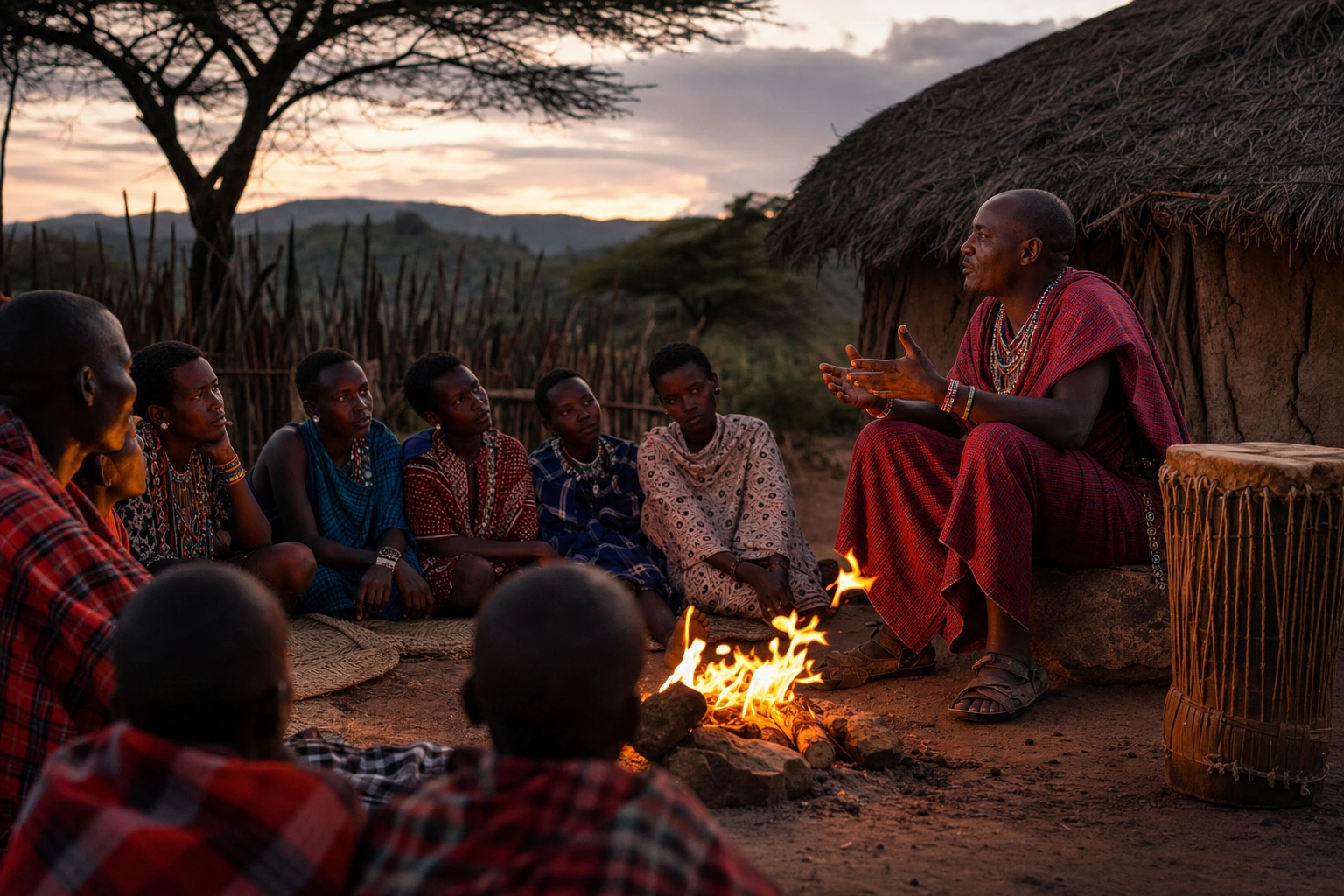
Oral literature is not simply written literature spoken aloud. It is a living artistic practice in which a performer uses voice, movement, language, music and interaction to create meaning before an audience. A folktale told beside a cooking fire, a praise poem performed at a public ceremony, a work song shared by a group or a proverb used during a family discussion all depend on the circumstances of performance.
Understanding performance therefore helps learners move beyond the question, “What does this story say?” They also ask, “Who performs it, for whom, where, when and how?” These questions reveal how oral literature entertains, teaches, preserves memory, comments on power and strengthens community identity.
What Performance Means in Oral Literature
In oral literature, performance is the complete act through which an oral work is communicated and experienced. It includes the words, but also the performer’s voice, pace, facial expression, gestures, posture, use of space, musical accompaniment and relationship with the audience.
A written story usually remains relatively stable when it is read in different places. An oral narrative may change each time it is performed. The performer can shorten an episode, add a local reference, repeat a striking line, invite the audience to respond or alter the ending to suit the occasion. The work is therefore both a traditional form and a current event.
This does not mean that oral literature is unstructured or careless. Performers often work within recognised conventions. A praise poem may use particular forms of address; a song may follow a familiar rhythm; a folktale may begin with an established opening formula; and a proverb may be introduced at a suitable point in a conversation. Skill lies in using these conventions effectively while responding to the immediate audience and situation.
The Main Elements of an Oral Performance
The performer
The performer is not merely a channel for a pre-existing text. They interpret and shape the material. Their knowledge of language, history, music, social customs and storytelling techniques influences how the audience understands the work.
A skilled storyteller may use a calm voice during a reflective moment, a faster pace during danger and a pause before an important revelation. A singer may alter the melody or invite another group to answer. A praise poet may use strong projection and carefully chosen forms of address to honour an individual or community.
The performer’s authority also matters. Some performances are associated with elders, specialists, religious figures, praise singers, musicians or community historians. The audience may listen differently depending on the performer’s social role and knowledge.
The audience
Oral literature is commonly interactive. The audience may laugh, sing, clap, answer a repeated line, ask questions, correct details or show approval and disagreement. Even when the audience does not speak openly, its attention and reactions influence the performer.
Many oral forms use a call-and-response pattern. One person or group leads, and another responds with a repeated phrase, chorus or rhythm. This structure makes the audience part of the performance rather than a group of silent observers. It can also create unity, particularly during communal songs, ceremonies and work activities.
When analysing a performance, consider the audience’s age, status, relationship to the performer and knowledge of the tradition. A children’s folktale, a political song and a ceremonial praise poem may use different language and techniques because their audiences and purposes differ.
Voice and language
Meaning in oral literature is strongly affected by how words are spoken. Volume can suggest authority, excitement or fear. Pitch can distinguish characters, express emotion or make a line memorable. Pace can build suspense, while deliberate repetition can emphasise an idea.
Language also carries cultural meaning. Proverbs, idioms, praise names and symbolic expressions may communicate more than their literal definitions. A performer may switch between languages or varieties of a language to mark identity, create humour or reach different members of the audience. Word choice can indicate respect, intimacy, conflict or social distance.
Repetition is especially important. A repeated phrase may help listeners remember a performance, give the audience an opportunity to participate or underline a moral principle. It can also create rhythm and anticipation. Repetition should not automatically be treated as evidence of limited vocabulary; within oral performance, it is often a deliberate artistic and memory-supporting technique.
Gesture, movement and facial expression
Oral performance communicates through the body as well as through speech. A raised hand may signal warning or command attention. A lowered voice combined with a serious expression may indicate secrecy. Movement towards or away from the audience can create closeness, tension or distance between characters.
In dance, drama, praise poetry and song, physical action may be central to the form. A performer’s posture can communicate dignity, grief, confidence or submission. Facial expression may reinforce the spoken words or create irony by contradicting them. These details are easy to miss when an oral work is studied only from a written transcript.
Music, rhythm and sound
Many oral performances use singing, drumming, clapping, rattles, whistles or other forms of musical accompaniment. Music can establish mood, mark transitions and encourage participation. Rhythm can help a group coordinate movement during work or ceremony, while a refrain can make a song easy to remember and repeat.
Sound effects can also support storytelling. A performer may imitate an animal, imitate a character’s voice or use silence to create suspense. The absence of sound can be as meaningful as sound itself. A pause may allow the audience to reflect, signal that an important statement is coming or give listeners time to respond.
Space, time and occasion
Where and when a performance takes place affect its meaning. A story told in a family setting may create intimacy, while a public performance may emphasise community identity. A song performed during work has a different function from a song performed at a wedding, initiation-related gathering, memorial event or political meeting.
The physical arrangement also matters. A performer in the centre of a circle can interact differently from one standing on a raised stage. The distance between performer and audience may influence volume, gesture and movement. Weather, lighting, available instruments and the presence of children, elders or visitors can also shape the event.
Why Performance Is Essential to Meaning
Performance can change the meaning or emotional effect of the same words. A line that appears humorous in a transcript may become serious when spoken slowly and accompanied by a solemn gesture. A proverb may sound like advice in one context but criticism in another. A praise poem may celebrate a leader while also reminding that leader of responsibilities.
Performance also connects oral literature to social life. A folktale may teach values such as cooperation, caution or respect, but its lesson is shaped by the occasion and the teller’s emphasis. A work song may support coordination while expressing hardship or solidarity. A satirical song may entertain listeners while commenting on unfairness or misuse of authority.
Oral literature can preserve collective memory, but it is not a museum object. Each performance may relate inherited material to present concerns. A performer might use a traditional character to discuss a current social problem, or adapt an old song for a new community event. This ability to combine continuity with change is one reason oral literature remains relevant.
Performance and the Written Text
Written versions of oral works are useful for learning, comparison and preservation, but they are records of performances rather than complete replacements for them. A transcript can preserve words while leaving out tone, timing, gestures, audience reactions and the physical setting.
Transcription may also make a performance appear more fixed than it actually is. Different performers can produce different versions of the same narrative, and both may be valid within the tradition. Translation introduces another layer of interpretation because a translator must decide how to represent idioms, rhythm, humour, wordplay and culturally specific references.
When reading a written version, learners should ask what may have disappeared during recording or transcription. Are pauses marked? Are audience responses included? Is the language translated? Are songs represented by lyrics alone? Has the recorder identified the occasion and participants? These questions help prevent the written record from being mistaken for the whole performance.
Common Oral Forms and Their Performance Features
Folktales and oral narratives
Oral narratives often depend on character voices, suspense, repetition and direct interaction with listeners. A storyteller may ask a question before revealing an event or use a repeated formula that invites the audience to respond. Animal characters can represent human qualities, allowing the performer to explore wisdom, greed, courage, foolishness or cooperation indirectly.
The narrative’s lesson is not always stated at the end. It may be communicated through the consequences faced by characters, the performer’s tone or discussion among listeners after the story.
Proverbs and riddles
Proverbs are short, compressed statements whose meaning depends heavily on context. Their performance involves timing and judgement. Used at the right moment, a proverb can settle an argument, offer guidance or criticise behaviour without direct accusation.
Riddles often depend on a challenge-and-response structure. The performer presents a puzzle, and participants attempt to solve it. The pleasure comes from both the answer and the process of reasoning, wordplay and competition. Tone and timing can make a riddle playful, difficult or teasing.
Songs and chants
Songs may express emotion, preserve history, accompany labour, mark ceremonies or strengthen group identity. Their performance often combines melody, rhythm, movement and communal participation. A chorus can make a message collective, while changes in tempo can signal a change in mood or activity.
Praise poetry and spoken verse
Praise poetry uses carefully selected names, images, descriptions and references to honour a person, family, group or institution. The performance may involve dramatic delivery, rhythmic speech and movement. Praise is not necessarily simple flattery. It can recall achievements, identify ancestry, celebrate courage and remind the subject of expected conduct.
How to Analyse an Oral Performance
- Identify the form and occasion. Decide whether the performance is a narrative, song, proverb, riddle, praise poem, chant or another form. Record where and when it occurs and what social event surrounds it.
- Describe the participants. Identify the performer, the audience and any supporting singers, musicians or dancers. Consider their roles and relationship to one another.
- Examine the verbal content. Look at themes, characters, imagery, proverbs, idioms, repetition, questions and patterns of address. Ask what values or conflicts the words express.
- Study delivery. Note changes in volume, pitch, pace, tone and pronunciation. Identify pauses, laughter, silence, singing and imitations of voices or sounds.
- Observe non-verbal communication. Consider gestures, facial expressions, posture, movement, costume where relevant and the use of physical space.
- Analyse audience interaction. Record responses such as singing, clapping, laughter, corrections, questions or silence. Ask how these reactions shape the performance.
- Interpret purpose and effect. Explain whether the performance mainly entertains, teaches, praises, criticises, commemorates, unites, consoles or coordinates activity. Many performances serve several purposes at once.
- Consider change and variation. Compare the performance with another version if available. Identify what has been retained, changed or added, and explain why the context may have encouraged those choices.
Applying This in Practice
Suppose you are studying a communal song performed at a local cultural event. Do not begin by analysing only the lyrics. First describe the setting, the occasion and the people involved. Note whether one singer leads while others respond, whether instruments or clapping establish the rhythm and whether the song is performed while people sit, work, march or dance.
Next, examine the language. Look for repeated lines, references to shared history, praise names, warnings or expressions of belonging. Then connect the musical and physical features to the message. A strong chorus may make the idea collective; a rising tempo may create excitement; a pause may mark a solemn memory.
Finally, consider the audience’s response and the performance’s wider social function. Does it preserve a story, teach younger members, honour someone, encourage cooperation or comment on a current issue? Your analysis should show how these functions are created through the combination of words, delivery, participation and context.
For entrepreneurs, educators and community organisers, this approach is also useful beyond literature classes. Understanding performance can improve public speaking, training, storytelling, cultural programming and community communication. A message becomes more memorable when its language, rhythm, delivery, setting and audience participation support one another.
Key Takeaways
- Oral literature is a live performance, not merely a written text spoken aloud.
- The performer, audience, language, voice, gesture, music, space and occasion all contribute to meaning.
- Audience participation through response, repetition, song or movement is often part of the artistic form.
- Written transcripts may preserve words while leaving out tone, gesture, timing, context and interaction.
- To analyse an oral performance, examine its form, participants, verbal content, delivery, non-verbal features, audience response and purpose.
- Variation between performances reflects the living and adaptable nature of oral literature.
No comments yet.