
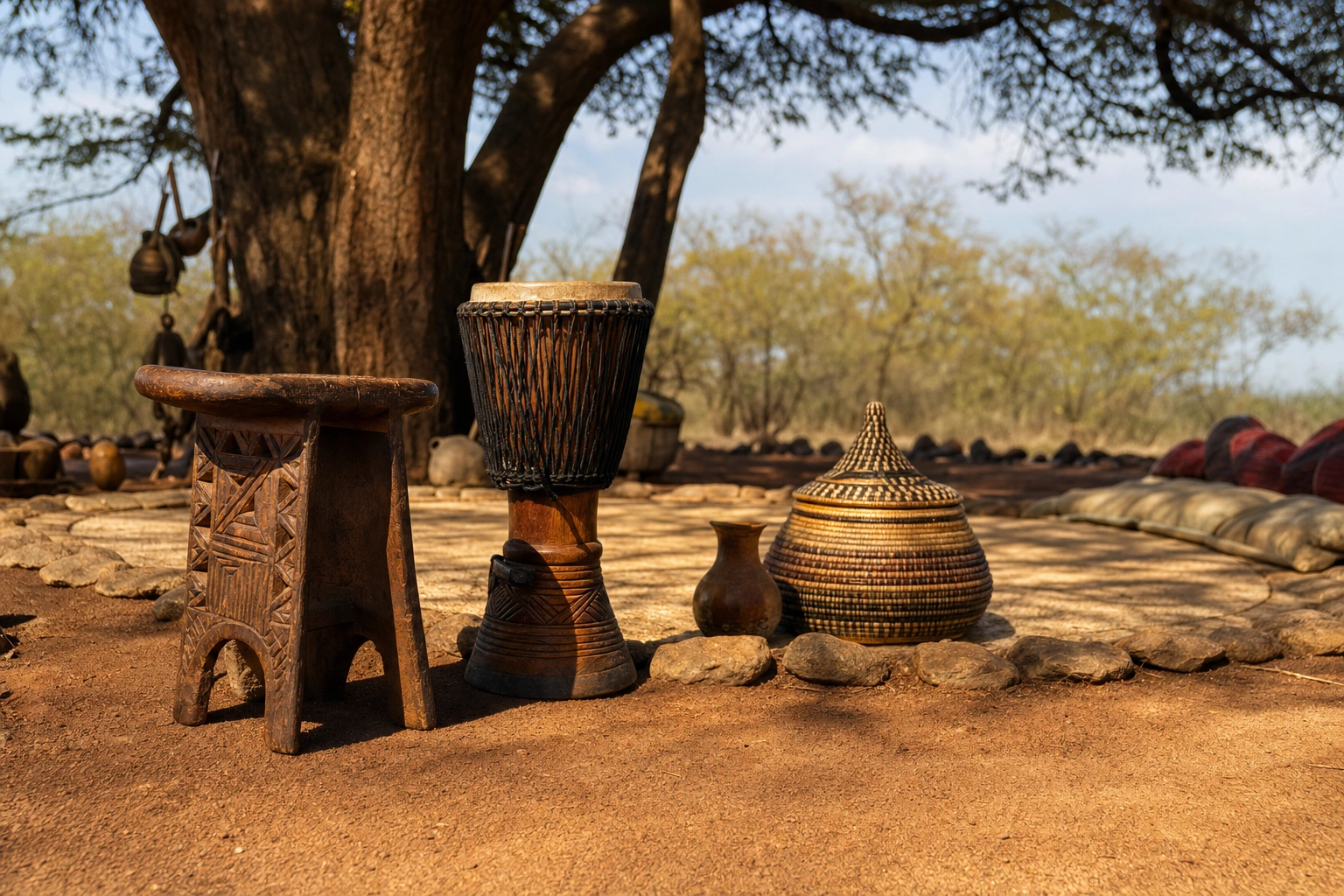
Oral literature is literature created, shared and preserved through speech, song, chant, recitation, performance and participation rather than through writing alone. It includes the stories people tell, the songs they sing, the riddles they pose, the proverbs they use and the dramatic performances through which communities interpret life.
Although oral literature is often associated with traditional societies, it remains part of modern life. A grandmother telling a family history, a musician commenting on public events, a religious leader using a parable, or a storyteller entertaining children is participating in an oral literary tradition. Understanding oral literature therefore means studying not only words, but also voice, audience, setting, memory, movement and cultural meaning.
What Is Oral Literature?
Oral literature is imaginative or artistic expression transmitted by word of mouth and performance. It may be passed from one generation to another, adapted by individual performers, or created in response to a particular event. Unlike a fixed printed text, an oral work may change slightly each time it is performed.
This does not mean that oral literature is disorganised or less valuable than written literature. Oral artists use established forms, patterns, images, repetition and techniques of delivery. A skilled narrator knows when to pause, vary the voice, invite a response or repeat a phrase. A singer may use rhythm and melody to make lines memorable. A speaker may select a proverb because it expresses a complex idea in a concise and culturally recognised form.
Oral literature is both a product and a process. The product is the narrative, song, proverb or performance that an audience hears. The process includes the social situation in which it is created, performed, understood and remembered.
Major Forms of Oral Literature
Oral narratives
Oral narratives include myths, legends, folktales, fables, trickster tales, historical accounts and personal stories. They may explain the origin of a community, teach acceptable behaviour, entertain listeners or preserve memories of important people and events.
Myths often address origins, supernatural beings or fundamental questions about the world. Legends are usually connected to people, places or events believed to have some relationship with history, even when the story contains imaginative elements. Folktales are commonly shared stories that express community values, while fables often use animals or other non-human characters to comment on human behaviour.
Trickster stories are especially useful for examining social tension. A character who is physically weak but mentally clever may challenge powerful figures. The trickster can be amusing, disobedient, selfish or creative, and the story may encourage listeners to question pride, greed or unfair authority.
Proverbs and sayings
Proverbs are brief, memorable statements that express observations, advice or shared wisdom. Their meaning is often indirect. For example, a proverb about repairing a roof before the rainy season may advise people to prepare for difficulty before it arrives. The force of a proverb depends on the context in which it is used and the audience's ability to interpret it.
Proverbs can support an argument, settle a disagreement, teach patience or make a speech more persuasive. They are not automatically true in every situation, however. A thoughtful analysis should ask who uses a proverb, what behaviour it encourages and whether another proverb could express a different point of view.
Riddles
Riddles are short verbal puzzles that usually require a listener to identify an object, animal, person or idea from indirect clues. They develop observation, memory, imagination and language skills. In many communities, riddles have traditionally been used to entertain and educate young people, especially during informal gatherings.
A riddle often depends on metaphor and shared knowledge. Understanding it may require familiarity with local tools, farming practices, animals, food or the natural environment. This makes riddles valuable evidence of how a community sees and categorises the world.
Songs, chants and poems
Oral poetry may be sung, spoken, chanted or accompanied by instruments, clapping and movement. Examples include work songs, lullabies, praise songs, wedding songs, mourning songs, religious songs, initiation songs, protest songs and songs performed during ceremonies.
Music and rhythm make oral poetry easier to remember, but they also communicate emotion and social purpose. A work song can coordinate activity; a lullaby can comfort a child; a praise song can honour a leader or community; and a protest song can express dissatisfaction. The words should therefore be studied together with melody, repetition, tempo, audience participation and occasion.
Drama, dance and public performance
Oral drama combines speech with action, costume, gesture, music and sometimes dance. It may be performed during ceremonies, festivals, community events or educational activities. The performer may take on different characters, while the audience responds through laughter, singing, questions or comments.
In oral literature, performance is not merely an extra feature added to a written script. It is part of the meaning. A line delivered quietly may suggest fear, while the same line shouted by a group may suggest confidence or resistance. Movement, costume and the arrangement of performers can also communicate social roles.
Key Features of Oral Literature
- Performance: Meaning is shaped by voice, gesture, rhythm, facial expression, music and interaction.
- Audience participation: Listeners may answer questions, repeat refrains, correct details, laugh, sing or influence the direction of a performance.
- Repetition: Repeated words, phrases, characters or events help performers remember material and help audiences follow it.
- Variation: A performer may alter a story to suit the audience, occasion, location or current concerns.
- Memorability: Rhythm, formulaic openings, proverbs, parallel structures and vivid imagery make oral works easier to recall.
- Collective ownership and individual creativity: A community may recognise a story as part of its heritage, while each performer gives it a personal style.
- Cultural context: The meaning of a performance is connected to beliefs, values, history, environment and social relationships.
How Oral Literature Works in Society
Education and moral instruction
Stories and songs can teach lessons about honesty, courage, cooperation, responsibility and respect. A tale in which a selfish character suffers the consequences of refusing help may encourage generosity. However, moral teaching is not always simple. Some stories present competing values, such as cleverness versus obedience or individual freedom versus community responsibility. The audience may be expected to discuss and interpret the lesson rather than receive a single rule.
Preserving history and identity
Oral accounts can preserve memories of migration, conflict, leadership, family origins, work and changing landscapes. They help people connect present experiences with earlier generations. At the same time, oral history is shaped by memory and perspective. A responsible learner should compare accounts where possible and distinguish between a community's remembered interpretation and independently verified historical detail.
Entertainment and social connection
Entertainment is not a trivial function. Shared laughter, singing and storytelling strengthen relationships and create opportunities for people to gather. In a Kenyan village, a family setting, a school club or an urban cultural event, oral performance can bring different age groups into conversation. It may also preserve language varieties and expressions that are not commonly used in formal writing.
Social criticism
Oral literature can challenge injustice without making a direct accusation. A satirical song, a trickster tale or a proverb may expose hypocrisy, misuse of power or poor leadership. Because the criticism is conveyed through humour, symbolism or indirect language, the performer can invite reflection while reducing open confrontation.
Oral Literature and Written Literature
Oral and written literature overlap, but they are not identical. A folktale transcribed into a book becomes available for repeated reading, quotation and classroom analysis. Yet the printed version may not fully capture the original voice, pauses, music, gestures or audience responses. A written record is therefore valuable, but it is an interpretation or representation of an oral performance rather than the entire performance itself.
Written literature is usually associated with a more stable text, although authors may revise their work and readers may interpret it differently. Oral literature is more openly shaped by performance and variation. It is also often embedded in social occasions, whereas a written poem can be read privately without the original community setting.
The two forms can influence each other. Contemporary musicians, spoken-word artists, podcasters and broadcasters may adapt proverbs, folktale structures or praise-poetry techniques. Writers may collect oral narratives and reshape them into novels, plays or poems. When this happens, learners should ask what has been retained, what has been changed and whose voice is being represented.
A Practical Method for Analysing an Oral Work
- Identify the form. Decide whether the work is a folktale, proverb, riddle, song, praise poem, legend, speech or another form. Some performances combine several forms.
- Describe the occasion and audience. Ask where and when it was performed, who performed it, who listened and whether the audience participated. A wedding song will not function in exactly the same way as a lullaby.
- Examine the content. Identify the main characters, events, conflict, images, themes and implied values. Consider what the work says about relationships, leadership, work, gender, age, nature or community.
- Study the techniques. Look for repetition, rhythm, call and response, humour, symbolism, irony, suspense, exaggeration and changes in tone. In a performance, observe gesture, movement, instruments and silence as well as spoken words.
- Consider variation. If different versions exist, compare them carefully. Changes may reflect the performer's creativity, the audience's expectations or developments in society.
- Evaluate the social function. Explain whether the work entertains, educates, preserves memory, honours someone, supports a ceremony, criticises behaviour or strengthens group identity.
- Reflect on your position as a learner. Avoid treating your own cultural assumptions as universal. Ask what knowledge is needed to interpret the work fairly and whether cultural permission is required before recording or sharing it.
Example of Analysis
Imagine a community song performed during a harvest gathering. The song contains a repeated refrain inviting people to work together, verses praising those who contribute and humorous lines about a person who arrives only when the food is ready.
Its form is a communal work or celebration song, and its audience is not passive because people join the refrain. Repetition makes the song memorable and helps coordinate participation. Praise rewards useful effort, while humour discourages selfishness without directly naming or publicly shaming a particular individual. The performance therefore entertains, builds solidarity and reinforces the value of cooperation.
If the song is later recorded and printed, the words can be preserved, but the analysis should also acknowledge what may be missing: the melody, the pace of the work, the movements of participants, the setting and the emotional response of the group. The written record is useful, but it should not be mistaken for the whole event.
Preserving and Sharing Oral Literature Responsibly
Recording oral literature can protect valuable knowledge, especially when languages, occupations and social practices are changing. Learners can document performances through careful notes, audio or video recordings, translations and contextual descriptions. They should record the performer, location, date, language, occasion and permission conditions where appropriate.
Ethical preservation requires respect. A performer or community may not want a sacred, private or ceremonial work published without restriction. Translation can also affect meaning, particularly when a proverb depends on wordplay or cultural knowledge. A responsible project should preserve the original language where possible, explain translation choices and acknowledge the people who shared the material.
Digital platforms create new opportunities for oral literature to reach schools and wider audiences, but they can also remove a performance from its context. Before uploading material, consider consent, ownership, privacy, cultural sensitivity and whether viewers might misunderstand or commercially exploit it. Preservation should support communities rather than treat them merely as sources of content.
Applying This in Practice
To study an oral work, begin with a performance that you can access respectfully through a family member, community elder, cultural group, school activity or public recording. Ask permission before recording. Listen more than once, and write down not only the words but also the setting, audience reactions, repeated sections, pauses, music and gestures.
Next, prepare two descriptions: a factual account of what happened and an interpretation of what it may mean. Keep these separate so that personal assumptions are not presented as facts. If the work is in a language you are learning or do not fully understand, consult a fluent speaker and preserve important expressions in the original language.
Finally, ask whether your analysis recognises both the performer and the community. A strong study explains the artistic techniques, but it also shows why the work matters in a particular social setting. This approach is useful for classroom assignments, cultural documentation, creative writing, community research and professional work involving education or heritage.
Key Takeaways
- Oral literature is created and transmitted through speech, song, performance and participation.
- Its major forms include narratives, proverbs, riddles, songs, chants, poetry and oral drama.
- Voice, rhythm, repetition, gesture, audience response and setting are part of an oral work's meaning.
- Oral literature educates, entertains, preserves memory, strengthens identity and can criticise social behaviour.
- A recorded or written version preserves useful information but may not capture the complete live performance.
- Analyse an oral work by examining its form, context, techniques, variation, audience and social function.
- Document and share oral literature responsibly by seeking permission and respecting language, ownership and cultural sensitivity.
No comments yet.