
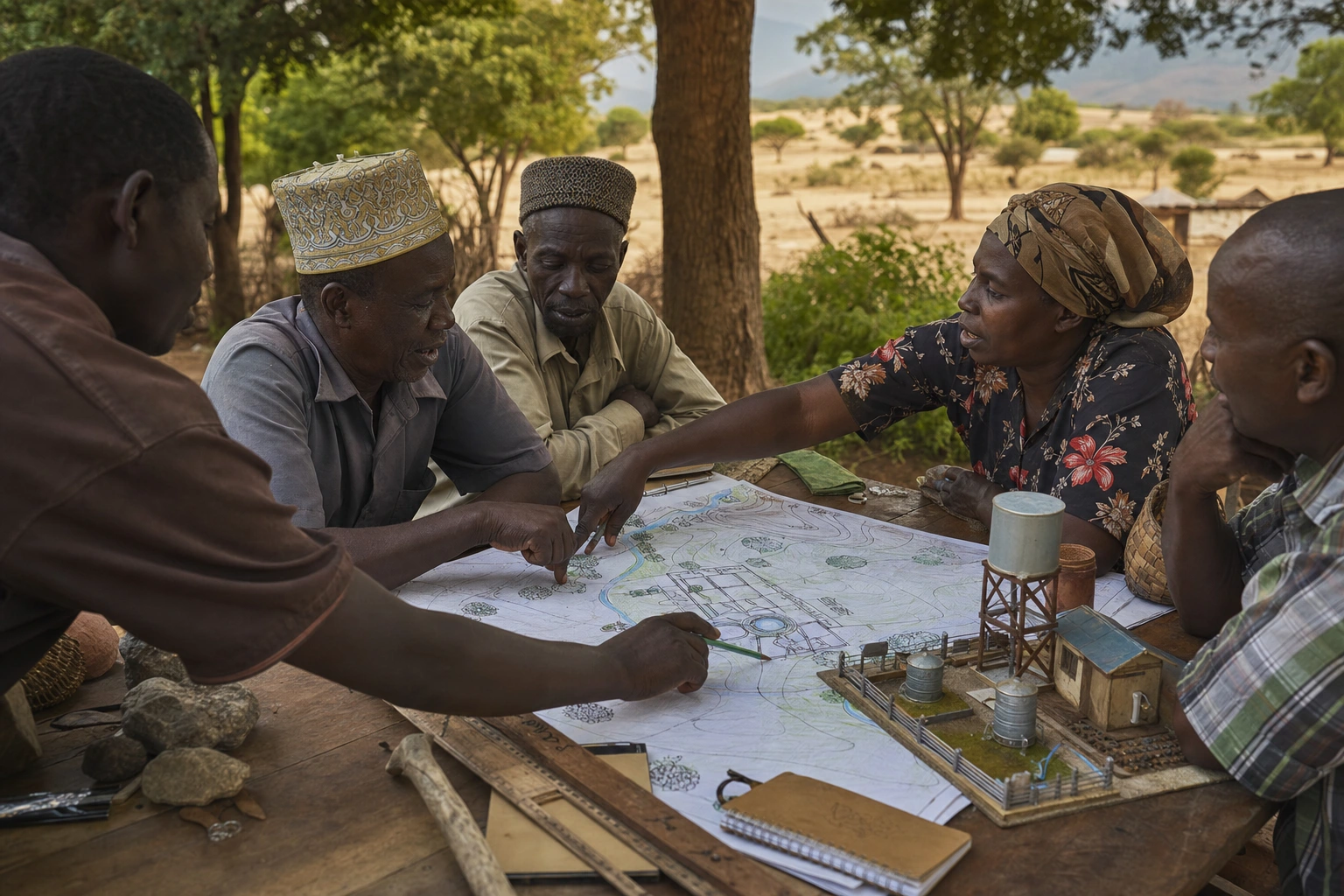
Community projects are more likely to be useful and sustainable when the people affected by them help shape, implement and review them. Participation is not simply a meeting where residents are informed about a decision that has already been made. It is a process through which community members contribute knowledge, priorities, labour, resources, oversight and feedback at appropriate stages of a project.
This approach matters in projects such as water supply, public health, education, livelihoods, environmental conservation, housing and local infrastructure. A technically sound project can still fail if it ignores local routines, excludes vulnerable groups or creates responsibilities that residents cannot realistically carry. Meaningful participation helps project teams understand the context, make better decisions and build ownership without transferring unfair burdens to the community.
What Community Participation Means
Community participation is the active involvement of people who are affected by a project in decisions and activities that influence their lives. The level of involvement can vary. A community may provide information, help identify needs, take part in planning, contribute resources, monitor implementation or share responsibility for long-term management.
For example, suppose a project aims to improve access to water in a rural area. Participation might include residents mapping existing water points, women explaining collection patterns, people with disabilities identifying access barriers, local artisans advising on maintenance, and a community committee reviewing whether the finished facility is working fairly. These contributions are different from merely announcing the project at a public meeting.
Participation should also be understood as a relationship rather than a single activity. A project team that consults residents during the planning stage but ignores them during implementation is not practising continuous participation. Trust grows when people see that their views are recorded, considered and reflected in decisions—or when they receive a clear explanation of why a suggestion could not be adopted.
Why Participation Matters in Projects
It improves problem definition
Project teams often begin with an assumption about the problem. Community members can reveal whether that assumption is accurate. A proposed market shelter, for instance, may appear to need more stalls, while traders may identify drainage, storage, safety or access to transport as more urgent concerns. Local knowledge helps the project address causes and practical constraints rather than only visible symptoms.
It makes projects more relevant
People use services within particular cultural, economic and environmental conditions. A training programme scheduled during peak farming activities may have low attendance. A public facility designed without considering local movement patterns may be difficult to reach. Involving users early allows the design to reflect real behaviour, language, working hours and accessibility needs.
It strengthens ownership
When people have helped shape a project, they are more likely to understand its purpose and support its responsible use. Ownership does not mean that communities must finance or maintain everything themselves. It means that the project is recognised as relevant and that roles, responsibilities and decision-making arrangements are understood.
It identifies risks early
Residents may know about land disputes, seasonal flooding, unsafe routes, local conflicts or previous projects that failed. Sharing this information early can prevent avoidable costs and delays. Participation can also identify social risks, such as the possibility that a committee will exclude minority groups or that user fees will make a service inaccessible to poorer households.
It supports accountability
Participation creates opportunities for communities to ask questions about budgets, timelines, quality and results. Transparent communication does not require every project detail to be understood by everyone, but it does require information to be presented clearly and important decisions to be open to scrutiny. Feedback and complaints mechanisms help project teams respond before dissatisfaction becomes conflict.
Levels of Community Participation
Not every project requires the same level of participation, but project teams should be honest about what influence the community will have. A useful distinction is between informing, consulting, involving, collaborating and supporting community-led action.
- Informing: The project team shares decisions, plans or schedules. This is useful for communication, but residents have little influence.
- Consulting: Community members are asked for opinions or information. The project team remains responsible for decisions and should explain how feedback was used.
- Involving: Residents take part in activities such as needs assessment, planning, implementation or monitoring.
- Collaborating: Community representatives and project teams share decision-making, responsibilities and problem-solving.
- Supporting community-led action: The community identifies priorities and leads much of the process, while external organisations provide resources, technical advice or connections when needed.
These levels are not automatically good or bad. The important issue is whether the level of influence matches what has been promised. Calling a project “community-led” when residents can only attend an information meeting damages trust. Similarly, consultation may be appropriate for a technical decision, provided the limits of consultation are made clear.
Who Should Participate?
“The community” is not a single group with one opinion. It includes people with different interests, resources, identities and levels of influence. A project may need to hear from householders, tenants, traders, farmers, young people, older people, people with disabilities, local leaders, faith groups, informal workers and service providers.
Participation can become unrepresentative when only confident, wealthy or politically connected individuals attend meetings. Project teams should therefore ask who is absent and why. Are meetings held at a time when women are caring for children or people are working? Is the venue physically accessible? Do participants feel safe expressing disagreement? Is information available in a language that people understand?
Representation should be practical rather than symbolic. Inviting one young person or one person with a disability does not automatically make a process inclusive. The project should create conditions in which different participants can speak, influence decisions and receive information. Separate discussions with particular groups may sometimes be useful before a mixed community meeting, especially where power differences make open discussion difficult.
A Step-by-Step Participation Process
1. Understand the context
Begin by learning about the community, the proposed project and the relationships that may affect it. Review existing information, visit the area and speak with a range of people. Identify formal and informal leaders, local organisations, vulnerable groups, possible conflicts and previous experiences with development projects.
Do not treat local leaders as the only source of community knowledge. They are important stakeholders, but they may not represent every household or group. Combining leadership discussions with household visits, focus groups, observation and open forums can provide a fuller picture.
2. Map stakeholders and interests
List the people and organisations affected by the project, those who can influence it and those who may be overlooked. Consider each stakeholder’s interests, expected benefits, possible concerns and ability to participate. For a waste-management project, stakeholders might include households, collection workers, landlords, traders, schools, health facilities, local authorities and residents living near disposal sites.
This mapping helps the team plan appropriate engagement instead of inviting everyone to every activity. It also highlights potential conflicts. A group that benefits from a proposed land-use change may have different priorities from a group that currently uses the land for grazing or trading.
3. Agree the purpose and boundaries
Before asking for input, explain what the project is trying to achieve, what decisions are open for discussion and what constraints already exist. These constraints may include a fixed funding agreement, safety standards, legal requirements or a limited implementation period. Clear boundaries prevent false expectations and allow communities to participate realistically.
4. Choose suitable methods
Use methods that fit the question and the people involved. Community mapping can identify resources and service gaps. Small-group discussions can help quieter participants speak. Public meetings can build shared awareness. Household interviews may reveal private concerns. Demonstrations, prototypes and site visits can make technical ideas easier to assess.
Digital tools such as messaging groups or online surveys can extend communication, but they should not replace face-to-face options where internet access, data costs or digital confidence are limited. In many African communities, a blended approach may work better: in-person discussions supported by phone communication and clearly displayed information.
5. Record and analyse contributions
Good participation requires more than collecting comments. Record the main issues raised, who raised them, areas of agreement and disagreement, and decisions that follow. The team should distinguish between a preference, a technical requirement and a serious safeguard concern.
For example, residents may prefer a particular location for a community hall, while an assessment shows that the site is vulnerable to flooding. The project can acknowledge the preference, explain the technical concern and work with residents to identify an alternative. This is more respectful than silently disregarding the suggestion.
6. Make decisions transparently
After engagement, communicate what was decided and why. A simple feedback report can list key suggestions, the response to each suggestion and any changes to the project plan. Where no change is possible, explain the reason in plain language. This “closing the feedback loop” is essential because participation without visible response can feel extractive.
7. Share implementation roles
Agree who will do what, by when and with what resources. Roles might include mobilising participants, providing local information, supervising contractors, maintaining records, monitoring service quality or managing a facility. Responsibilities should be voluntary or fairly compensated where appropriate, and they should not depend on unpaid labour from already disadvantaged groups.
8. Monitor together and adapt
Community monitoring can examine whether activities are occurring as planned, whether resources are being used properly and whether the project is reaching intended users. Use understandable indicators, such as the functionality of a water point, attendance at a service, waiting time, maintenance response or participation by different groups. Monitoring should support learning, not become a way to blame residents or staff.
Common Challenges and How to Manage Them
Tokenism
Tokenism occurs when people are invited to create the appearance of participation but have little real influence. It can be reduced by stating the decisions participants can affect, providing enough information to make informed contributions and documenting responses to their views.
Dominant voices
Meetings may be controlled by local elites, officials or confident speakers. Facilitators can use smaller groups, structured turn-taking, anonymous questions and separate consultations. They should also avoid assuming that silence means agreement.
Conflict and competing interests
Participation does not eliminate disagreement; it often makes disagreements visible. The project team should not promise that every group will receive everything it wants. Instead, it can clarify the issue, separate facts from assumptions, identify shared interests and use fair criteria for decisions. Serious disputes may require an independent mediator or a formal grievance process.
Participation fatigue
Communities can become tired of repeated meetings that produce little action. Coordinate engagement activities, keep meetings purposeful and return with updates. A short, well-prepared session that leads to a decision is usually more valuable than frequent gatherings without progress.
Unrealistic expectations
Projects often become associated with wider needs that they cannot address. Teams should explain the scope, budget and timeline at the beginning. They can record additional concerns for referral or future planning without implying that the current project will solve them.
Unequal costs
Attendance may involve transport costs, lost working time, childcare responsibilities or social risks. Consider accessible venues, suitable times, refreshments where appropriate and compensation for specialised contributions. Inclusion is not achieved by inviting people who cannot afford to participate.
Applying This in Practice
Imagine that a county-level partnership is planning a small irrigation project for farming households. A weak process would select the site, announce the design and ask residents to provide labour. A stronger process would begin by examining water access, land use, seasonal patterns and existing maintenance arrangements. It would speak with women farmers, tenant farmers, landowners, youth groups, people with disabilities, local technicians and households that may be downstream.
The project team could then facilitate a discussion about possible sites and criteria such as reliability, accessibility, environmental effects and maintenance cost. Before finalising the design, it would share a clear explanation of the preferred option. During construction, community representatives could monitor progress against agreed standards, while the project team ensures that technical and safeguarding responsibilities remain clear. Before handover, the parties would agree on maintenance procedures, contribution arrangements, record-keeping and a process for reporting faults.
For any community project, use the following practical questions:
- Who is affected, and which groups are currently missing from the conversation?
- What decisions can community members genuinely influence?
- What local knowledge could improve the design or reduce risk?
- Are the meeting method, language, venue and timing accessible?
- How will suggestions, disagreements and complaints be recorded?
- What responsibilities are being shared, and are they adequately resourced?
- How will the project show participants what changed because of their input?
Key Takeaways
- Community participation is an ongoing process of influence, collaboration and accountability—not a single information meeting.
- Local knowledge helps projects define the right problem, design relevant solutions and identify risks early.
- Be honest about the level of influence available: informing, consulting, involving, collaborating and community-led action are different.
- Plan for inclusion by identifying who is absent, not only by inviting recognised leaders.
- Close the feedback loop by explaining which suggestions were adopted, changed or declined and why.
- Agree practical roles, resources and monitoring arrangements so that ownership does not become an unfair burden.
No comments yet.