
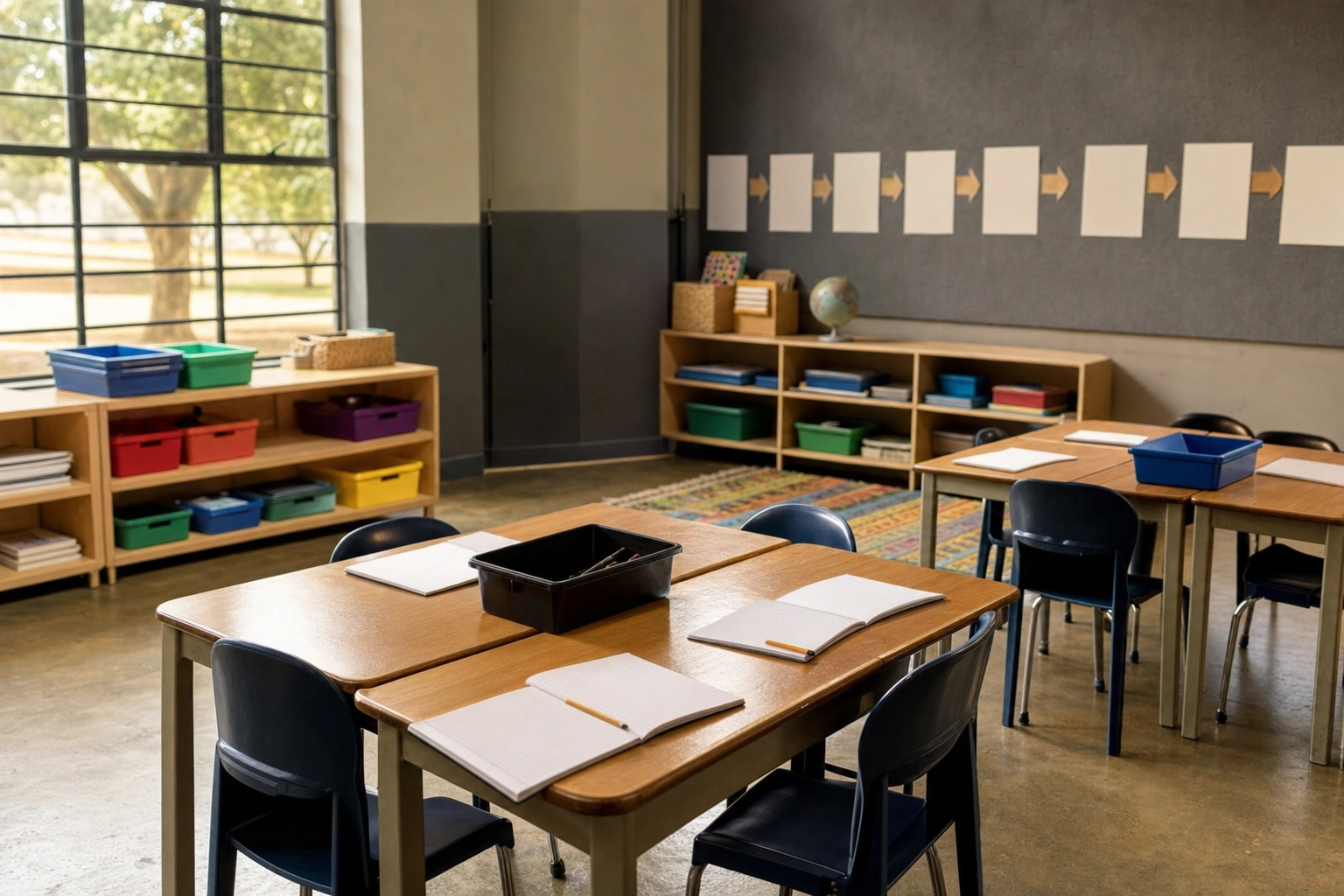
A well-managed classroom is not held together by constant reminders, raised voices or a long list of punishments. It is supported by clear, predictable routines that help learners move through the school day with confidence. When students know how to enter, begin work, ask for help, use materials, change activities and leave, more attention can be given to learning rather than uncertainty.
Classroom routines are repeated procedures for common situations. They are different from rules, although the two work together. A rule expresses an expectation, such as treating others respectfully. A routine explains how that expectation is carried out, such as waiting for a turn to speak, moving quietly into groups or returning shared materials to a designated place.
What Are Classroom Routines?
A classroom routine is a consistent sequence of actions that learners practise until it becomes familiar. It may be very simple, such as placing homework in a tray at the start of a lesson, or more detailed, such as a process for collecting science equipment, completing an investigation and cleaning the work area.
Routines can apply to:
- Arriving and settling down
- Taking attendance or responding to a registration activity
- Starting independent work
- Submitting assignments
- Requesting help or permission
- Moving between individual, pair and group activities
- Using books, devices and other learning resources
- Participating in discussions
- Responding to unfinished work
- Ending a lesson and leaving the room
The purpose is not to make every moment rigid. Effective routines provide a dependable structure within which teachers can adapt lessons, respond to learners and encourage creativity. A routine should reduce unnecessary decisions, not remove thoughtful teaching.
Why Classroom Routines Matter
They protect learning time
Small delays can accumulate during a lesson. If learners are unsure where to find materials, how to form groups or what to do after completing a task, the teacher may spend valuable time giving the same instructions repeatedly. A routine makes these processes quicker and clearer, leaving more time for explanation, practice, feedback and reflection.
For example, a teacher might display a short “Do Now” task on the board before learners enter. Students know that they should take out their books, read the instructions and begin independently. The teacher can then welcome the class, check attendance and identify learners who need immediate support without waiting for everyone to settle.
They reduce uncertainty
Unclear expectations can create hesitation, noise and conflict. Predictable routines help learners understand what will happen next and what successful participation looks like. This is particularly useful at the beginning of a term, after a change of teacher, during a transition between year groups or when a class includes learners with different educational experiences.
Predictability can also support learners who find sudden changes, crowded movement or unclear instructions difficult. A visible timetable, a consistent signal for attention and a clearly taught process for transitions can make the classroom easier to navigate.
They support positive behaviour
Behaviour management is often more effective when teachers teach desired behaviour instead of only correcting mistakes. A routine turns a vague instruction such as “Behave properly” into observable actions: walk rather than run, bring the correct book, listen while another person speaks and begin within an agreed period.
This does not eliminate challenging behaviour. It does, however, make expectations easier to explain and apply fairly. When a learner forgets a procedure, the teacher can calmly reteach the routine rather than treating the mistake as a personal challenge.
They build learner independence
Classroom routines should gradually transfer responsibility from the teacher to the learners. If students know how to collect resources, check instructions, seek assistance and review their work, they do not need to wait for the teacher for every next step.
Independence is especially important in adult education, vocational training and professional learning. Learners may need to manage equipment, organise group tasks, record progress or complete work outside the classroom. Routines that promote planning and self-monitoring prepare them for these responsibilities.
Routines, Rules and Procedures: The Difference
These terms are related but should not be treated as interchangeable.
- Rules state broad standards of conduct. For example: “Use equipment safely” or “Respect other people’s right to learn.”
- Procedures describe the steps for completing a particular task. For example: “Collect one worksheet from the front table, write your name and begin question one.”
- Routines are procedures used regularly until they become familiar and automatic. For example: “At the start of every lesson, read the board task and begin quietly.”
A rule without a procedure may be difficult to follow. “Work collaboratively” is a useful expectation, but learners may still need to know how groups are formed, how roles are shared, how disagreements are handled and how the final work is submitted.
Characteristics of Effective Classroom Routines
They are clear
A good routine can be explained in language suitable for the learners’ age, language ability and level of experience. Give specific directions rather than several broad commands. “Place your exercise books on the left corner of the desk and open to the next empty page” is clearer than “Get ready.”
They are teachable
Do not assume that learners already know how to follow a routine. Explain the purpose, model the process, allow learners to practise it and provide feedback. Younger children may need the routine demonstrated physically. Adult learners may benefit from a short explanation of how the procedure supports efficient collaboration or assessment.
They are consistent
A routine is weakened when it changes without explanation. Consistency does not mean that a teacher can never adapt. If a lesson requires a different arrangement, explain the change and identify which parts of the usual process still apply.
They are efficient
Routines should simplify classroom life. If a procedure has too many steps, requires unnecessary movement or depends on several reminders, it may need revision. Ask whether each step serves a clear purpose.
They are inclusive
Consider learners with different physical abilities, communication preferences, literacy levels, languages, cultures and access to resources. A routine that depends entirely on fast reading may disadvantage learners who need more processing time. A routine that requires rapid movement may exclude someone with a mobility difficulty.
Use more than one way to communicate important procedures. Spoken instructions can be supported by diagrams, demonstrations, gestures, written prompts or a model example. Inclusion does not mean lowering expectations; it means removing avoidable barriers to meeting them.
How to Establish a Classroom Routine
- Identify a recurring challenge. Start with a situation that repeatedly consumes time or creates confusion, such as late starts, noisy transitions or incomplete submission of work.
- Define the desired outcome. Decide what learners should do and what successful completion will look like. Keep the outcome observable. “Learners move into groups within a reasonable period and begin the assigned task” is more useful than “Learners transition well.”
- Design the fewest necessary steps. Consider where learners will stand, what they will carry, where materials will be placed and how they will know what to do next.
- Explain the reason. Learners are more likely to take a routine seriously when they understand its purpose. Explain that the procedure protects learning time, supports safety, makes group work fair or helps everyone access resources.
- Model the routine. Demonstrate the process slowly. If appropriate, show both an effective example and a common mistake, then discuss the difference.
- Practise without pressure. Ask learners to rehearse the routine. Stop and reset when necessary. Practice is not wasted time; it is preparation for smoother lessons later.
- Give precise feedback. Notice what worked and identify one improvement. Instead of saying “That was messy,” say, “Most groups moved quickly, but several people did not check the role cards before starting. Next time, read the role card first.”
- Review and adjust. After using the routine, consider whether it achieved its purpose. Ask learners what was unclear and look for practical obstacles. Modify the procedure while keeping the underlying expectation clear.
Examples of High-Value Classroom Routines
Beginning-of-lesson routine
A consistent opening might include entering calmly, placing belongings in an agreed location, collecting required materials, reading the learning objective and completing a short starter task. In a Kenyan secondary school, this could help a teacher begin promptly even when a class has moved from another room. In an adult evening class, the opening might include signing in, reviewing the previous session and identifying the evening’s practical goal.
Help-seeking routine
Many classrooms become noisy because every learner calls the teacher at once. A help-seeking routine could ask learners to reread the instructions, check an example, consult a partner and then use a quiet signal or place their name on a help list. The routine should still allow urgent questions, especially where safety or wellbeing is concerned.
Discussion routine
For a productive discussion, learners need more than the instruction “Talk to your group.” Establish how long they have, who speaks first, how others show they are listening, how evidence is recorded and how the group reports back. Roles such as facilitator, note-taker, timekeeper and reporter can make participation more balanced, although roles should rotate rather than permanently label learners.
Resource routine
Shared books, art materials, laboratory equipment and digital devices can cause delays if their use is not organised. A resource routine might specify who collects items, how they are checked, where they are returned and what learners do if something is missing or damaged. In practical subjects, include safety checks before the activity and cleaning responsibilities afterwards.
End-of-lesson routine
A strong ending is more than waiting for the bell. Learners might complete an exit question, record unfinished work, return resources, check the floor and remain seated until dismissed. The teacher can use the final response to identify what needs reteaching in the next lesson.
Teaching Routines Without Creating Dependence
There is a difference between a routine and constant teacher control. If the teacher gives every instruction verbally at every stage, learners may become dependent on prompts. Use visual cues, checklists, timers where appropriate and classroom displays so that learners can access the procedure independently.
Gradually reduce reminders. At first, the teacher may explain each step. Later, the teacher might point to a displayed sequence or ask, “What is the next step?” Eventually, learners should be able to begin the process themselves. This gradual release is particularly valuable when teaching study skills, workplace procedures or project-based learning.
It is also important to distinguish a forgotten routine from deliberate refusal. A learner who is confused may need clarification or another demonstration. A learner who understands the procedure but chooses not to follow it may need a private conversation, a proportionate consequence and a plan for repairing the disruption. Treating every difficulty as defiance can damage trust.
Common Mistakes to Avoid
- Introducing too many routines at once: Begin with the procedures that have the greatest effect on safety, learning time and respectful participation.
- Assuming that explanation equals learning: Learners need to see, practise and revisit routines.
- Using vague language: Replace “Be responsible” with actions that can be observed and practised.
- Changing expectations from day to day: If an exception is necessary, explain it clearly.
- Ignoring learner feedback: A routine may fail because the seating plan, timing, equipment or instructions are impractical.
- Using routines as punishment: Procedures should make participation easier, not humiliate learners or restrict ordinary access to learning.
- Forgetting transitions: The moments between activities often need as much planning as the activities themselves.
Applying This in Practice
Choose one routine to improve over the next week. A transition between activities is often a useful starting point because it affects the whole class. Write the routine in three to five steps, explain its purpose and decide how learners will know that the transition is complete.
For example:
- When the signal is given, stop writing and look at the teacher or displayed instructions.
- Place the current material in the correct location.
- Move to the assigned group or station calmly.
- Collect only the resources listed for the next task.
- Read the first instruction and begin.
Teach the routine when there is enough time to practise it. Observe what happens without relying only on memory. Are learners unsure where to go? Do they have to cross the room unnecessarily? Are instructions visible from all seats? Does one learner carry too much responsibility? Use these observations to make a small improvement.
Teachers can also invite learners to help refine routines. Ask questions such as: Which step is easiest to forget? What would make the process clearer? How can everyone participate fairly? Such questions develop ownership while keeping the teacher responsible for the final structure and safeguarding requirements.
Key Takeaways
- Classroom routines are repeated procedures that make expectations clear and protect learning time.
- Rules state broad standards, while routines and procedures show learners how to act in specific situations.
- Effective routines are clear, teachable, consistent, efficient and inclusive.
- Teach routines through explanation, modelling, practice, feedback and review rather than assuming learners already know them.
- Use routines to build independence through visual prompts, checklists and gradually reduced reminders.
- Start by improving one recurring problem, observe the results and adjust the procedure based on practical evidence.
No comments yet.