
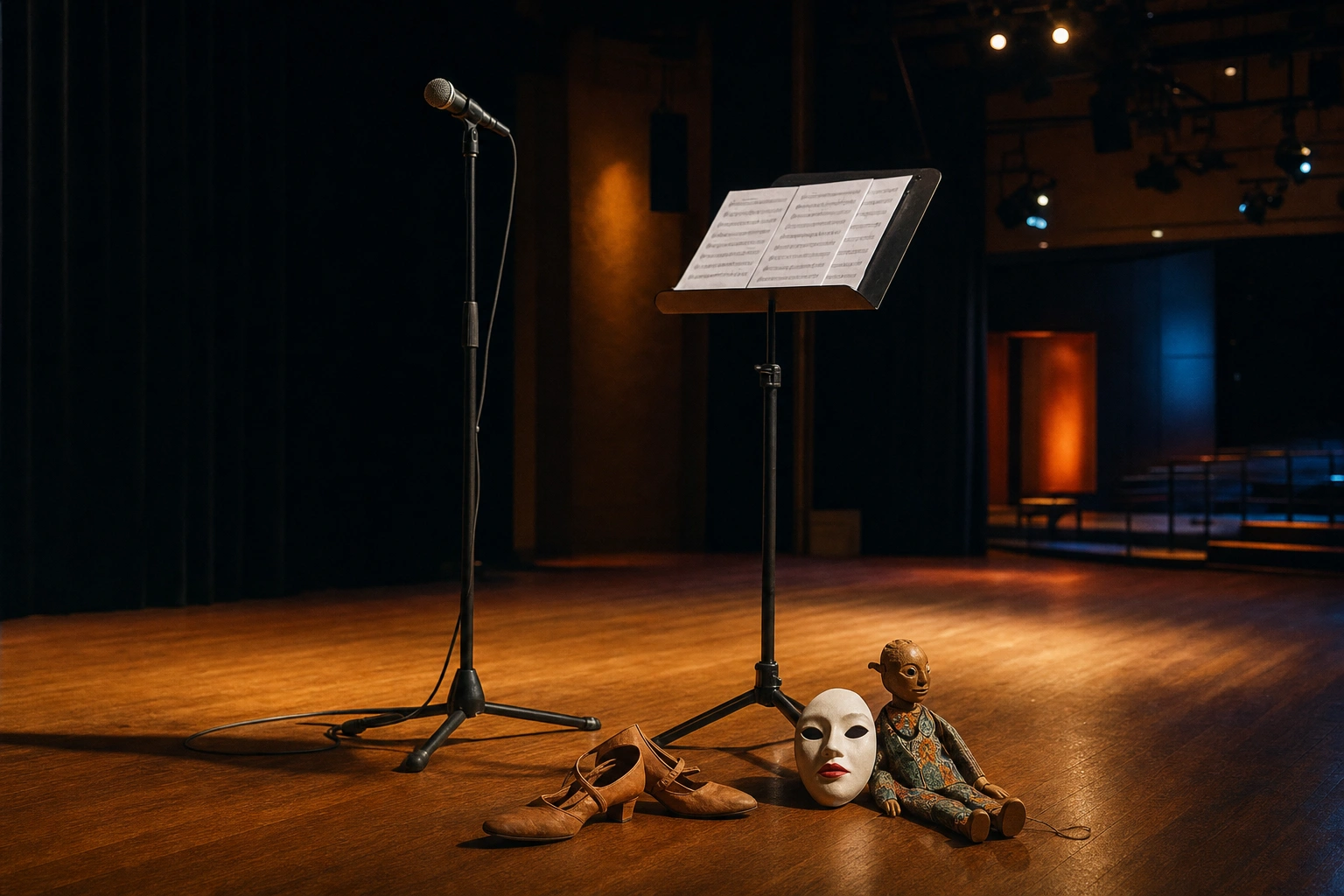
Performing arts are creative activities in which artists use their bodies, voices, instruments, movement and presence to communicate with an audience. Unlike a painting or a sculpture, a performance unfolds through time. It may happen on a stage, in a concert hall, at a community event, in a classroom, on a street or through a recorded and digitally distributed production.
The main forms of performing arts are music, dance and theatre, but the field is broader than these three categories. Opera, musical theatre, spoken word, storytelling, puppetry, circus and many traditional performance practices combine several art forms. Understanding these forms helps learners appreciate performances, choose areas for study and identify practical roles in the creative industries.
What makes an art form a performing art?
A performing art normally involves an artist or group presenting an artistic work before an audience. The performance can be live or recorded, although the presence of time, action and interpretation remains important. A singer interprets a song, an actor embodies a character, and a dancer communicates through organised movement.
Most performances contain several common elements:
- Performer: The person or group who presents the work, such as an actor, musician, dancer, vocalist or storyteller.
- Audience: The people who watch, listen to or otherwise experience the performance.
- Space: The location in which the work occurs, from a formal theatre to a public square or digital platform.
- Time: The sequence, rhythm and duration through which the performance develops.
- Technique: The learned physical, vocal, musical or interpretive skills used by the performer.
- Production: The design, rehearsal, direction, sound, lighting, costume and management that support the performance.
These elements explain why performing arts are both creative and practical. A successful production requires imagination, but it also depends on preparation, collaboration, communication and technical organisation.
1. Music
Music is the organised use of sound, silence, rhythm, melody, harmony, tone and expression. It can be performed by one person or by an ensemble. Common examples include singing, instrumental performance, orchestral music, choral music, popular music, jazz, folk music, religious music and electronic performance.
Music may be written in notation, learned by listening, improvised or passed through oral traditions. In many African communities, music is closely connected with ceremony, work, dance, storytelling and social life. Instruments and musical practices differ across regions, while contemporary musicians may combine local traditions with global genres such as hip-hop, reggae, gospel, jazz or electronic music.
A music performance may focus on technical accuracy, emotional interpretation, entertainment, cultural expression or experimentation. A solo vocalist needs control of pitch, breathing, phrasing and stage presence. A band must also listen to one another, maintain timing and balance the overall sound.
Key roles in music
- Vocalists and instrumentalists
- Songwriters and composers
- Conductors, arrangers and music directors
- Sound engineers and recording technicians
- Producers, managers and live-event coordinators
Music careers therefore extend beyond performing. A person with musical knowledge may work in teaching, composition, production, arts administration, broadcasting or sound design.
2. Dance
Dance is the expressive and often structured use of body movement. Dancers communicate ideas, emotions, identity, relationships or narratives through posture, gesture, rhythm, space and physical energy. Dance can be choreographed in advance, improvised in the moment or developed through a combination of both approaches.
Major dance traditions include classical forms such as ballet, modern and contemporary dance, traditional and cultural dances, social dance, street dance and commercial choreography. The purpose of dance may be artistic, ceremonial, recreational, competitive, educational or theatrical.
Dance is not simply movement performed to music. A dance can use silence, spoken sound or environmental noise. Choreographers make decisions about levels, direction, speed, repetition, group formations and the relationship between performers and space. These choices create meaning even when there is no spoken dialogue.
For example, a group dance may use repeated movements to show unity, while contrasting movements may suggest disagreement or social tension. A solo performance may explore memory, identity or personal change through changes in weight, balance and pace.
Skills and opportunities in dance
Dancers develop physical conditioning, flexibility, coordination, balance, musicality, spatial awareness and performance discipline. They also need to understand injury prevention and the importance of warming up and recovery. Professional opportunities include performing, choreography, teaching, rehearsal direction, movement coaching, arts education and fitness-related work.
Dance companies, schools, cultural organisations, music productions, film projects, festivals and community programmes may all require dancers or choreographers. In Kenya and elsewhere, dance can also support cultural education and help communities preserve and reinterpret traditional movement practices.
3. Theatre and drama
Theatre is the performance of stories, ideas or situations through actors, dialogue, action and design. Drama is often used to describe the written or performed representation of conflict and human experience, while theatre usually refers to the wider event that includes performers, audience, space and production.
A theatrical performance may be scripted, devised collaboratively or partly improvised. It may be realistic, symbolic, comic, tragic, historical, experimental or designed for education. Some productions use elaborate scenery and costumes, while others rely on the actor's body, voice and a few carefully chosen objects.
Theatre usually depends on several connected roles. Actors interpret characters and situations. Directors shape the artistic vision and guide rehearsals. Playwrights create scripts, although a script may also be developed by a group. Designers work on set, costume, lighting, sound and props. Stage managers organise rehearsals and performances, while producers handle planning, funding, contracts and logistics.
How a theatre production develops
- Concept and selection: A team chooses a script, theme or performance idea and identifies its intended audience.
- Interpretation: The director and creative team decide how the work will be understood and presented.
- Preparation: Actors learn lines, explore characters and rehearse movement, while designers develop the visual and technical elements.
- Integration: Acting, scenery, costumes, lighting, sound and stage movement are combined in technical and dress rehearsals.
- Performance and review: The production is presented to an audience, then evaluated for future improvement.
Theatre is especially useful for exploring social issues because it places human choices and relationships at the centre of the work. It can entertain, challenge assumptions, teach, preserve stories or create space for public conversation.
4. Opera
Opera is a form of theatre in which much of the dramatic action is communicated through singing, supported by instrumental music and theatrical design. It often combines solo singing, duets, ensembles, choruses, orchestral accompaniment, acting, costumes and scenery.
Opera singers require advanced vocal technique because they must project and express the voice within a large musical structure. They also need acting skills, musical literacy and the ability to work with a conductor and other performers. The music may be written in advance, and the performance often follows a detailed score.
Opera is sometimes associated only with European classical traditions, but the broader idea of sung drama can be understood across many cultures. Different communities have their own forms of musical storytelling, ceremonial performance and narrated song. The important distinction is that opera places sustained singing and dramatic action at the heart of the theatrical experience.
5. Musical theatre
Musical theatre combines acting, singing, dance, dialogue and stage design to tell a story. Unlike a play that may use occasional songs, a musical gives music and choreography a central role in the structure of the performance.
In a musical, a song may reveal a character's feelings, move the plot forward, introduce a setting or bring an ensemble together. Dance may create spectacle, show relationships or communicate energy that ordinary dialogue cannot express. Performers therefore need a combination of acting, vocal and movement skills.
Musical theatre is highly collaborative. The creative team may include a book writer who develops the dialogue and story, a composer, a lyricist, a director, a choreographer, performers, musicians, designers and technical specialists. Rehearsals must coordinate these elements so that the production feels like one complete work rather than separate songs and scenes.
6. Spoken word, poetry and storytelling
Spoken-word performance presents language through voice, rhythm, emphasis, gesture and direct engagement with an audience. It may include poetry, personal testimony, social commentary, narrative, satire or dramatic monologue. The performer does not merely read words; they interpret and shape them through delivery.
Storytelling is one of the oldest performing arts. A storyteller may use voice, gesture, repetition, character changes, song, audience participation and pauses to communicate a narrative. Oral storytelling traditions across Africa and other parts of the world demonstrate how performance can preserve history, values, humour and community knowledge.
These forms require strong writing or narrative skills, but performance technique is equally important. A well-written poem can lose its effect if the delivery is too quiet, rushed or emotionally unclear. Effective spoken-word artists consider breath, pace, articulation, vocal variation, physical presence and the expectations of their audience.
Spoken-word performance can take place in theatres, schools, festivals, community spaces, places of worship and online platforms. It is also used in education, advocacy and public communication because it can present complex experiences in a personal and memorable form.
7. Puppetry and object theatre
Puppetry uses specially made figures, objects or materials to represent characters, animals, ideas or environments. A puppeteer may control the figure with the hands, rods, strings or other mechanisms. Object theatre extends this idea by using ordinary objects in imaginative ways rather than relying only on traditional puppets.
Puppetry combines visual art, performance, movement, voice and sometimes music. The performer must make the audience believe that an inanimate object has intention, emotion or life. This requires precise manipulation, controlled movement and careful attention to the relationship between the puppeteer, puppet and audience.
Puppetry can be effective in children's education, community theatre, television, film, cultural performance and experimental art. It can also address serious subjects because symbolic characters may make difficult issues easier to approach.
8. Circus and physical performance
Circus arts combine physical skill, spectacle, comedy, character and risk management. Traditional circus may include acrobatics, juggling, clowning, aerial work and balancing. Contemporary circus often combines these skills with theatre, dance, music and visual storytelling rather than presenting them as separate acts.
Safety is central to circus training. Performers need progressive instruction, suitable equipment, conditioning, trusted supervision and clear communication. A visually impressive act is not successful if it ignores preparation or creates unnecessary danger.
Physical theatre overlaps with circus because it tells stories through the body, often with limited spoken language. It may use exaggerated movement, masks, mime, ensemble work and carefully designed physical sequences. These approaches are useful when a performance needs to communicate across language barriers.
How the forms overlap
The main forms of performing arts should not be treated as sealed categories. A stage production may include acting, music, dance, poetry, video and puppetry. A concert may use choreography, visual design and theatrical characters. A cultural festival may combine music, dance, storytelling, costume and ritual.
The difference between forms usually depends on which method carries the main artistic message. In a music performance, organised sound may be central. In dance, movement may carry most of the meaning. In theatre, character and dramatic action may lead the communication. In musical theatre, no single element works alone; the form is deliberately integrated.
This overlap creates opportunities for interdisciplinary artists. However, combining forms effectively requires more than adding many elements. Each component should have a clear purpose and should support the work's theme, audience and setting.
Choosing a performing-arts pathway
Learners can begin by asking what they most naturally enjoy and what they are willing to practise consistently. Someone who notices melody and rhythm may explore music. Someone drawn to physical expression may begin with dance or physical theatre. A person interested in characters, dialogue and human behaviour may prefer theatre. Others may enjoy combining several disciplines.
It is also useful to distinguish between performing and supporting roles. Not every creative professional needs to appear on stage. Directing, writing, choreography, stage management, lighting, costume, set design, sound, production, marketing and arts education are essential parts of the field.
Begin with manageable projects: join a community group, practise an instrument, create a short performance, attend rehearsals, volunteer backstage or record a spoken-word piece for constructive feedback. Build a portfolio that shows development rather than waiting for perfect work. Professional practice grows through repetition, reflection and collaboration.
Applying This in Practice
- Observe: Watch a performance carefully and identify its main form and supporting forms.
- Analyse: Note how sound, movement, language, space, costume and lighting contribute to meaning.
- Research: Compare a local or African performance tradition with a performance from another cultural setting.
- Create: Develop a short two- to five-minute piece using one primary form and one supporting element.
- Review: Ask whether the performance communicated its intended idea and what could be improved.
When evaluating a performance, consider both artistic and practical questions: Was the work clear? Did the performers demonstrate control and commitment? Did the design support the action? Was the audience engaged? Were cultural references handled respectfully? Did the production use its space and resources effectively?
Conclusion
Performing arts are a broad family of creative practices built around live action, interpretation and communication. Music, dance and theatre form the core categories, while opera, musical theatre, spoken word, storytelling, puppetry, circus and physical performance expand the possibilities.
Each form has its own techniques, conventions and career pathways, yet they frequently meet in collaborative productions. Learning to recognise these forms helps audiences watch more thoughtfully and helps aspiring artists make informed choices about training and practice. The most useful starting point is curiosity followed by disciplined exploration: experience different performances, identify the skills involved and create work that connects form with purpose.
No comments yet.