
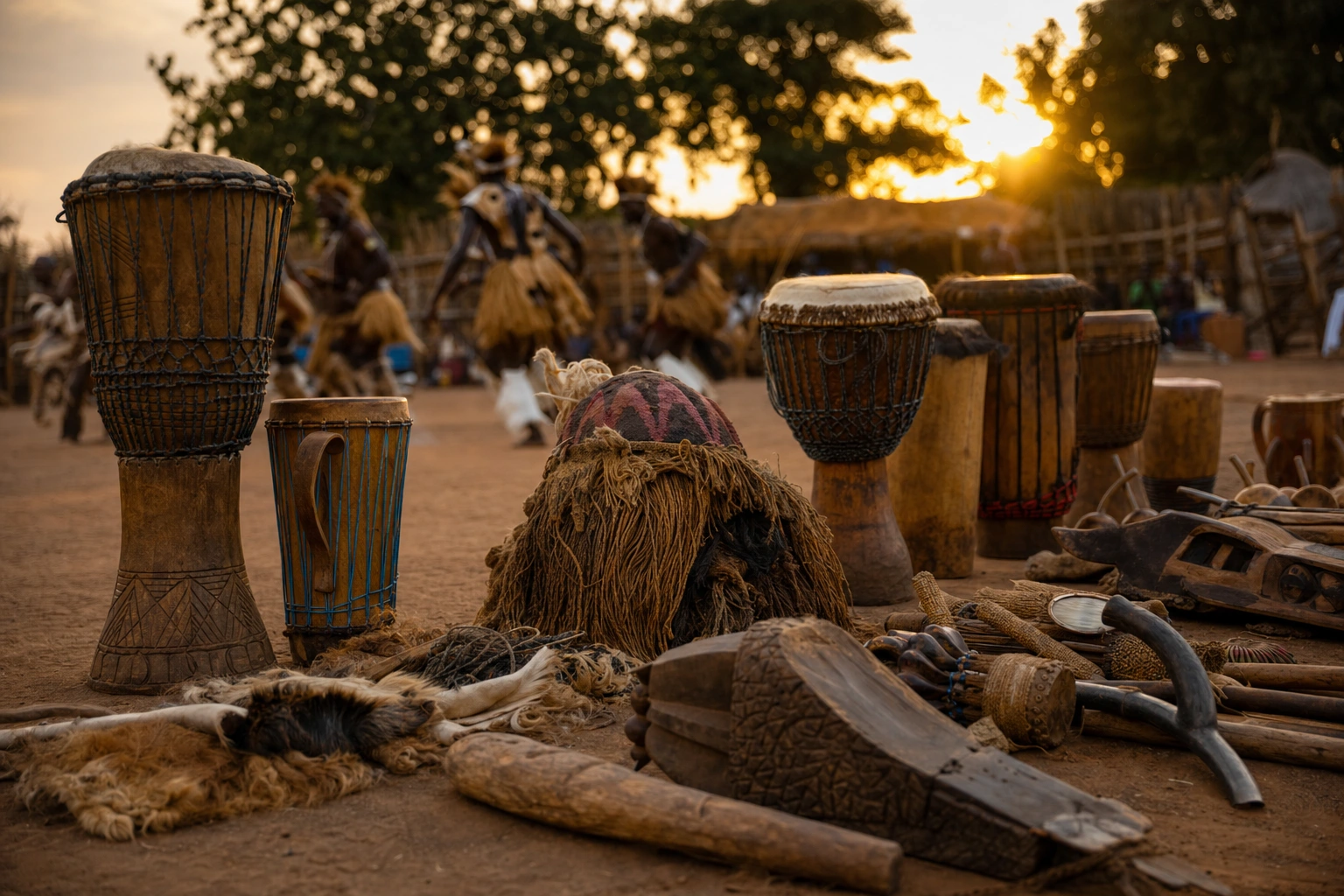
African traditions in performance encompass a wide range of artistic practices found across the continent and its diasporas. They include song, dance, storytelling, drumming, praise poetry, masquerade, theatre, ritual movement and forms of public celebration. These traditions are not one single style. They differ according to language, history, religion, environment, social organisation and the experiences of particular communities.
What many traditions share is the understanding that performance is more than entertainment presented to a passive audience. It can preserve history, teach values, honour ancestors, mark important life stages, strengthen social relationships, express resistance and create a sense of belonging. Studying African performance therefore requires attention not only to what happens on stage, but also to who performs, who participates, where the event takes place and what it means to the community.
Understanding Performance as a Social Practice
In many African societies, performance has traditionally been woven into everyday and ceremonial life rather than separated into a specialised theatre building. A performance may take place in a village gathering space, a royal court, a religious setting, a family compound, a marketplace or a public procession. The boundaries between performer and audience can be flexible: people may sing along, dance, respond to a narrator, contribute a proverb or join a procession.
This participatory quality is sometimes described through the idea of “call and response”. A leader sings, speaks or plays a musical phrase, and a group answers. The response may repeat words, add a contrasting phrase, reinforce a rhythm or communicate agreement. Call and response can make performance communal, but it should not be treated as a universal feature of every African tradition. Practices vary greatly across regions and communities.
Performance also often connects different art forms. A storyteller may use gesture, song, rhythm, character voices and movement. A dance may depend on drumming and spoken cues. A ceremony may combine costume, sculpture, music, poetry and processional movement. These combinations challenge the modern separation of music, dance, theatre and visual art into entirely different disciplines.
Oral Tradition and the Preservation of Knowledge
Before written records became widely used in many communities, oral performance played a major role in transmitting knowledge between generations. Even where written traditions exist, oral forms remain important. Through repeated telling, adaptation and public participation, communities can preserve accounts of migration, leadership, conflict, moral responsibility, family history and relationships with the natural world.
Storytelling is not simply the recitation of a fixed script. A skilled narrator may adjust a story for a particular audience, occasion or location. They may lengthen a scene, introduce humour, ask questions or use a familiar proverb to connect an old lesson to a current concern. Listeners are expected to interpret, respond and remember. In this way, storytelling is both an artistic practice and a form of education.
Proverbs, praise poetry and genealogical recitations are also significant. A proverb can compress a complex observation into a memorable image, while praise poetry may celebrate a leader, family, community or individual achievement. Praise poetry often depends on vocal skill, timing, metaphor and knowledge of historical references. It can honour people, but it may also remind leaders of the standards expected of them.
Griots or hereditary oral historians are associated particularly with several West African traditions, although their roles and names differ between communities. It is important not to use “griot” as a general label for every African storyteller or musician. Each tradition should be understood on its own terms, including the local language and the social responsibilities attached to the role.
Music, Rhythm and Instruments
Music in African performance traditions can organise movement, signal transitions, carry words and shape collective attention. Rhythm is often created through layers rather than a single repeated beat. Different drums, rattles, bells, clapping patterns and voices may interlock, producing a texture in which each part contributes to the whole.
Drums are important in many traditions, but African music is not defined by drums alone. Instruments include lamellophones such as the mbira, xylophones, lutes, harps, flutes, horns, string instruments, idiophones and various forms of percussion. The names, construction, playing techniques and cultural meanings of instruments vary widely. Some instruments are used for entertainment, while others may have ceremonial, royal, spiritual or communicative roles.
Rhythm can communicate identity and social connection. A community may recognise a particular pattern associated with a dance, ceremony, occupation or historical event. In performance, musicians may respond to dancers, and dancers may respond to changes in tempo or phrasing. This interaction means that rhythm is not merely background sound; it can act as a conversation between bodies, instruments and voices.
For learners, it is useful to listen actively. Notice whether the music has a leader and group response, whether patterns repeat or develop, how instruments are layered and how performers signal changes. Avoid describing every complex rhythm as simply “tribal” or “primitive”. Such labels are inaccurate, dismissive and too vague to support serious analysis.
Dance as Communication and Identity
African dance traditions include social dances, ceremonial dances, court dances, initiation-related performances, work-associated movements, masquerade dances and contemporary choreographies. Movement may communicate age, gender roles, social status, spiritual relationships, courtship, welcome, mourning, strength or collective identity. The meaning of a gesture cannot always be understood from its shape alone; context is essential.
Many dances use the whole body, including grounded footwork, flexible knees, articulated shoulders, expressive arms and responsive torso movements. However, there is no single “African dance technique”. Movement vocabularies differ considerably. Some performances are energetic and expansive, while others are restrained, processional or highly formal. Some are performed by individuals, others by groups arranged in lines, circles, pairs or changing formations.
Dance can also create a relationship between performers and the surrounding community. Spectators may clap, sing, make vocal responses or enter the dancing space. The event is therefore not always about watching a finished display. It may be an occasion for participation, recognition and social communication.
In Kenya, for example, cultural dances associated with different communities may use distinctive songs, costumes, instruments and movement patterns. These practices should not be treated as interchangeable examples of a single national style. A responsible learner asks which community a performance belongs to, what occasion it serves and how practitioners describe its meaning themselves.
Drama, Masquerade and Ritual Performance
Drama in African traditions may be found in storytelling, historical enactments, initiation instruction, festivals, royal ceremonies, masquerade and religious observance. Performers may use masks, elaborate costumes, painted bodies, props, music and movement to represent human, animal, ancestral or spiritual figures. Such figures can embody ideals, warnings, social tensions or relationships between the visible and invisible worlds.
Masquerade performance is particularly complex. A mask is not merely a decorative object placed on a performer’s face. In some communities, the full costume, movement, music, performance space and ritual preparation are all part of the masquerade’s identity. Access to particular masks or ceremonies may be restricted, and the knowledge surrounding them may belong to specific families, associations or custodians.
This is why photographs, recordings and reproductions should be approached carefully. A performance that is appropriate within its original setting may lose or change its meaning when removed for a commercial event, classroom demonstration or tourist presentation. Researchers and artists should ask permission, acknowledge community ownership where relevant and avoid revealing restricted material.
Ritual performance should also not be reduced to theatre in the modern commercial sense. A ritual may involve beliefs, obligations and relationships that participants regard as spiritually significant. An outside observer can analyse its movement, sound and structure, but should not assume that its purpose is simply to entertain an audience.
Costume, Space and Symbolic Meaning
Visual elements help establish the identity and atmosphere of a performance. Costume may indicate a character, age group, rank, profession, spiritual association or connection to a particular community. Colour, material, body adornment and pattern can carry local meanings, although these meanings are not identical across Africa. A colour that suggests mourning in one context may have a different association elsewhere.
Performance space is equally important. A circle can encourage shared participation, while a procession can connect separate locations and involve people who are not seated in a formal audience. A raised platform may emphasise authority or visibility. A courtyard, public square or sacred location may carry memories and obligations that cannot be reproduced fully in a theatre.
Props can function as more than visual decoration. A staff may represent office or leadership; a vessel may connect the performance to household or agricultural life; a specific object may recall an ancestor, event or social role. Interpretation should be based on community knowledge and performance context rather than assumptions made from appearance alone.
Functions of African Traditional Performance
Traditional performance can serve several purposes at once. Its functions may include:
- Education: Stories, songs and dances can teach history, ethical conduct, social responsibilities and practical knowledge.
- Celebration: Performance may mark harvests, weddings, naming ceremonies, community achievements or public occasions.
- Ritual and spiritual connection: Music, movement and spoken forms may support ceremonies and relationships with ancestors or spiritual beings.
- Social criticism: Satire, praise poetry and comic characters can expose selfishness, abuse of power or breaches of community expectations.
- Identity and belonging: Shared performance can strengthen connections between families, age groups, communities and generations.
- Healing and emotional expression: Lament, song, dance and communal gathering can help people express grief, hope or solidarity.
These functions often overlap. A festival performance may entertain, teach history, honour a community and create opportunities for younger performers to learn from elders. Treating art as separate from social life can hide much of its importance.
Change, Urbanisation and Contemporary Performance
African performance traditions are not frozen in the past. They have changed through migration, urbanisation, formal education, religious change, political history, recording technologies, radio, film, television, tourism and digital media. Performers may combine inherited forms with popular music, spoken-word poetry, contemporary theatre, hip-hop, gospel, electronic sound or modern choreography.
Adaptation does not automatically mean loss of authenticity. A tradition can remain meaningful while its instruments, language, venue or audience changes. At the same time, commercial presentation can simplify a complex practice into a short spectacle designed mainly for visitors. The key questions are who controls the adaptation, who benefits from it, whether practitioners consent and whether the performance is presented honestly.
Contemporary African theatre and dance-makers often use traditional forms to address current issues such as migration, work, gender relations, public accountability, environmental pressure and cultural memory. They may quote a proverb, reshape a drum pattern, reinterpret a folktale or place a traditional movement beside a modern urban style. Such work demonstrates that heritage can be a resource for questioning the present, not only a display of the past.
How to Study or Create Responsibly
When studying African performance, begin with specificity. Identify the community, region, language, occasion and performers instead of making broad claims about “African culture”. Use local names where possible and learn how practitioners explain the form. Observe the relationship between music, movement, speech, costume, space and audience participation.
When creating new work inspired by African traditions, distinguish between respectful learning and uncredited borrowing. Do not copy sacred movements, restricted songs, masks or ceremonial costumes simply because they look visually powerful. If you work with a community or cultural practitioner, discuss permission, credit, payment, recording and future use before the project begins.
It is also important to avoid presenting a reconstructed performance as unchanged tradition. A contemporary stage adaptation should be identified as an adaptation. This gives audiences a more accurate understanding and recognises the creative decisions made by the new performers.
Applying This in Practice
- Choose a specific tradition: Select one performance form, community or region rather than attempting to represent the whole continent.
- Research its setting: Find out when it is performed, who participates, what instruments or movements are used and what purposes it serves.
- Listen to practitioners: Give priority to explanations from artists, elders, cultural organisations or reliable educational sources connected to the tradition.
- Analyse the complete event: Consider sound, movement, language, costume, space, audience behaviour and the social occasion together.
- Check ethical boundaries: Ask whether the material is public, restricted, sacred or owned by a particular community before recording or reproducing it.
- Reflect on adaptation: If developing new work, explain what has been changed, why it has been changed and how the original practitioners have been acknowledged.
Key Takeaways
- African performance traditions are diverse and should be studied through specific communities, regions, languages and occasions.
- Music, dance, storytelling, drama, costume and visual art often operate together rather than as isolated disciplines.
- Performance can preserve knowledge, teach values, mark ceremonies, build identity and express social criticism.
- Audience participation and the relationship between performers and community are often central to meaning.
- Traditional forms continue to change through urban life, technology and contemporary artistic practice.
- Respectful study and creation require context, accurate attribution, consent and sensitivity to restricted or sacred material.
No comments yet.