
Pest control is not only a cleanliness issue; it is a core food-safety responsibility. In hospitality businesses, insects, rodents, birds and other pests can contaminate ingredients, damage packaging, spread microorganisms and undermine customer confidence. A clean dining area can still be unsafe if pests are entering through a delivery door, nesting behind equipment or accessing food waste overnight.
Effective pest control therefore combines prevention, monitoring and proportionate action. It is most successful when it is built into daily food-handling procedures rather than treated as an occasional response to visible cockroaches, flies or rodents. This approach protects guests, staff, the reputation of the business and the quality of food from delivery through to service.
Why Pests Are a Food-Safety Hazard
Pests can carry dirt, microorganisms and other contaminants on their bodies, fur, feathers, legs and digestive systems. When they move from drains, waste areas or contaminated surfaces to food-contact surfaces, they may transfer hazards. A cockroach travelling across a refuse area and then over a preparation bench is one example of how contamination can occur.
Pests can also contaminate food indirectly. Rodents may urinate or leave droppings near stored ingredients. Flies can land on uncovered food and waste before moving to a buffet. Birds may contaminate outdoor food-service areas, while ants can enter sugar, flour or other sweet products. Even where no illness results, damaged packaging or visible pest activity can make food unacceptable to customers.
There are three broad types of food-safety concern:
- Biological contamination: Pests may transfer harmful microorganisms to food, utensils, equipment or surfaces.
- Physical contamination: Hair, body parts, droppings, nesting material or damaged packaging may enter food.
- Chemical contamination: Incorrectly used pesticides can contaminate food, food-contact surfaces or equipment.
Food businesses must therefore control both the pest and the methods used to control it. Spraying chemicals without addressing food storage, waste or building defects may provide only temporary relief and can create additional risks.
Common Pests in Hospitality Operations
Flies
Flies are attracted to refuse, drains, food residues, animal waste and sweet liquids. They can enter through open doors, windows and service areas, particularly during warm weather. Their presence is more likely when bins are overflowing, waste is stored for too long or cleaning is incomplete.
Cockroaches
Cockroaches favour warm, dark and damp places. They may hide behind refrigerators, beneath sinks, inside wall gaps, near drains or in equipment that is rarely moved. They can be introduced through deliveries, packaging, used equipment or adjacent premises.
Rodents
Rats and mice need food, water and shelter. They may enter through gaps around doors, pipes, drains and walls. Signs include droppings, gnaw marks, damaged packaging, grease marks along walls, unusual odours and scratching sounds. Rodents can damage electrical cables and insulation as well as contaminate food.
Stored-product pests
Weevils, beetles, moths and similar pests may be found in dry goods such as cereals, flour, pulses, spices and nuts. They can arrive in packaging from a supplier and spread to nearby stock. Infestation is not always obvious at delivery, so dry stores require regular inspection.
Birds and other animals
Birds may access outdoor dining spaces, refuse areas, loading bays and open kitchens. Domestic animals, stray animals and insects may also create risks where food is prepared or served. Hospitality businesses should prevent animals from entering food-preparation and storage areas and should protect food from contact with them.
Integrated Pest Management
Integrated pest management is a structured way of reducing pest risks through several complementary controls. It does not rely on routine chemical treatment as the first or only solution. The main principles are exclusion, sanitation, control of conditions, monitoring and carefully selected treatment.
- Identify the pest and the source. Confirm what pest is present, where it is active and what is attracting or enabling it. A few flies near a waste area require a different response from rodent activity in a dry store.
- Remove food and water sources. Clean spills promptly, repair leaking taps, empty waste containers appropriately and avoid leaving food residues overnight.
- Prevent entry. Seal cracks, repair damaged screens, fit suitable door seals and keep doors closed when not in use.
- Monitor activity. Use inspections, traps, proofing checks and staff observations to identify patterns before the problem becomes serious.
- Use treatment proportionately. Where control products are necessary, they should be selected and applied safely, following the product instructions and the requirements of competent authorities or qualified service providers.
- Review the result. Check whether activity has stopped and whether the underlying cause has been corrected.
This approach is particularly important in hotels, lodges and restaurants because kitchens often operate for long hours, receive frequent deliveries and generate food waste every day. A pest-control contractor may provide valuable technical assistance, but the business remains responsible for maintaining safe daily conditions.
Preventing Pest Entry and Harbourage
Physical exclusion is often more reliable than trying to eliminate pests after they enter. Inspect the building from the outside and inside. Look for gaps beneath doors, cracks around pipes, holes in walls, damaged ceiling panels, broken drain covers and openings around ventilation systems. Repair defects using suitable materials that are durable and easy to clean.
Doors leading to kitchens, stores and waste areas should not be left open unnecessarily. Windows and ventilation openings may require intact insect screens. Deliveries should not be left exposed on the ground, and external storage should not create shelter against walls. Vegetation, discarded equipment and unused containers near the building can provide hiding places and should be managed.
Inside the premises, reduce clutter and make cleaning possible. Equipment should be positioned so that staff can clean beneath and around it, or it should be sealed appropriately. Unused boxes should not accumulate in food rooms because cardboard can provide shelter for insects and can be difficult to clean. Keep food stores organised, with stock raised from the floor and separated from walls sufficiently to allow inspection and cleaning.
Food Storage and Delivery Controls
Pest control begins when ingredients arrive. Staff receiving deliveries should examine packaging for holes, gnaw marks, droppings, webbing, live insects, unusual odours or signs of moisture damage. Damaged or suspect products should be isolated and reported rather than placed directly into the main store.
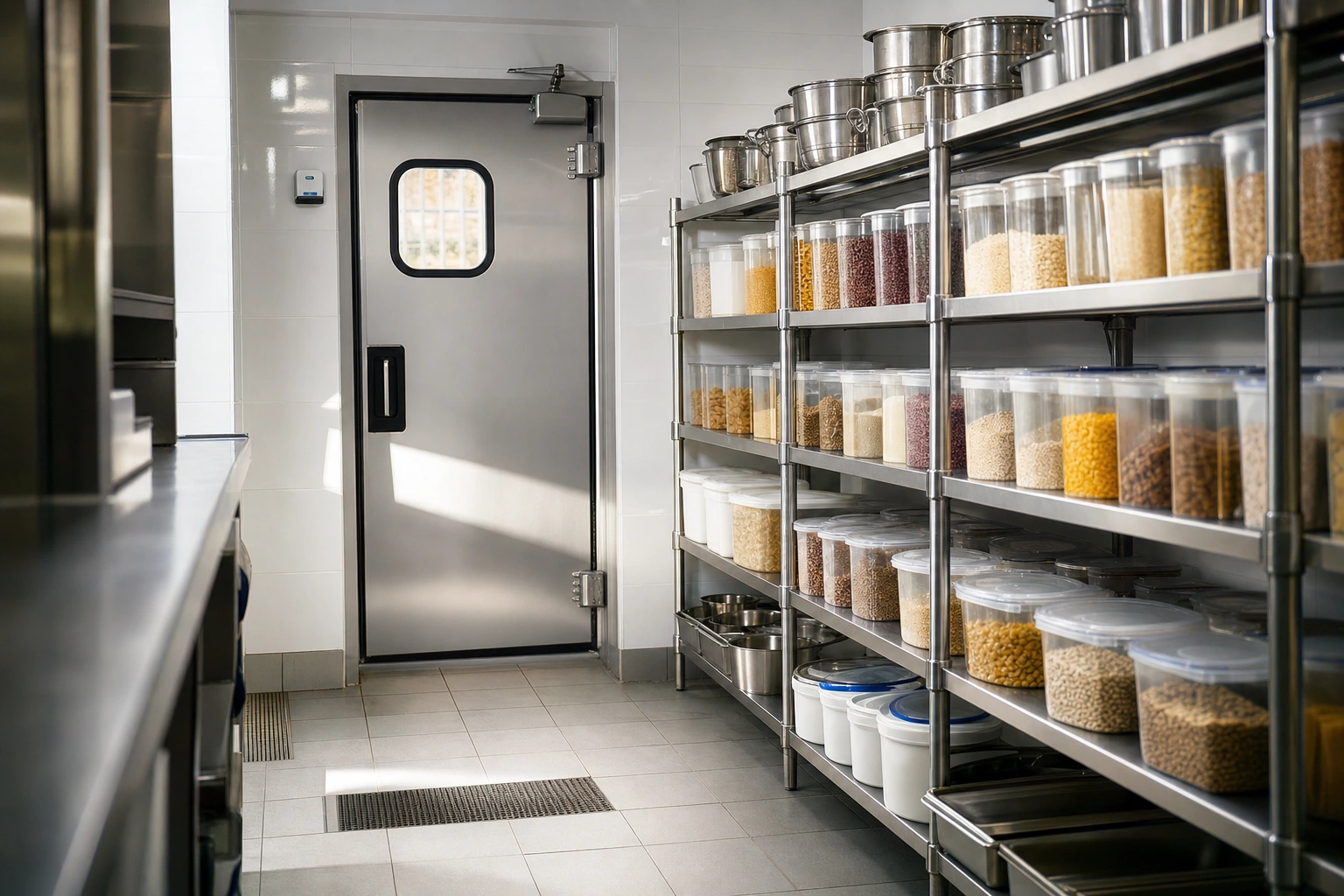
Dry goods should be transferred, where appropriate, into clean, secure containers that protect them from pests and moisture. Containers must be labelled clearly so staff can identify the contents and apply stock rotation. Older stock should be used before newer stock, provided that it remains safe and within its usable period.
Refrigerated and frozen foods require effective temperature control, but cold storage does not replace pest control. Clean spills quickly, avoid overloading shelves and keep storage areas in good repair. Food should be covered whenever practical, especially during preparation breaks and service periods.
Waste packaging from deliveries should be removed promptly. Wooden pallets, sacks and cardboard should be checked before being taken into clean storage areas. The receiving area itself should be kept clean because it can become a bridge between outside contamination and the kitchen.
Cleaning, Waste and Drain Management
Good cleaning removes the food residues that sustain pests. Cleaning schedules should cover floors, corners, drains, equipment bases, shelving, refuse areas and hard-to-reach spaces. Particular attention is needed after food preparation, during closing duties and following spills.
Cleaning should be carried out in the correct order for the task. Staff need to remove food debris, use the appropriate cleaning method and avoid spreading contamination from dirty areas to food-contact surfaces. Cloths, brushes and cleaning equipment should be maintained hygienically and stored away from food.
Waste containers should be suitable, covered where necessary and emptied often enough to prevent overflow. Waste should not be allowed to accumulate beside preparation areas or entrances. External refuse points should be positioned and maintained so that they do not attract pests towards the building. Leaking bins and contaminated waste surfaces require prompt attention.
Drains can provide water, shelter and food residues for pests. They should be kept in good condition and cleaned according to a defined schedule. Persistent odours, slow drainage or repeated insect activity near drains should be investigated rather than masked with chemicals or air fresheners.
Monitoring and Early Detection
Monitoring helps a business act before a minor problem becomes an infestation. A responsible staff member or manager should check high-risk areas regularly, including dry stores, refuse areas, loading bays, under sinks, behind large appliances, staff facilities and spaces near doors.
Monitoring may include visual inspections, non-toxic monitoring traps, insect light traps where suitable and review of pest-control service reports. Traps and monitoring devices must be positioned so that they do not create a contamination risk or interfere with food operations. They should be checked, maintained and recorded.
Records should show the date, location, finding, action taken, person responsible and follow-up date. For example, a record might note droppings found behind a dry-store shelf, the affected stock being isolated, the area being cleaned, an entry gap being sealed and a follow-up inspection being scheduled. A record is useful because it demonstrates control, reveals repeated patterns and supports communication between shifts.
Responding to Pest Activity Safely
When pest activity is discovered, staff should protect food first. Stop using any exposed food or equipment that may have been contaminated. Isolate affected stock, identify the affected area and inform the person responsible for food safety or operations. Do not sweep droppings into the air or handle contaminated material without suitable protection and an appropriate cleaning procedure.
Food-contact surfaces and equipment should be cleaned and sanitised using approved procedures before being returned to service. Open food, packaging that has been penetrated and food contaminated by droppings, insects or chemicals should not be served. The business should assess whether nearby stock, utensils or preparation surfaces could also have been affected.
Chemical treatment requires special care. Pesticides must never be sprayed on or near exposed food, utensils or food-contact surfaces. Food should be removed or protected as required, treatment should be carried out by a competent person, and the area should be ventilated and cleaned according to instructions before operations resume. Staff should follow product labels and workplace procedures rather than guessing concentrations or application methods.
If the cause is structural, such as a broken door seal or open pipe penetration, the repair must form part of the corrective action. Otherwise, treatment may suppress the symptoms while the problem continues.
Roles, Training and Communication
Everyone working in a hospitality operation has a role in pest prevention. Food handlers should know how to report sightings, protect food during interruptions, keep doors closed and avoid leaving residues or waste behind. Cleaners need clear instructions for drains, refuse areas and hard-to-reach surfaces. Receiving staff should understand how to inspect deliveries, while supervisors should review records and follow up unresolved issues.
Training should use realistic examples. Staff can be shown how to recognise droppings, gnaw marks, insect activity, damaged packaging and conditions that attract pests. They should also understand that hiding a sighting is more harmful than reporting it. A prompt report allows the business to isolate risk and investigate the cause.
Communication between shifts is essential. A night worker who notices activity behind a refrigerator must be able to alert the morning team and manager. Pest-control information should also be shared with contractors, maintenance staff and relevant suppliers when their work may affect food safety.
Applying This in Practice
A small café, hotel kitchen or catering business can begin with a practical pest-control routine:
- Map the premises and mark high-risk points such as entrances, drains, stores, refuse areas and delivery zones.
- Inspect food, packaging and equipment at receiving and before use.
- Complete daily cleaning and waste checks, including areas that are often overlooked.
- Carry out a documented weekly inspection for entry gaps, droppings, damaged packaging and signs of insects.
- Record every sighting, even when only one pest is seen, and investigate the likely source.
- Assign corrective actions with a responsible person and a completion date.
- Review recurring findings monthly and change procedures, repairs or supplier controls where necessary.
Managers should ask practical questions: Where would a pest find food or water tonight? Which door, drain or wall gap could allow entry? Could a delivery introduce pests into storage? Are cleaning and waste procedures actually completed during the busiest shifts? Are staff confident about what to do when they see signs of contamination?
The answers help turn pest control from an emergency reaction into a routine food-safety system. In a busy Kenyan restaurant, coastal lodge, urban café or institutional kitchen, the details will differ, but the principles remain the same: prevent access, remove attractants, monitor consistently and respond without creating new hazards.
Key Takeaways
- Pests can create biological, physical and chemical food-safety hazards.
- Prevention depends on sealing entry points, controlling waste, removing food residues and managing water sources.
- Inspect deliveries and isolate damaged or suspect food before it enters storage.
- Use regular inspections, suitable monitoring devices and clear records to detect activity early.
- When pests are found, protect food first, isolate affected stock and clean and sanitise potentially contaminated areas.
- Pesticides must be used carefully and must never contaminate food, utensils or food-contact surfaces.
- All staff should know how to report pest activity and complete their part of the prevention routine.
No comments yet.