
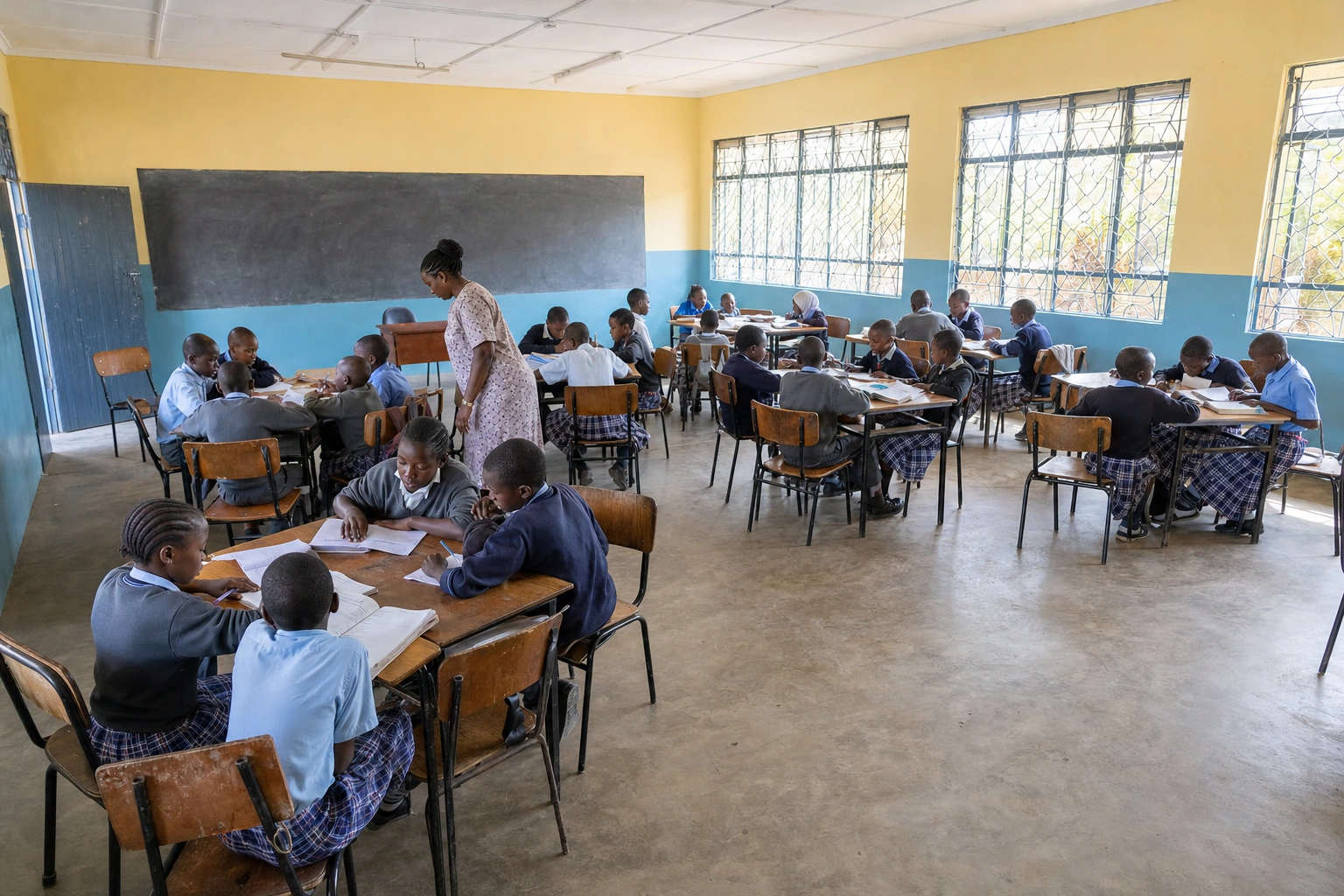
Managing a large class effectively is not simply a matter of keeping learners quiet. It involves designing a classroom where learners know what is expected, have meaningful work to do, can access support and understand how their behaviour affects the learning of others. Whether you are teaching in a crowded primary classroom, a secondary school, a college lecture room or a professional training programme, good management creates the conditions in which learning can take place.
Large classes present practical challenges: limited space, different learning needs, competing questions, noise, movement and less individual contact with the teacher. These challenges become more manageable when classroom management is treated as a system rather than a series of reactions. The strongest systems combine preparation, clear communication, consistent routines, active teaching methods and respectful relationships.
What Makes a Large Class Difficult to Manage?
A class becomes difficult to manage when the teacher cannot easily see, hear or support every learner. The problem may arise from the number of learners, the physical layout, limited resources, mixed ability levels or the nature of the lesson. A discussion-based lesson, for example, requires different arrangements from a practical science activity or a written assessment.
Several challenges commonly appear together:
- Limited attention: Learners may lose focus if explanations are long or if they have no active role.
- Uneven participation: Confident learners can dominate while quieter learners remain invisible.
- Slow transitions: Distributing materials, forming groups or changing activities may create noise and wasted time.
- Difficulty monitoring work: One teacher cannot provide detailed feedback to every learner at every moment.
- Behaviour contagion: A small number of disruptive actions can quickly affect the wider class.
- Different levels of readiness: Some learners may finish quickly while others need additional explanation or practice.
Effective management does not remove every difficulty. Instead, it reduces avoidable problems and gives the teacher practical ways to respond when challenges occur.
Build the Management System Before the Lesson
Many classroom problems begin before learners enter the room. A well-prepared lesson reduces uncertainty, and uncertainty often produces unnecessary movement, questions and off-task behaviour.
Plan a clear learning sequence
Know what learners should understand or be able to do by the end of the lesson. Divide the session into manageable stages, such as a brief introduction, teacher modelling, guided practice, independent or group work, checking and review. Each stage should have a purpose and an approximate time allocation.
For example, a mathematics lesson on percentages might begin with a practical problem involving a shop discount, continue with a worked example, move into paired calculations and finish with an individual exit question. This sequence gives learners something to do at each point rather than leaving them waiting while the teacher decides what comes next.
Prepare resources in advance
Place books, worksheets, equipment or board notes where they can be accessed efficiently. If resources are limited, decide how they will be shared. In a Kenyan school, for instance, a teacher may need to organise learners into groups around a small number of textbooks or science materials. Assigning a materials monitor in each group can prevent several learners from leaving their seats at once.
Define the routines
Routines should answer ordinary questions before they arise:
- How do learners enter and settle?
- How do they obtain and return materials?
- How do they ask for help?
- How do they move into groups?
- What should they do when they finish early?
- How should work be submitted?
Teach these routines explicitly, especially at the beginning of a term or when working with a new group. A routine is not effective merely because the teacher has announced it; learners need to practise it and receive consistent reminders.
Establish Expectations Without Creating Fear
Large classes need clear expectations, but rules are most useful when learners understand their purpose. Rather than listing many prohibitions, identify a small number of observable behaviours linked to learning and safety. For example: listen when someone is speaking, begin work promptly, treat people and materials with care, and ask questions respectfully.
Describe what the expectation looks and sounds like. “Work quietly” may be unclear, particularly during group activity. “Discuss the question with the members of your group using a voice that does not disturb nearby groups” is more specific.
Apply expectations consistently. If a learner is corrected for calling out while another learner is allowed to do the same, the class may perceive the system as unfair. Consistency does not mean responding identically in every situation. A learner who is struggling with a task may need support, while a learner deliberately interrupting others may need a different response. Fairness means applying the same principles while considering the circumstances.
Correct behaviour calmly and briefly. A useful sequence is:
- Move closer or use a quiet non-verbal signal where appropriate.
- State the expected behaviour clearly.
- Give the learner a chance to comply.
- Follow the established consequence if the behaviour continues.
- Speak privately when a longer conversation is necessary.
Public arguments consume teaching time and can turn a minor issue into a performance for the class. Private correction protects dignity and often makes cooperation more likely.
Use the Classroom Space Strategically
The arrangement of desks affects movement, visibility and interaction. There is no single best layout for every lesson. Rows may support individual writing and assessment; pairs may suit peer discussion; groups may help with problem-solving or practical work. Choose the arrangement that matches the learning activity.
In a large room, create clear pathways so that you can move through the class. Circulate rather than remaining at the front. Movement allows you to check progress, notice confusion early and communicate that the whole room is within your attention. If the room is crowded, even a small change—such as leaving a central walkway or positioning frequently used materials at the side—can improve access.
Consider visibility as well. Learners should be able to see the board, demonstration or presentation. The teacher should be able to see as many learners as possible. If some seats are hidden behind equipment or pillars, adjust the seating or move around during explanations.
Use the board deliberately. Divide it into sections for the lesson objective, key vocabulary, examples and tasks. This helps learners who need more time to copy and reduces repeated questions about what they should be doing.
Give Instructions That Large Classes Can Follow
Instructions become more important as the number of learners increases. If a direction is unclear, the same confusion is repeated many times and noise rises while learners seek clarification.
Use a short, ordered sequence. State what learners will do, how they will organise themselves, what resources they need and how much time they have. For example: “In pairs, read the two scenarios. Identify one cause and one possible solution for each. Record your answers in your exercise books. You have eight minutes.”
Do not give five instructions while learners are still collecting materials. Give directions at the point when they are needed, and display essential steps on the board. Ask a learner to repeat the task in their own words, or ask groups to show readiness before beginning.
Check understanding of the task rather than asking, “Do you understand?” Many learners will say yes even when they are uncertain. Instead ask questions such as:
- “What is the first thing you will do?”
- “Will you work alone or with a partner?”
- “Where will you write your answer?”
- “What should you do if you finish early?”
This quick check can prevent several minutes of confusion.
Keep Learners Actively Involved
Passive listening is particularly difficult to sustain in a large class. Active learning does not require expensive technology or elaborate materials. It can involve brief questioning, pair discussion, problem-solving, written responses, demonstrations, peer explanation or retrieval of earlier learning.
Use a rhythm that changes the type of participation. After a short explanation, ask learners to think individually, discuss with a partner and then share selected responses. This gives more learners an opportunity to rehearse an answer before speaking publicly. It also reduces dependence on the same few volunteers.
Questioning should be planned. Ask a mixture of questions that check recall, interpretation and application. Allow thinking time before selecting a respondent. Sometimes ask all learners to write an answer or show a response simultaneously using notebooks or simple response cards. This provides wider evidence of understanding than relying on raised hands.
Group work can be effective, but simply placing learners in groups does not guarantee learning. Give each group a clear product and a time limit. Assign roles where useful, such as facilitator, recorder, reporter, timekeeper or resource manager. Rotate roles so that responsibility is shared. In a large class, appointing a group reporter can reduce the number of voices competing for the teacher's attention, but do not allow the reporter to become the only learner who participates.
Monitor Understanding Efficiently
Large-class teaching requires efficient assessment. The aim is not to mark every sentence immediately; it is to collect enough evidence to decide what to do next.
As learners work, circulate with a purpose. Check a sample of groups, look for common errors and ask learners to explain their reasoning. If several learners make the same mistake, pause the activity and address it for the whole class. This is more efficient than repeating the same correction at many desks.
Use quick formative assessment techniques, including:
- A one-minute written response to a focused question.
- A short exit question at the end of the lesson.
- Peer checking with clear answers or criteria.
- Thumb signals or other agreed non-verbal responses.
- Mini-whiteboards, exercise books or response cards held up together.
- A “most difficult point” note from each learner.
Peer assessment must be structured. Provide criteria, model how to give respectful feedback and make clear that checking another learner's work is not the same as assigning a final grade. This approach can increase the amount of feedback available while keeping the teacher responsible for important judgements.
Support Different Learners in the Same Room
A large class may include learners with different language backgrounds, prior knowledge, confidence levels, disabilities and access to learning materials. Effective management includes planning for this variation rather than treating it as a disruption.
Use clear language, explain essential vocabulary and connect new ideas to familiar situations. Provide examples before asking learners to work independently. Where appropriate, offer a core task and an extension task. Learners who need more practice can focus on the essential skill, while those who finish early can apply it in a more demanding context.
Pairing and grouping should be purposeful. Sometimes mixed-readiness groups encourage peer explanation; at other times, temporary groups based on a shared need allow the teacher to provide targeted support. Avoid labelling learners publicly or creating permanent groups that restrict expectations.
For learners who need additional support, consider seating, print size, time, access to notes, oral explanation or a quieter working position. Small adjustments can improve participation without lowering the learning goal.
Handle Disruption and Conflict Proportionately
Not every interruption requires a public response. Distinguish between low-level off-task behaviour, persistent disruption, conflict between learners and behaviour that threatens safety. Match the response to the seriousness and frequency of the issue.
For low-level problems, use proximity, eye contact, a pause, a reminder or a change of task. For repeated disruption, speak privately, describe the behaviour and its effect, listen to the learner's explanation and agree on the next expectation. Record concerns according to your institution's procedures when necessary and involve colleagues or families through the appropriate channels.
Avoid humiliating learners, using threats you cannot enforce or punishing an entire class for the actions of a few. Such responses may create resentment and do not teach the behaviour you want to see. If conflict occurs, separate the immediate safety issue from the later restorative conversation. Learners need to understand what happened, who was affected and what must change, while the teacher maintains professional boundaries.
Applying This in Practice
Before a large-class lesson, ask yourself five questions:
- What is the most important learning outcome?
- What will learners be doing during each stage of the lesson?
- How will resources, movement and group formation be managed?
- How will I know who understands, not just who volunteers?
- What predictable behaviour problem can I prevent through better instructions or routines?
After the lesson, review evidence rather than relying only on your feelings. Which transition took too long? Which instruction produced confusion? Which learners participated? What common error appeared in the work? Choose one improvement for the next lesson, such as displaying group roles, shortening explanations, changing the seating arrangement or adding an early understanding check.
Over time, small improvements create a dependable classroom system. Learners become familiar with routines, the teacher gains better information about their needs and more lesson time is available for meaningful learning.
Key Takeaways
- Plan routines for entry, resources, movement, help-seeking, transitions and finished work before problems occur.
- State a small number of clear, observable expectations and apply them consistently and fairly.
- Match the seating arrangement, board layout and movement pathways to the learning activity.
- Give short, ordered instructions and check that learners know what to do before they begin.
- Use pair work, group roles, questioning and quick written responses to increase active participation.
- Monitor common errors across the room so that one whole-class explanation can replace repeated individual corrections.
- Review each lesson and make one specific management improvement for the next session.
No comments yet.