
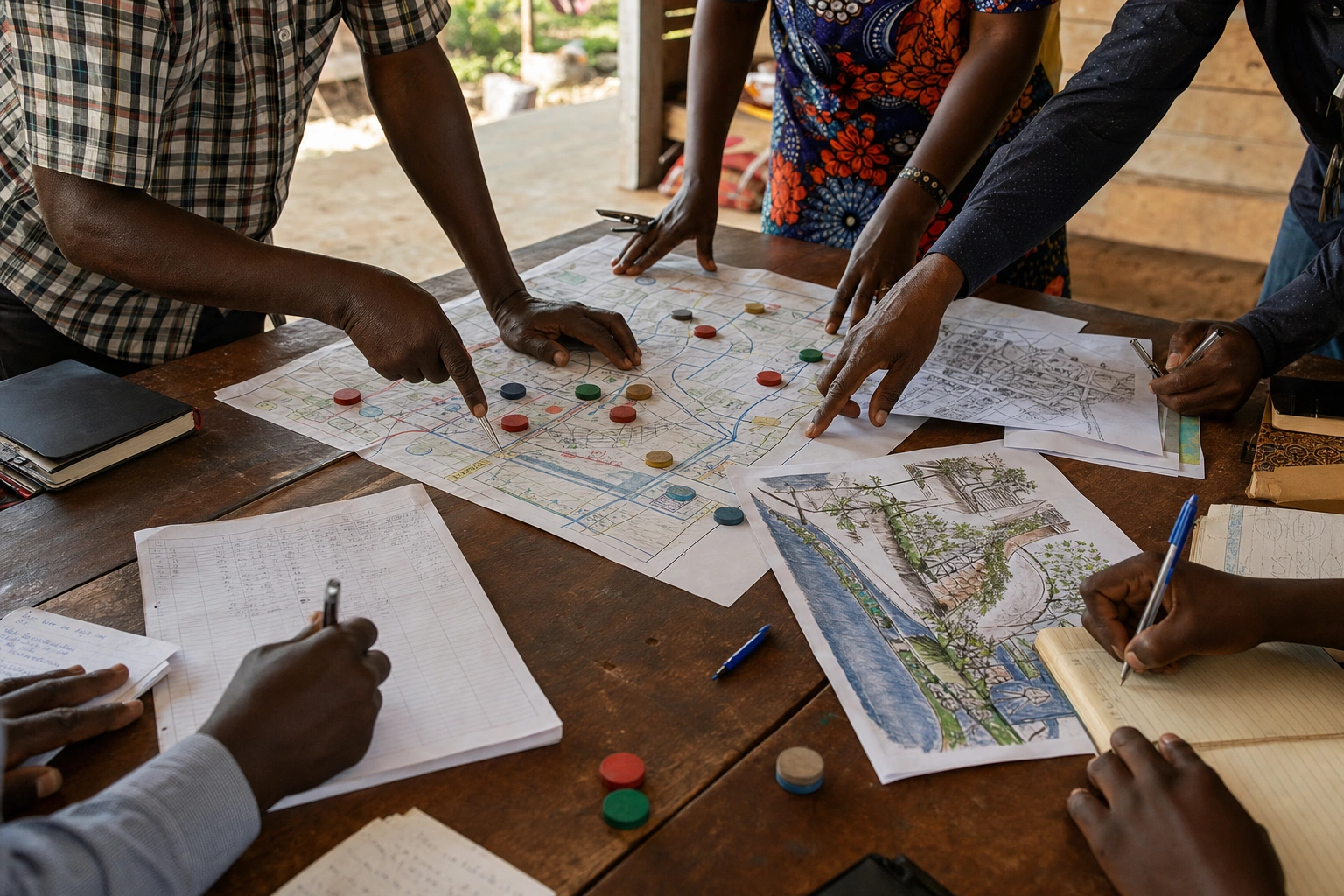
Community participation does not happen simply because a meeting has been announced. People take part when they understand why their involvement matters, trust the process and can see a realistic connection between their contribution and the decisions that affect their lives. Community leaders play an important role in creating these conditions.
A community leader may be an elected representative, elder, religious leader, youth organiser, women’s group coordinator, professional, village volunteer or respected informal influencer. Their authority may come from an official position, but it may also come from knowledge, integrity, relationships and a record of helping others. Through these forms of influence, leaders can either widen participation or unintentionally limit it to the same visible and powerful voices.
What Community Mobilisation Means
Community mobilisation is the process of bringing people together to identify shared concerns, make decisions, use available resources and take collective action. It is broader than inviting residents to attend an event. Effective mobilisation helps people move from awareness to involvement and, where appropriate, to joint responsibility for solving a problem.
For example, a community may be concerned about poor waste management. Mobilisation could involve mapping the problem, listening to households and traders, discussing responsibilities with local authorities, organising clean-up activities and agreeing how progress will be monitored. A leader’s role is not to do every task personally. It is to help the community organise itself around a clear and legitimate purpose.
Participation can take different forms:
- Receiving information: people learn about a project, public decision or available service.
- Expressing views: residents share experiences, priorities and concerns.
- Taking part in decisions: community members help set priorities or choose between options.
- Contributing resources: people offer time, skills, money, materials or local knowledge.
- Taking collective action: residents work together to implement an agreed activity.
- Monitoring and accountability: people track progress and ask responsible institutions for explanations.
These forms should not be treated as identical. A community that is merely informed has less influence than one that helps shape a decision. Good leaders are therefore careful not to describe attendance at a meeting as meaningful participation unless people had a genuine opportunity to speak, influence outcomes or take part in follow-up action.
How Leaders Influence Participation
1. They build trust
Trust is one of the strongest foundations of participation. People are more likely to attend, speak honestly and contribute effort when they believe that leaders will listen, treat them fairly and communicate what happens next.
Trust is built through consistent behaviour rather than promises alone. Leaders can demonstrate it by arriving prepared, keeping agreed commitments, explaining limitations honestly and reporting back after consultations. If a community’s preferred option cannot be adopted because of funding, legal or practical constraints, a clear explanation is more respectful than silence.
Trust also depends on how leaders handle disagreement. A leader who dismisses criticism may secure outward compliance but lose the confidence needed for future cooperation. A leader who allows respectful disagreement helps residents believe that participation is more than a public performance.
2. They make information understandable and accessible
People cannot participate effectively in decisions they do not understand. Community leaders often act as interpreters between institutions and residents. They may explain a public notice, clarify the purpose of a development project or translate technical language into terms that relate to everyday experience.
Useful communication answers practical questions: What is being discussed? Why does it matter? Who is responsible? What choices are available? When and where can people contribute? What will happen after their views are collected?
One communication method rarely reaches everyone. Depending on the setting, leaders may use small group discussions, local gatherings, noticeboards, radio, phone calls, messaging platforms, religious spaces, schools or door-to-door outreach. In parts of Kenya and other African countries, oral communication and trusted local networks may be particularly important where internet access, literacy or time is uneven. Digital tools can extend participation, but they should not replace non-digital options when many residents cannot use them reliably.
3. They connect people to decisions and institutions
Many residents want to influence decisions but do not know which office, committee or process is responsible. Leaders can make participation more practical by connecting community concerns to the institutions that have the authority or resources to respond.
This may involve helping residents prepare a clear memorandum, organising a meeting with a service provider, submitting a collective request or explaining how feedback will be considered. The leader is acting as a bridge, not as a gatekeeper. A bridge carries community voices towards decision-makers while also bringing accurate information back to residents.
Problems arise when leaders become the only channel through which information flows. If residents must depend entirely on one person, that person can control access, filter concerns or claim to represent views that were never properly discussed. Strong mobilisation develops several informed representatives and makes communication as open as the circumstances allow.
4. They create safe and relevant spaces for participation
The setting and format of an activity influence who takes part. A large public meeting may be useful for sharing information, but it may not allow quieter residents, people with disabilities or those who fear public disagreement to contribute. Small discussion groups, separate listening sessions or anonymous feedback can sometimes produce a fuller picture.
Leaders should consider practical barriers such as meeting times, transport, childcare, language, disability access, personal safety and the cost of participation. A meeting scheduled during working hours may exclude traders, casual workers or caregivers. A discussion conducted only in formal language may exclude residents who understand the issue but express themselves more comfortably in another language.
Inclusion does not mean that every person must attend every activity. It means that the mobilisation process makes a serious effort to hear affected groups, especially those whose interests are often overlooked. Women, young people, older people, people with disabilities, minority groups, migrants and residents in remote areas may require deliberate outreach rather than a general invitation.
5. They model shared leadership
Participation becomes stronger when leadership is distributed. A leader who insists on speaking for everyone may appear efficient, but can weaken local ownership. Shared leadership allows different people to contribute their knowledge and develop confidence in organising.
A community initiative might assign different responsibilities for communication, record-keeping, finance, outreach, technical advice and monitoring. Rotating facilitation roles can prevent one individual from dominating discussions. Publicly recognising contributions also shows that community work is not the property of a single office-holder.
Shared leadership requires boundaries. Roles should be clear, resources should be recorded and decisions should be documented where appropriate. Openness reduces suspicion and helps prevent participation from being used to hide personal or political interests.
From Attendance to Meaningful Participation
Attendance is easy to count, but it does not reveal whether people had influence. A meeting can be crowded while decisions have already been made elsewhere. To assess the quality of participation, leaders and communities should ask several questions.
- Were people given information early enough to consider the issue?
- Were affected groups represented, or only those who are already active?
- Could participants ask questions and challenge proposals respectfully?
- Were different options explained, including their likely costs and benefits?
- Did community views affect the final decision or its implementation?
- Was feedback provided after the meeting?
- Are there opportunities to review progress and raise new concerns?
These questions distinguish consultation from tokenism. Consultation occurs when people are invited to give views, although the final authority may remain elsewhere. Collaboration involves shared planning or implementation. Community-led action goes further, with residents taking substantial responsibility for defining and addressing an issue. Each level can be appropriate, but leaders should describe honestly what influence participants have.
Common Ways Participation Becomes Weak
Inviting people too late
If a project design, budget or decision is already fixed, asking for opinions may create frustration. Early engagement gives residents a better chance to identify risks, suggest alternatives and contribute local knowledge.
Relying on the most visible voices
The people who attend public meetings regularly may not represent the whole community. Leaders should compare meeting contributions with wider listening activities and ask who is absent. Representation should be examined rather than assumed.
Using mobilisation for personal or political interests
Leaders may have political affiliations, business interests or personal priorities. These do not automatically disqualify them from organising, but responsible leadership requires transparency. People should know the purpose of an activity, who controls resources and whether participation is voluntary.
Promising outcomes that cannot be guaranteed
Overpromising can produce short-term attendance but damage long-term trust. Leaders should distinguish between what the community can decide, what another institution must approve and what remains uncertain.
Failing to report back
When people give time and ideas but hear nothing afterwards, they may conclude that their participation had no value. Even a brief update is useful: what was agreed, what changed, who is responsible and when the next review will occur.
A Practical Mobilisation Process
A structured process helps leaders turn goodwill into organised participation. The exact steps will vary, but the following sequence is adaptable to many community issues.
- Understand the issue. Gather initial information and distinguish facts, assumptions and rumours. Identify who is affected and what decisions are possible.
- Map the community. Identify formal organisations, informal networks, trusted communicators, vulnerable groups and institutions with relevant responsibilities.
- Agree on the purpose. State whether the activity is for information, consultation, joint planning, implementation or monitoring. Do not imply more decision-making power than participants will have.
- Choose inclusive methods. Combine suitable approaches such as small groups, public meetings, household outreach, written feedback or digital communication. Provide reasonable alternatives for people who cannot attend.
- Facilitate fairly. Set ground rules, manage dominant speakers, invite quieter contributions and record differing views accurately. Neutral facilitation may be valuable where conflict is high.
- Convert ideas into responsibilities. Define the actions, people or institutions responsible, available resources and realistic time frames. Avoid vague agreements that nobody can follow up.
- Report and review. Share what happened after the engagement and create a way to monitor progress. If circumstances change, involve the community in revising the plan.
Applying This in Practice
Imagine residents in a growing settlement are concerned about flooding during heavy rain. A weak mobilisation approach would announce a single meeting, collect complaints and promise that the problem will be solved. A stronger approach would begin by listening to residents in the affected areas, including tenants, traders, people with disabilities and households located away from the main road.
Leaders could then work with residents to identify blocked drainage points, unsafe crossings and areas where waste accumulates. They could clarify which issues require household action, which require municipal services and which may need longer-term planning. At a public session, participants could prioritise actions using agreed criteria such as urgency, number of people affected and available resources.
The process would become more credible if leaders recorded the priorities, identified responsible actors and returned with an update. Even where major construction could not begin immediately, practical steps such as clearing a specific obstruction, improving communication before heavy rain or documenting a service request could show that participation leads to follow-up.
For any community initiative, leaders can use a simple review checklist:
- Whose knowledge is essential to understanding the issue?
- Who may be excluded by the chosen time, place, language or technology?
- What decision or action can participants genuinely influence?
- How will disagreements and minority views be recorded?
- What resources and responsibilities are clear?
- When and how will the community receive an update?
Key Takeaways
- Community mobilisation is more than gathering people; it connects shared concerns with collective decisions and action.
- Trust grows when leaders communicate honestly, keep commitments and report back after participation activities.
- Meaningful participation requires accessible information, genuine influence and deliberate inclusion of less-visible groups.
- Leaders should act as bridges to institutions without becoming the only gatekeepers of information or representation.
- Shared responsibilities, transparent records and follow-up help turn meetings into accountable community action.
- Before mobilising people, clarify the purpose, the available choices, the decision-makers and the next steps.
No comments yet.