
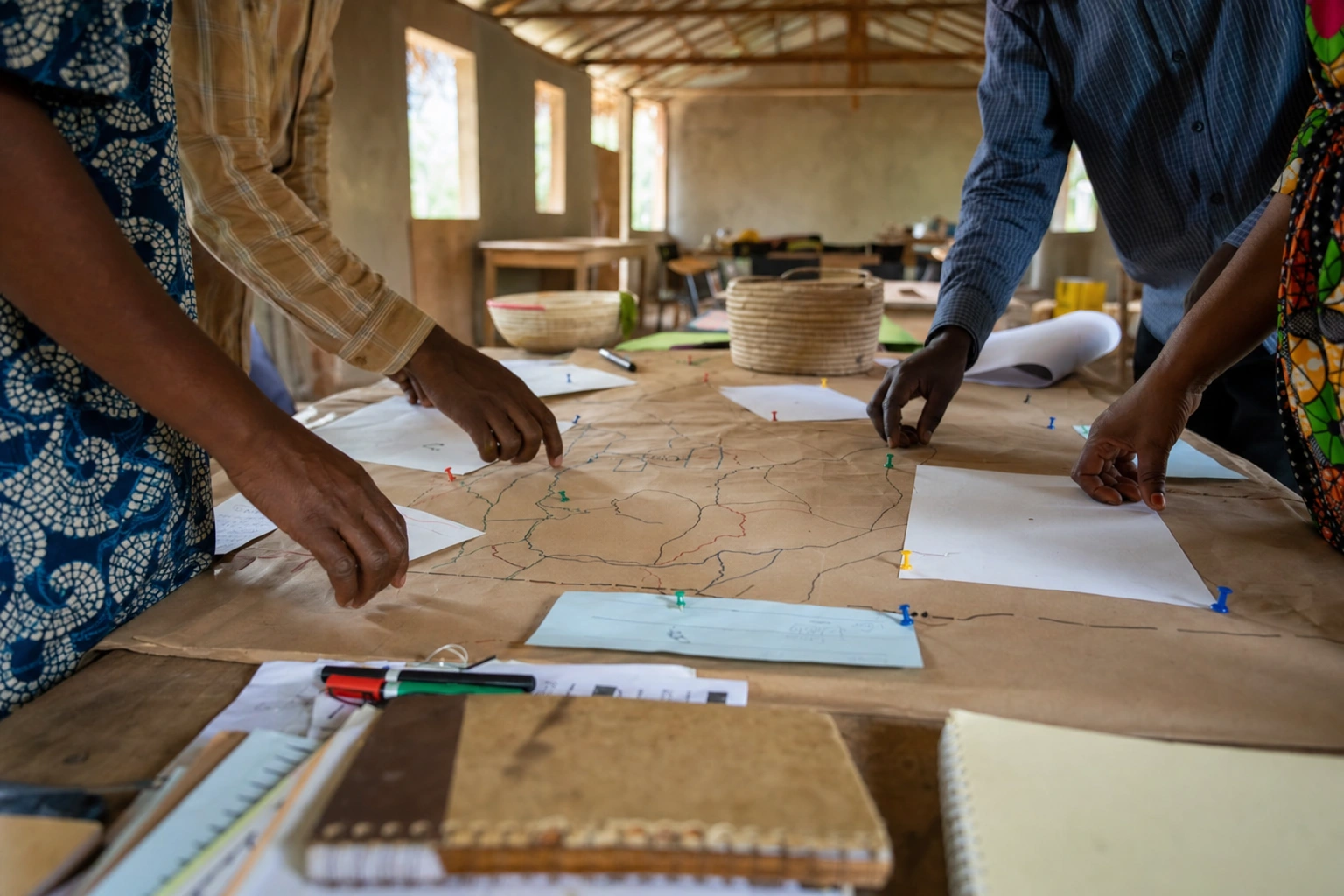
Community mobilisation is the process of bringing people together to identify concerns, agree on shared goals and organise action to address them. It is more than calling a public meeting or asking residents to support a project. Effective mobilisation helps people understand an issue, recognise their collective influence and take responsibility for decisions and activities that affect their lives.
Communities may mobilise around many goals: improving access to water, supporting young people into employment, protecting a local environment, improving public health, responding to insecurity or holding service providers accountable. The methods will differ, but the central idea remains the same: people achieve more when they develop a common purpose and coordinate their skills, relationships and resources.
What Community Mobilisation Means
Community mobilisation involves a series of connected activities through which individuals, groups and institutions work towards a shared objective. It usually includes listening to community members, analysing a situation, building trust, planning action, assigning responsibilities and reviewing progress.
The word “community” does not refer only to people living in the same place. A community may be defined by a neighbourhood, occupation, faith, age group, interest, disability, cultural identity or shared experience. For example, small-scale farmers in a county may mobilise around fair market access even though they live in different villages. Parents, teachers and local organisations may form a community around improving school attendance.
Mobilisation is also different from simply informing people. Information flows in one direction, while mobilisation encourages participation and shared ownership. A notice about a clean-up day may inform residents; a process in which residents decide which areas need attention, organise equipment and monitor the results is mobilisation.
Why Shared Goals Matter
A shared goal provides direction. Without one, people may agree that a problem exists but pursue different solutions. One group may want immediate relief, another may prefer long-term investment and another may not see the issue as urgent. A clear goal helps the community decide what it is trying to change and how it will recognise progress.
Shared goals are most effective when they are specific enough to guide action but broad enough to include different perspectives. “Improve our community” is too general to organise around. “Make the market area safer and cleaner during trading hours” gives people a clearer basis for discussion and planning.
A good shared goal usually answers three questions:
- What needs to change? This identifies the problem or desired improvement.
- Who is affected or involved? This prevents planning from being limited to the most visible or powerful voices.
- What can the community influence? This keeps the goal realistic and connects it to available opportunities for action.
For instance, a community cannot single-handedly redesign a national road policy, but it may be able to document dangerous sections, organise residents, engage the relevant authorities and advocate for safer crossings or signage.
Core Principles of Effective Mobilisation
Participation rather than instruction
People are more likely to support an initiative when they have helped shape it. Mobilisation should therefore create opportunities for community members to speak, question proposals and influence decisions. Leaders may provide structure, but they should not treat residents as passive recipients of a ready-made plan.
Participation does not mean that everyone must attend every meeting. It means that the process makes a genuine effort to hear different views and explain how decisions are made. Small discussion groups, household visits, accessible forums and feedback channels can help include people who cannot attend large gatherings.
Inclusion and representation
Communities contain different interests and levels of power. Women, young people, older people, people with disabilities, minority groups, tenants, informal workers and people living in remote areas may experience a problem differently. If only influential individuals participate, the final goal may reflect their priorities rather than those of the wider community.
Inclusion requires deliberate action. Meetings should be held at times and places that are practical for different groups. Communication should use language that people understand. Where appropriate, organisers should consider mobility, childcare, safety and the needs of people with hearing, visual or other disabilities.
Trust and transparency
Trust develops when organisers keep promises, share information and explain decisions. Communities are understandably cautious when previous projects have failed, resources have disappeared or outsiders have made commitments without following through.
Transparency can include publishing a simple activity plan, recording agreed decisions, explaining how funds or materials will be managed and reporting both achievements and difficulties. Honest communication about limitations is usually more credible than exaggerated promises.
Local ownership
External organisations can provide technical knowledge, funding or connections, but the community should not become dependent on outside direction. Local ownership grows when residents help define the issue, contribute ideas and resources, select representatives and monitor the work.
Local contributions need not be financial. People may contribute time, meeting space, professional skills, local knowledge, transport, communication networks or practical labour. Recognising these contributions helps communities see mobilisation as a shared responsibility rather than a project belonging to a sponsor.
Action and learning
Mobilisation should lead to practical steps, not endless discussion. At the same time, action should be treated as a learning process. A community may discover that its first approach is too expensive, excludes some people or does not produce the expected result. Reviewing progress allows the group to adapt without abandoning the broader goal.
Stages of Community Mobilisation
1. Understand the situation
Begin by learning how people experience the issue. This may involve conversations, observation, community mapping, small group discussions, surveys or reviewing available records. The purpose is not to produce a complicated report; it is to develop a grounded understanding of causes, effects, existing resources and possible partners.
Suppose residents want to improve waste management. Listening may reveal that the problem is not simply a lack of collection. There may also be unclear collection schedules, limited storage points, blocked drainage channels, weak enforcement or a lack of agreement about who is responsible. Understanding these factors prevents the group from choosing a solution that addresses only one part of the problem.
2. Identify stakeholders and existing assets
Stakeholders are people or institutions affected by the issue, able to influence it or holding relevant knowledge and resources. They may include residents, local administrators, businesses, schools, health workers, faith groups, elected representatives, civil society organisations and informal leaders.
It is equally important to identify assets. A community asset might be a youth group with communication skills, a local hall, a health professional, a savings group, a trusted radio presenter or an existing relationship with a public office. Starting with strengths can make a plan more practical and reduce the assumption that progress depends entirely on external funding.
3. Build a representative organising group
A small organising group can coordinate the process, but it should not become a permanent substitute for community participation. Members should be selected for their reliability, ability to listen and willingness to work with others, not merely for social status.
The group should clarify roles. One person might coordinate meetings, another may manage communication, another may document decisions and another may maintain contact with partners. Responsibilities should be visible, and important decisions should remain open to appropriate community oversight.
4. Agree on the shared goal
Use the information gathered to develop a goal that people recognise as relevant and achievable. Invite participants to distinguish between immediate needs, underlying causes and longer-term ambitions. This may produce a sequence of goals rather than one large promise.
For example, a community concerned about youth unemployment might first aim to map local skills and available opportunities, then organise career information sessions and employer engagement. A later goal could involve developing apprenticeships or improving access to finance. Breaking the issue into stages makes action easier to manage.
5. Develop an action plan
An action plan should state what will be done, by whom, by when and with which resources. It should also identify possible risks and ways to respond to them. A simple plan might include:
- Activities: the specific steps required.
- Responsibilities: the individuals or groups coordinating each step.
- Resources: materials, money, skills, permissions or relationships needed.
- Time frame: when activities will begin and what milestones will be used.
- Indicators of progress: observable signs that the work is moving forward.
For a neighbourhood safety initiative, activities might include mapping poorly lit areas, collecting residents’ experiences, meeting relevant authorities and organising a community information session. Progress indicators could include a completed map, documented concerns, scheduled meetings and agreed responsibilities.
6. Communicate consistently
Communication should continue between meetings. Use channels that community members already trust and access, such as noticeboards, local groups, phone calls, community radio or face-to-face conversations. Messages should explain the purpose of the activity, what people are being asked to do and how they can provide feedback.
Communication should not be used only to request attendance or contributions. It should also share decisions, acknowledge contributions and report on challenges. Two-way communication helps organisers identify rumours or misunderstandings before they weaken participation.
7. Implement, monitor and adapt
Once activities begin, the organising group should track progress and invite community feedback. Monitoring can be simple: attendance records, completed tasks, photographs where appropriate, expense records, short interviews or observations of change. The method should match the size and nature of the initiative.
Evaluation asks whether the activity made a meaningful difference and what should change next time. For example, if a public forum is attended mainly by older residents, the group may need to adjust its communication or timing to reach young people. Adaptation is not failure; it is a responsible response to evidence.
Leadership in Community Mobilisation
Community mobilisation needs leadership, but effective leadership is facilitative rather than controlling. A facilitator helps people clarify issues, manage disagreement, share responsibility and move from discussion to action.
Good community leaders listen carefully, make space for quieter participants and separate personal authority from the community’s decision-making process. They also understand when specialist advice is needed. Technical knowledge can improve a project, but experts should explain options in accessible language and respect local knowledge.
Conflict is normal when people have different priorities or when decisions involve limited resources. Leaders should not hide disagreement. They can help by identifying the specific issue, allowing each side to explain its concerns, checking facts and looking for a fair process. Written criteria can be useful when the community must prioritise among several requests.
Common Challenges and How to Address Them
Low participation
Low attendance may indicate inconvenient timing, limited trust, unclear benefits or previous disappointment. Organisers should ask people directly what prevents participation rather than assuming that they are uninterested. Smaller meetings, rotating venues and clearer communication may help.
Dominant voices
When a few people speak for most of the meeting, others may withdraw. Facilitators can use structured turns, small groups, anonymous feedback or targeted conversations. They should also make it clear that leadership status does not automatically make one person’s view the community’s view.
Dependence on funding
Funding can be useful, but a project designed around a grant may collapse when the grant ends. Before accepting support, communities should consider the long-term costs, local maintenance capacity and whether the activity fits existing priorities. A modest initiative that people can sustain may be more valuable than a larger project with no local ownership.
Unrealistic expectations
Mobilisation cannot solve every problem immediately. Clear boundaries are essential. Organisers should distinguish between what the community can do directly, what requires partnership and what must be addressed through wider advocacy. This prevents disappointment and makes requests to public authorities or other institutions more precise.
Weak accountability
Unclear finances, unrecorded decisions and unreported delays can damage trust. Even small groups should agree on basic accountability practices, such as keeping receipts, recording contributions, sharing meeting notes and providing regular updates.
Applying This in Practice
Imagine residents in a Kenyan market centre want to reduce flooding during heavy rain. A practical mobilisation process might begin with conversations among traders, nearby households, transport workers and local officials. Residents could map blocked drainage points and identify how waste, construction or maintenance practices contribute to the problem.
The group could then agree on a first goal: improving drainage maintenance and reducing waste entering the channels before the next rainy period. An organising team might coordinate a clean-up with relevant authorities, communicate safe disposal practices, document locations requiring technical attention and follow up on requests for repairs.
The community should decide how progress will be reviewed. It might check whether priority sections have been cleared, whether responsibilities are understood and whether problem areas become blocked again. If clean-ups do not address the main cause, the group can revise its plan and pursue a different intervention.
When planning any mobilisation effort, ask:
- Do the people most affected by the issue have a meaningful voice?
- Is the shared goal clear enough to guide practical decisions?
- Which local skills, relationships and resources can support action?
- Who is responsible for each activity, and how will progress be reported?
- What could prevent participation, and how can the process be made more accessible?
- How will the community learn from results and adjust its approach?
Key Takeaways
- Community mobilisation turns a shared concern into coordinated, participatory action.
- A strong goal identifies what should change, who is affected and what the community can influence.
- Inclusion requires deliberate attention to voices that may be overlooked or less powerful.
- Trust grows through transparent decisions, honest communication and clear accountability.
- Local skills, relationships, time and knowledge are important resources alongside money.
- Effective mobilisation involves planning, action, monitoring and adaptation rather than one-off meetings.
No comments yet.