
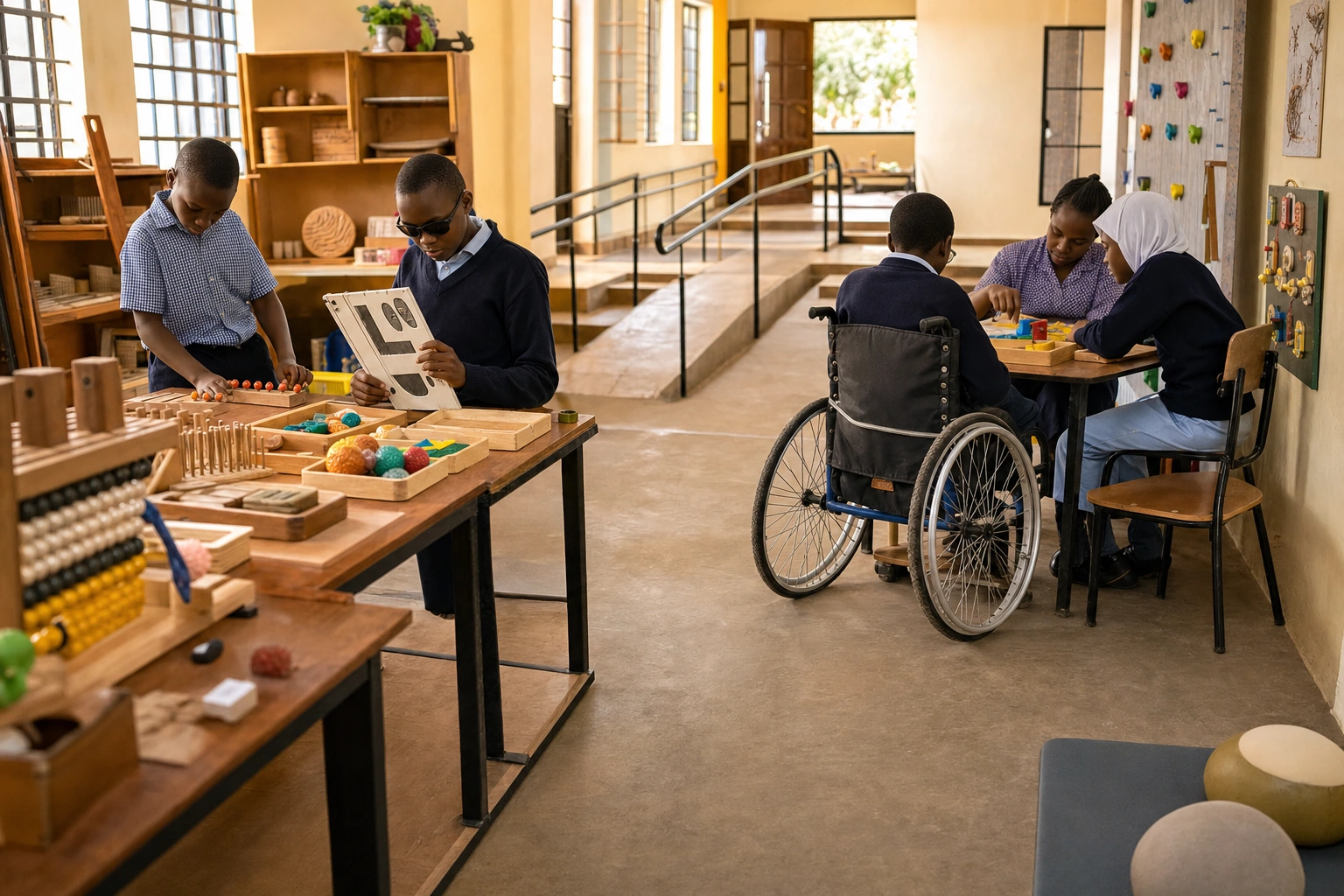
Education does more than transfer knowledge. It shapes confidence, relationships, opportunity and a person’s sense of belonging. When learners are excluded from lessons, activities or school life because of disability, poverty, language, gender, culture or another circumstance, their education is limited even if they are physically present in a classroom.
Inclusive education is an approach that aims to ensure all learners can participate meaningfully in education and receive the support they need to progress. It is not simply about placing different learners in the same room. It requires schools, teachers, families and communities to identify barriers and change teaching, assessment, communication and the learning environment so that more learners can succeed.
What Inclusive Education Means
Inclusive education means designing education systems and learning experiences for the widest possible range of learners. It recognises that learners differ in how they communicate, move, concentrate, process information, learn languages, demonstrate understanding and respond to the environment.
In an inclusive setting, difference is not treated as a problem that must be hidden or as a reason to lower expectations automatically. Instead, educators ask practical questions:
- Can every learner access the classroom, materials and activities?
- Can learners understand what is being taught and express what they know?
- Do classroom routines support participation rather than create unnecessary obstacles?
- Are learners treated with dignity and included in friendships, group work and school activities?
- Does assessment allow different learners to demonstrate progress fairly?
Inclusion applies to learners with disabilities, but its scope is broader. It can include children and adults who face barriers related to poverty, displacement, language, ethnicity, religion, gender, health, caring responsibilities, isolation or previous interruptions to education. A learner may experience several barriers at once, so a single solution will rarely work for everyone.
Inclusion Is More Than Physical Presence
A learner can be present in a classroom without being included. For example, a pupil who uses a wheelchair may attend lessons but be unable to reach the laboratory or participate in outdoor activities. A learner who is still developing proficiency in the language of instruction may sit through lessons but understand very little. Another learner may be placed in a group yet never be given a meaningful role.
These examples show three related but different ideas:
- Presence: the learner attends the school or learning session.
- Participation: the learner can engage in activities, relationships and discussions.
- Progress: the learner receives appropriate teaching and support to develop knowledge and skills.
Effective inclusion considers all three. Attendance matters, but it is only the starting point. Schools should also examine whether learners feel safe, respected and able to influence their own learning.
Why Inclusion Matters for Learners
It protects dignity and belonging
Belonging is an important part of learning. Learners are more likely to ask questions, attempt difficult tasks and seek help when they feel accepted rather than judged. Inclusive education communicates that every learner has value and a legitimate place in the classroom.
This is especially important for learners who have experienced stigma or exclusion. A child with a disability, a newcomer who speaks a different home language or a learner returning after a long absence may already doubt whether school is meant for them. Consistent inclusion can help rebuild trust and participation.
It improves access to learning
Barriers are not always caused by a learner’s ability. They may arise from inaccessible buildings, small print, rapid explanations, unfamiliar vocabulary, rigid timetables, noisy rooms or assessment methods that measure communication skills instead of the subject being taught.
When these barriers are reduced, learners have a fairer opportunity to show what they understand. For example, a teacher might provide diagrams alongside spoken instructions, allow additional processing time, use captions or offer an accessible digital document. These adjustments do not give an unfair advantage; they help ensure that the intended learning objective can be assessed.
It supports academic and personal development
Inclusive classrooms can offer more opportunities for collaboration, explanation and problem-solving. Learners encounter different perspectives and learn to communicate with people whose experiences are not identical to their own. They can develop patience, empathy, negotiation and the ability to adapt—skills that matter in employment, entrepreneurship, family life and civic participation.
Inclusion should not be presented as beneficial only to learners who need additional support. A well-designed lesson with clear instructions, varied materials and flexible ways to participate can help many learners, including those who are anxious, learning a new language or studying in difficult circumstances.
Why Inclusion Matters for Society and Work
Schools are part of society, not separate from it. When learners study together with appropriate support, they have more opportunities to build relationships across differences. This can challenge stereotypes before they become deeply established.
Inclusive education also helps prepare people for diverse workplaces and communities. Modern organisations need staff who can collaborate across cultures, communicate clearly and design products or services for a wide range of users. An entrepreneur who understands accessibility, for instance, may notice that a shop, website, payment process or public service excludes potential customers.
Exclusion can also create long-term costs. When people are denied meaningful education, they may face reduced access to work, further training and participation in community decision-making. Inclusion cannot solve every social or economic inequality, but it gives more people a stronger foundation from which to pursue opportunities.
Common Barriers to Inclusive Education
Understanding barriers helps schools move beyond good intentions. Common barriers include:
- Physical barriers: steps without alternatives, narrow doorways, inaccessible toilets, poor lighting or unsafe routes.
- Communication barriers: unclear instructions, lack of captions, limited access to sign language or teaching that assumes one language background.
- Curriculum barriers: content and examples that ignore learners’ experiences or offer only one way to engage.
- Attitudinal barriers: low expectations, bullying, stigma or the assumption that some learners cannot contribute.
- Assessment barriers: inflexible examination conditions or tasks that test speed, handwriting or public speaking when these are not the main learning objectives.
- Economic barriers: the cost of transport, devices, uniforms, learning materials, meals or internet access.
- Organisational barriers: large classes, limited specialist support, inflexible timetables or weak coordination between teachers and families.
Some barriers are visible, while others are embedded in routine decisions. A school may have a ramp but still exclude a learner if lessons are held in rooms that cannot be reached, or if teachers do not adapt activities.
Practical Principles for Inclusive Teaching
Plan for learner variability
Rather than designing a lesson for an imaginary average learner, teachers can anticipate differences from the beginning. This may involve combining explanation, demonstration, discussion, practice and visual representation. Learners can be given more than one way to engage with content and more than one appropriate way to show understanding.
This approach is sometimes associated with universal design for learning. Its central practical idea is simple: build flexibility into lessons before a learner has to request an exception. A science teacher might explain a process orally, display a labelled diagram, provide a short written sequence and allow learners to record their observations in writing, drawings or a structured table.
Use clear routines and accessible language
Clear routines benefit the whole class. Teachers can state the learning objective, break complex tasks into steps, check understanding and give instructions in more than one form. Important vocabulary can be introduced before a new topic, especially when learners are working in a language that is not spoken at home.
Checking understanding should not mean asking only, “Does everyone understand?” Learners may hesitate to admit confusion. More useful approaches include asking them to explain the first step, demonstrate a process, compare answers or identify what information is still missing.
Maintain high expectations with appropriate support
Inclusion does not mean giving every learner identical work or assuming that support requires easier work. It means keeping meaningful learning goals while adjusting the route towards them where necessary.
For example, a learner who struggles with handwriting may use a keyboard, speech-to-text tool or oral response where appropriate. A learner who needs more time may complete fewer repetitive questions while still practising the essential skill. The adjustment should be linked to the barrier, not used as a general label.
Build cooperative participation
Group work is not automatically inclusive. Without structure, confident learners may dominate while others become observers. Teachers can assign rotating roles, provide discussion prompts and assess both the group outcome and individual contribution. Roles should be meaningful rather than symbolic; every learner should have a genuine way to influence the task.
Inclusion in the Kenyan and African Context
Across Kenya and other African countries, educators may work with large classes, limited resources, multiple languages, long travel distances or uneven access to assistive technology. Inclusive education therefore cannot depend only on expensive equipment or a specialist for every learner.
Resourceful practice can begin with low-cost changes: seating a learner where they can see and hear clearly, pairing visual explanations with spoken ones, using locally available objects for demonstrations, sharing materials, and involving families in understanding a learner’s strengths and needs. Community knowledge can also enrich lessons. Examples from local farming, markets, transport, health practices, crafts or environmental challenges can make learning more relevant while allowing learners to contribute their own experience.
At the same time, low-cost strategies should not be used to excuse neglect. Some learners require specialist assessment, mobility support, communication assistance, medical care or accessible infrastructure. Schools should identify what they can provide directly and where they need help from education authorities, professionals, families or community organisations.
The Role of Families, Leaders and Learners
Teachers cannot create inclusion alone. School leaders influence whether inclusion is treated as a shared responsibility or left to one individual. Leaders can review attendance, participation, discipline, facilities and achievement to identify patterns of exclusion. They can also create respectful procedures for raising concerns and ensure staff discuss practical solutions rather than blame.
Families often hold valuable information about a learner’s communication, interests, routines and effective support. Partnership works best when families are listened to as contributors, not invited only when there is a problem. Communication should be accessible, respectful and available through realistic channels.
Learners themselves should have a voice. They can explain which parts of a lesson help them, where they experience difficulty and what would make participation easier. Peer support can be useful, but it should not turn classmates into unpaid carers or make one learner responsible for another’s education. Adults remain responsible for providing appropriate support.
Applying This in Practice
Any school, training centre or workplace learning programme can begin with a focused inclusion review. The process does not need to solve every problem at once.
- Identify who may be excluded. Look beyond enrolment or attendance. Ask who rarely speaks, misses practical activities, leaves early, struggles with materials or is absent from social and leadership opportunities.
- Find the barrier. Describe the obstacle precisely. Is it the building, language, cost, timetable, teaching method, assessment, social climate or lack of information?
- Agree on a practical adjustment. Choose a change that directly addresses the barrier, such as accessible seating, translated key terms, flexible deadlines, visual instructions or a different response format.
- Involve the learner and relevant supporters. Ask what has worked before and what the learner prefers. Coordinate with families or specialists when appropriate.
- Monitor participation and progress. Check whether the adjustment improves access, not merely whether it was provided. Be prepared to revise it.
- Improve the system, not only the individual case. If several learners face the same barrier, change the routine or environment so future learners do not have to request the same support repeatedly.
For example, if learners regularly fail to complete a practical assignment because instructions are given only once orally, the solution may be a standard written and visual instruction sheet for the whole class. This is more sustainable than relying on a classmate to repeat the teacher’s directions each time.
Questions to Consider
- Can every learner enter, move through and use the learning environment safely?
- Which learners are present but not participating fully?
- Are our examples, texts and classroom discussions respectful of different backgrounds and experiences?
- Do our assessments measure the intended knowledge or skill, rather than unnecessary barriers such as speed or handwriting?
- How do learners and families tell us when an arrangement is not working?
- What one change could we make this term, and how will we know whether it helped?
Key Takeaways
- Inclusive education combines presence, meaningful participation and genuine progress.
- Inclusion is broader than disability; it addresses barriers linked to language, poverty, culture, gender, health and other circumstances.
- Flexible teaching, clear communication and varied assessment can improve access for many learners.
- High expectations should be maintained while support and learning routes are adjusted to remove specific barriers.
- Families, school leaders and learners all contribute to identifying barriers and testing solutions.
- Effective inclusion requires reviewing systems and environments, not placing the entire responsibility on an individual learner.
No comments yet.