
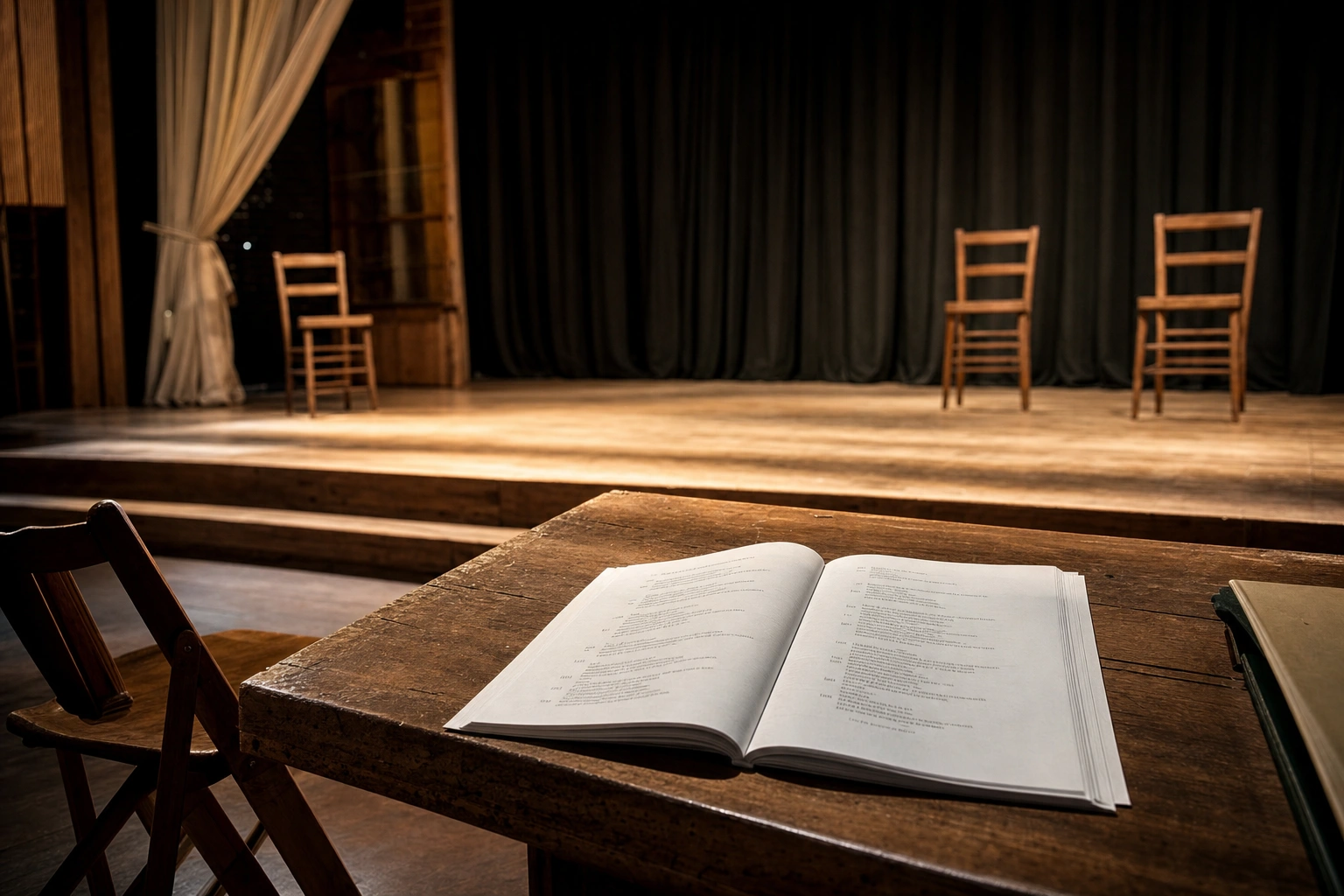
Drama is one of the major forms of English literature, alongside poetry and prose fiction. It tells stories through characters who speak and act, usually before an audience. Unlike a novel, which can directly describe a character’s private thoughts or explain events through a narrator, drama presents much of its meaning through dialogue, action, silence, movement, setting and performance.
To understand drama well, therefore, a reader must imagine both the written script and the production that could emerge from it. A play is a literary text, but it is also a blueprint for performance. The words on the page matter, while lighting, costume, gesture, sound, pace and the relationship between actors and audience can significantly shape interpretation.
What Is Drama?
Drama is a form of literature written primarily to be performed. The word refers both to a type of literary composition and to the art of presenting that composition on stage or in another performance space. A dramatic text normally includes spoken dialogue, stage directions, characters and a sequence of events.
The term drama comes from a Greek word associated with action or doing. This origin reflects an important distinction: drama does not merely tell us what happens; it shows characters doing, choosing, resisting, deceiving, suffering and changing. Even when a character delivers a long speech, the speech is usually part of an active situation involving other characters, an audience or an internal conflict.
Drama may be written in prose, verse or a mixture of both. Shakespeare’s plays, for example, frequently combine blank verse with prose. Modern plays may use everyday speech, fragmented dialogue, silence or non-linear scenes. What unites these varied forms is the presentation of human experience through performance and dramatic action.
Drama as Literature and Performance
A play has at least two connected dimensions. As literature, it can be studied through its language, imagery, structure, themes and characters. As performance, it depends on bodies, voices, space, timing and relationships with an audience.
These dimensions sometimes create different interpretations. A stage direction may suggest that a character speaks quietly, but a director and actor must decide exactly how that quietness appears. A pause may communicate fear, anger, uncertainty or an unwillingness to answer. A set may make a scene feel intimate, public, oppressive or unstable.
This is why reading a play differs from reading a novel. The script often leaves details open for interpretation. Readers must mentally supply the visual and vocal elements, while theatre practitioners make those choices publicly in performance. A strong literary analysis can acknowledge both possibilities by examining what the text requires, permits or makes difficult on stage.
Essential Elements of Drama
Plot and dramatic action
Plot is the organised sequence of events in a play. In drama, plot is closely connected to action: what characters want, what prevents them from achieving it and what they do in response. A plot does not need to be fast-moving. A play can create action through an argument, a revelation, a delayed decision or a character’s refusal to speak.
Many plays develop through conflict. Conflict may occur between individuals, such as two family members competing for power. It may exist within one character who must choose between duty and desire. It may also involve a person and a social institution, a community and its traditions, or human beings and forces such as poverty, war or fate.
Characters
Characters are the people, creatures or figures who participate in the action. Their words, choices and relationships reveal the play’s concerns. When analysing a character, avoid describing only personality traits. Ask what the character wants, what the character fears, what the character knows and how the character changes.
Some plays have a central protagonist whose decisions drive the action. Others distribute attention among several characters or deliberately make it difficult to identify a single hero. A character may also function as an antagonist, although the opposing force is not always an evil person. Social expectations, political authority, family pressure or a character’s own weaknesses may create opposition.
Dialogue
Dialogue is spoken interaction between characters. It can provide information, reveal emotion, establish relationships and advance the plot. However, characters do not always say exactly what they mean. A polite exchange may conceal hostility, while an apparently casual remark may expose a serious conflict.
Pay attention to patterns in speech. Does one character dominate conversations? Are replies direct or evasive? Do characters interrupt one another? Does the language change when a character speaks to a parent, employer, lover or stranger? These details can reveal power, intimacy, deception and social status.
Monologue and soliloquy
A monologue is a long speech delivered by one character. It may be addressed to other characters or to an audience. A soliloquy is a speech in which a character, traditionally alone on stage, expresses private thoughts aloud. Soliloquies are especially associated with Elizabethan and Jacobean drama, including Shakespearean tragedy.
Do not treat every long speech as a simple statement of truth. A speaker may be confused, self-deceiving, manipulative or deliberately performing for others. Analyse the circumstances of the speech, the language used and the difference between what the character claims and what the audience may recognise.
Stage directions
Stage directions are instructions supplied by the playwright about movement, tone, setting, entrances, exits, props or other performance details. Some are extensive and descriptive; others are brief. They can establish atmosphere, indicate a character’s physical condition or complicate the spoken dialogue.
For example, if a character says that everything is under control while repeatedly dropping objects or avoiding another character’s gaze, the physical action may challenge the words. When studying stage directions, ask what they make visible, what mood they create and how they guide an actor or director.
Setting
Setting includes the time, place and social environment of a play. A setting can be realistic, symbolic, historical, imaginary or constantly changing. It influences what characters can do and how audiences understand their choices.
A family home may represent security for one character and confinement for another. A courtroom, village meeting, school, workplace or public square can bring private conflicts into a social space. Setting may also expose inequalities involving class, gender, age, ethnicity, religion or political authority.
Dramatic Structure
Structure refers to the way a play arranges its scenes, acts, discoveries and turning points. Traditional five-act drama often moves from an introduction of the situation through rising conflict to a crisis, climax and resolution. Many plays use a three-act pattern, while others reject regular divisions altogether.
Key structural terms include:
- Exposition: information that establishes the characters, situation, setting and earlier events.
- Inciting incident: an event that begins or intensifies the central conflict.
- Rising action: complications that increase pressure and narrow the characters’ choices.
- Turning point: a moment after which the direction of the action changes.
- Climax: a high point of conflict or decision, although its exact position varies between plays.
- Resolution: the stage at which consequences become clearer; it may be complete, uncertain or disturbing.
Not all drama follows this pattern. Modern and contemporary playwrights may use fragmented scenes, repeated events, multiple narrators, flashbacks or an open ending. A broken structure can itself communicate confusion, trauma, memory or the instability of a society. Rather than forcing every play into a fixed model, identify the pattern the playwright has created and consider its effect.
Major Genres of Drama
Tragedy
Tragedy presents serious conflict and often leads to suffering, loss or death. The central character may possess a significant weakness, make a disastrous error or become trapped by circumstances beyond individual control. In Shakespearean tragedy, personal choices frequently interact with political conflict, family tension and moral uncertainty.
Tragedy does not simply mean that the ending is sad. It usually invites audiences to examine responsibility, justice, knowledge, power and the consequences of decisions. A tragic character may gain insight, but that understanding may arrive too late to prevent damage.
Comedy
Comedy often uses misunderstanding, disguise, wordplay, exaggeration and social inversion. It may end with reconciliation, marriage or the restoration of community, but comedy is not necessarily shallow or free from criticism. Humour can expose hypocrisy, challenge social authority and allow audiences to examine serious issues from a different angle.
When studying comedy, ask who is allowed to laugh, who becomes the object of laughter and whether the ending truly resolves the problems raised. A comic plot may restore order while still leaving important inequalities visible.
History and political drama
History plays dramatise events, leaders or conflicts associated with the past. They are not identical to history books because they select, compress and reshape events for theatrical purposes. Political drama, more broadly, examines authority, public responsibility, law, protest, oppression and the relationship between private lives and institutions.
Such plays should be analysed as interpretations rather than neutral records. Consider which voices are given importance, which experiences are omitted and how the dramatic form encourages an audience to judge leadership or resistance.
Romantic drama and tragicomedy
Romantic drama often focuses on love, desire, family expectation and social barriers. Tragicomedy combines serious danger with comic elements and may refuse to provide a completely happy or completely tragic ending. These mixed forms are useful because human experience rarely fits neatly into one emotional category.
Absurdist and experimental drama
Absurdist and experimental plays may use repetition, illogical conversations, minimal plots, unusual movement or a lack of conventional resolution. Their purpose is not always to tell a straightforward story. They may make audiences feel uncertainty, isolation or the difficulty of finding meaning.
When reading such drama, do not assume that apparent confusion is accidental. Examine recurring images, patterns of speech, silences, stage space and repeated actions. The audience’s discomfort may be part of the play’s method.
Language and Dramatic Meaning
Drama communicates through more than plot. A playwright may use metaphor, symbolism, irony, alliteration, dialect, rhythm or changes in register. A repeated object, phrase or image can gain new meaning as the action develops.
Irony is especially important. In dramatic irony, the audience knows something that one or more characters do not. This difference in knowledge can create suspense, humour or pity. A character may also speak ironically, saying one thing while intending another. Analyse the source of the irony and its effect on the audience rather than simply labelling a line as ironic.
Silence and interruption are also forms of communication. A pause may suggest thought, fear, resistance or emotional exhaustion. An interruption can show impatience or control. A character who receives no answer may be placed in a position of vulnerability. These features become especially significant when considering how a scene might be performed.
How to Analyse a Play Step by Step
- Read for the situation first. Identify who is present, where the scene occurs, what has happened before and what each character appears to want.
- Locate the conflict. State the disagreement or pressure as precisely as possible. Instead of writing that two characters argue, explain what they are arguing about and why it matters.
- Track changes. Compare the beginning and end of the scene. Has knowledge changed? Has a relationship shifted? Has a decision been made, delayed or made impossible?
- Study the language. Select short quotations and examine specific words, images, sentence patterns, repetition and tone. Avoid using quotations without explaining their effect.
- Consider performance. Imagine the actors’ movement, voice, pauses, positions and physical distance. Ask how different staging choices could alter the audience’s response.
- Connect the scene to the whole play. Explain how it develops a theme, foreshadows an event, reveals character or changes the direction of the plot.
- Form an interpretation. Support your view with evidence, but recognise complexity. A character can be both responsible for harm and shaped by unjust circumstances.
Understanding Drama Through an Example
Imagine a scene in which a small-business owner in Nairobi promises an employee that wages will be paid by the end of the week. The owner speaks confidently, while the employee asks increasingly direct questions. A mobile phone repeatedly rings, but the owner refuses to answer it. The scene contains conflict even before anyone openly argues.
The dialogue may reveal a difference in power: the owner controls information and payment, while the employee depends on a decision. The ringing phone may become a symbol of avoidance or an external pressure entering the workplace. A pause after the employee’s final question could suggest that the promise is no longer credible. If the owner exits without answering, the action may create a turning point rather than a resolution.
This example shows how analysis combines plot, character, dialogue, props, silence and performance. It also demonstrates that drama can address economic and social realities without relying on spectacular events. A brief conversation can expose trust, dependency and ethical responsibility.
Applying This in Practice
When preparing an essay, begin with a clear argument rather than a list of features. A useful claim might be: The playwright presents silence as a form of resistance, showing that the character’s refusal to answer challenges the authority of the other speaker. You can then select a stage direction, a pause, a change in dialogue and the scene’s outcome as evidence.
For a performance-based task, read the scene aloud with another learner. Try different choices: change the distance between characters, lengthen a pause, alter the volume or move one character away from the centre of the space. Discuss how each choice affects meaning. This exercise helps demonstrate that interpretation is shaped by both language and theatrical decisions.
For independent study, keep a drama journal with four columns: important event, revealing quotation, performance possibility and connection to a wider theme. This method prevents plot summary from taking over your analysis and encourages you to treat the play as both a written work and a potential performance.
Key Takeaways
- Drama is literature written for performance, so analyse words together with action, silence, movement and staging.
- Conflict is central to dramatic action; identify what characters want, what obstructs them and how their choices create consequences.
- Dialogue, monologues, soliloquies and stage directions reveal character and guide an audience’s response.
- Plot structure can follow traditional patterns, but fragmented or open forms may deliberately create uncertainty or challenge expectations.
- Genre affects the audience’s experience, yet tragedy, comedy, history and experimental drama can overlap.
- Strong play analysis uses precise textual evidence, considers performance choices and connects individual scenes to the whole work.
No comments yet.