
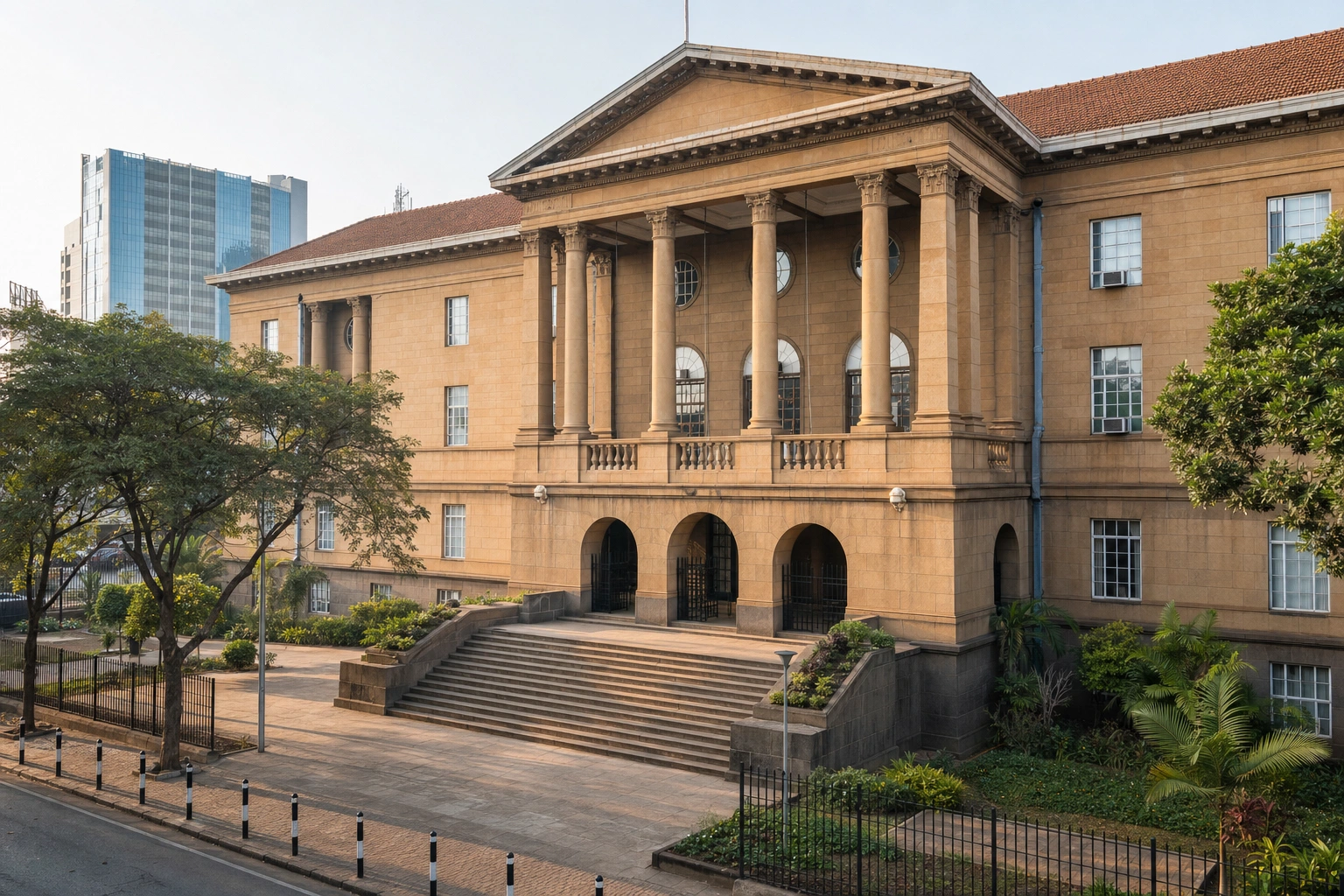
The High Court of Kenya is one of the most important courts in the country’s justice system. It deals with serious and complex disputes, protects constitutional rights, interprets the Constitution and supervises lower courts and certain bodies exercising judicial or quasi-judicial powers.
Understanding the High Court helps citizens, businesses, professionals and public institutions identify where a legal dispute belongs and what kind of remedy may be available. It also helps explain why some matters begin in the High Court, while others must first go through a magistrate’s court, a specialised court or a tribunal.
The constitutional position of the High Court
The High Court is established under Article 165 of the Constitution of Kenya, 2010. It is a superior court of record and has nationwide jurisdiction. A court of record keeps an official account of its proceedings and decisions, which can be important when a case is appealed or used in later legal reasoning.
The High Court is below the Court of Appeal and the Supreme Court in Kenya’s court hierarchy. It is, however, above subordinate courts such as magistrates’ courts and Kadhis’ courts. The High Court therefore has both original powers, where it hears a matter for the first time, and appellate or supervisory powers, where it reviews the work of another court or body.
What does “jurisdiction” mean?
Jurisdiction is a court’s legal authority to hear and determine a particular matter. It may depend on the subject of the dispute, the value or seriousness of a claim, the location of the parties or events, and the court that made the decision being challenged.
A court can have general authority but still lack jurisdiction over a specific dispute. For example, although the High Court has broad constitutional and civil jurisdiction, it does not hear matters reserved for the Supreme Court or matters assigned by the Constitution to specialised courts dealing with employment and labour relations or the environment and the use, occupation and title to land.
Jurisdiction is not a technical detail that can simply be ignored. If a court lacks jurisdiction, it may be unable to lawfully proceed with the case. Parties should therefore consider the correct forum before filing proceedings.
The original jurisdiction of the High Court
Original jurisdiction means the power to hear a case at first instance. The High Court has unlimited original jurisdiction in criminal and civil matters, subject to constitutional limits and the jurisdiction given to other courts.
Civil matters
The High Court may hear significant civil disputes, especially those involving complex legal questions, substantial public interest or remedies that a subordinate court cannot grant. Examples may include disputes involving constitutional interpretation, major commercial issues, public administration or applications for particular forms of judicial review.
Its unlimited civil jurisdiction does not mean that every civil claim should automatically be filed there. Magistrates’ courts have their own jurisdiction, including monetary limits set by law. Filing a routine dispute in the wrong court can cause delay, additional expense or the transfer or dismissal of proceedings.
Criminal matters
The High Court has jurisdiction to hear criminal cases involving offences under Kenyan law. In practice, many criminal cases begin in magistrates’ courts, while the High Court may handle serious offences and matters assigned to it by law. The High Court also hears appeals and applications arising from criminal proceedings in subordinate courts.
Criminal jurisdiction should be distinguished from criminal investigation. The police and other authorised investigative agencies investigate alleged offences, while prosecutors make decisions about presenting charges in court. The court independently assesses the evidence and applies the law.
Constitutional interpretation and enforcement of rights
One of the High Court’s most significant responsibilities is interpreting and applying the Constitution. It may determine whether a law or conduct is inconsistent with the Constitution, subject to the constitutional jurisdiction of the Supreme Court.
The High Court also has authority to determine whether a right or fundamental freedom in the Bill of Rights has been denied, violated, infringed or threatened. A person may therefore approach the court where, for example, a public decision is alleged to have unlawfully restricted a constitutional right.
Possible remedies depend on the facts and the law. They may include a declaration explaining the legal position, an order requiring a public body to perform a legal duty, an order stopping unlawful conduct, or another appropriate remedy. The court does not grant every remedy in every case. The applicant must establish the relevant facts, identify the legal violation and satisfy the procedural requirements that apply.
Constitutional litigation is not limited to disputes between private individuals. It often involves public authorities, legislation, administrative action or the conduct of institutions exercising public power. However, a constitutional claim should not be used merely to avoid ordinary procedures where an adequate legal remedy exists and no genuine constitutional issue arises.
Supervisory jurisdiction
The High Court supervises subordinate courts and any person, body or authority exercising a judicial or quasi-judicial function, except a superior court. A quasi-judicial body is an institution that is not formally a court but makes decisions after considering evidence, hearing parties or applying legal standards.
This supervisory power helps ensure that lower courts and relevant decision-making bodies act within the law. The High Court may call for the record of proceedings and make directions to ensure that justice is administered properly.
Supervision is not the same as taking over every decision. The High Court generally focuses on issues such as legality, procedural fairness, jurisdiction, failure to consider relevant matters or unreasonable exercise of power. It is not normally a fresh appeal on the merits unless the law provides an appellate route.
For example, if a licensing tribunal refuses to hear a person without giving a fair opportunity to respond, an affected party may consider judicial review or constitutional proceedings, depending on the circumstances. The court would examine whether the decision-making process complied with the law; it would not automatically replace the tribunal’s specialised decision with its own preferred outcome.
Appeals from subordinate courts and tribunals
The High Court hears appeals from subordinate courts in both civil and criminal matters where the law gives it appellate jurisdiction. An appeal asks a higher court to examine alleged errors in the decision, such as an incorrect interpretation of the law, an unsupported factual finding or an improper exercise of discretion.
An appeal is different from a new trial. The High Court reviews the record from the lower court and considers the grounds of appeal. In appropriate cases it may uphold the decision, vary it, set it aside, order a retrial or issue another lawful order.
Appeals are governed by rules on time limits, filing documents, security, preparation of records and service on the other party. A person considering an appeal should obtain the judgment or ruling, identify the precise errors being challenged and check the applicable deadline. A late appeal may require an application for extension of time, and extension is not automatic.
Some tribunals have their own statutory appeal procedures. The correct route depends on the law establishing the tribunal and the nature of the complaint. A party should distinguish between an appeal on the substance of a decision and judicial review of the legality or fairness of the decision-making process.
What matters does the High Court not hear?
The Constitution limits the High Court’s jurisdiction in important ways. It does not have jurisdiction in matters reserved for the exclusive jurisdiction of the Supreme Court. It also does not have jurisdiction over matters falling within the jurisdiction of the courts established under Article 162(2) of the Constitution.
These specialised courts include the Employment and Labour Relations Court and the Environment and Land Court. They deal with disputes within their respective constitutional and statutory mandates. For example, a dispute principally concerning an employment relationship may belong in the Employment and Labour Relations Court, while a dispute about ownership, use, occupation or title to land may fall within the Environment and Land Court.
The correct classification is not always obvious. A land dispute may also raise constitutional questions, and an employment dispute may involve alleged violations of rights. The nature of the dispute and the relief being sought must be examined carefully. Parties should avoid assuming that adding a constitutional reference automatically gives the High Court jurisdiction.
The High Court also does not hear appeals from the Court of Appeal or exercise supervisory authority over superior courts. The Court of Appeal has its own constitutional and statutory powers, while the Supreme Court is the highest court in Kenya.
The relationship between the High Court and other courts
Magistrates’ courts
Magistrates’ courts hear many ordinary civil and criminal cases at first instance. Their authority is defined by legislation, including limits relating to the type of case and, in civil claims, the amount in dispute. The High Court may hear appeals from these courts and may exercise supervisory jurisdiction over them.
Specialised superior courts
The Employment and Labour Relations Court and the Environment and Land Court are superior courts with status equivalent to the High Court in the areas assigned to them. “Equivalent status” does not mean that they are divisions of the High Court. They are separate courts with distinct subject-matter jurisdiction.
The Court of Appeal
The Court of Appeal hears appeals from the High Court and other courts or tribunals where the Constitution or legislation provides. A party dissatisfied with a High Court judgment must establish a lawful basis for appealing and comply with the applicable procedural rules.
The Supreme Court
The Supreme Court is Kenya’s highest court. It has specific original jurisdiction in presidential election disputes and hears certain appeals, including matters that meet the constitutional requirements for certification as involving a matter of general public importance. It may also give advisory opinions in circumstances provided by the Constitution.
High Court divisions and stations
The High Court operates through stations in different parts of Kenya and may organise its work into divisions or specialised administrative lists. Examples can include constitutional and human rights, commercial and tax, family, criminal, civil, judicial review or probation and aftercare work, depending on the court’s current administrative arrangements.
A division is generally an organisational arrangement for managing cases with particular characteristics. It does not create a separate constitutional court or remove the High Court’s overall jurisdiction. The correct filing location and division may depend on the subject of the case, where the events occurred, the parties involved and current court directions.
Technology has also changed how court users interact with proceedings. Electronic filing, virtual hearings and digital case-management services may be available in particular matters or stations. Availability and procedure can change, so litigants should rely on current directions from the Judiciary and the relevant registry.
How a matter may reach the High Court
- Starting a case: A person or organisation files the appropriate pleadings or application, pays the required court fee where applicable and serves the other parties according to the rules.
- Responding: The respondent may file a defence, replying affidavit, grounds of opposition or another permitted response. The document used depends on the type of proceeding.
- Pre-trial directions: The court may identify issues, give timelines, require documents, encourage alternative dispute resolution or make directions for a hearing.
- Hearing and evidence: The parties present their legal arguments and, where required, evidence. The court must apply fair hearing principles and the relevant rules of procedure.
- Decision: The judge gives a judgment or ruling explaining the orders made and the reasoning supporting them.
- After judgment: A party may comply, seek clarification or enforcement, apply for review where legally permitted, or pursue an appeal within the prescribed framework.
Not every High Court matter follows exactly this sequence. Judicial review, constitutional petitions, appeals and urgent applications have different procedures. The documents, deadlines and remedies depend on the type of case.
Applying This in Practice
Before choosing the High Court, ask four practical questions. First, what is the real subject of the dispute: a contract, a criminal charge, employment, land, constitutional rights or an administrative decision? Secondly, which court has jurisdiction over that subject? Thirdly, is the intended proceeding an original case, an appeal, a review or a request for supervision? Fourthly, what deadline or preliminary step applies?
Consider a small business in Kisumu challenging a county licensing decision. The business would need to identify the legal power under which the decision was made, examine whether the decision-maker followed a fair process and determine whether an appeal mechanism exists. If the complaint concerns unlawful administrative action, judicial review or a constitutional claim may be relevant. If the law provides a specialised appeal route, that route may need to be considered first.
In a land ownership dispute, the parties should investigate the jurisdiction of the Environment and Land Court rather than assuming that the High Court’s broad constitutional role makes it the correct forum. In an employment dispute, the Employment and Labour Relations Court may be the appropriate court. In each example, legal classification comes before drafting documents.
Individuals and organisations should keep contracts, notices, decisions, correspondence, receipts and previous court documents in an orderly file. They should also record important dates. Because procedure can determine whether a case is heard, professional legal advice is particularly valuable where jurisdiction, limitation periods, appeal deadlines or constitutional remedies are involved.
Key Takeaways
- The High Court is a superior court of record with nationwide jurisdiction under Article 165 of the Constitution.
- It hears original civil and criminal matters, constitutional cases, appeals and applications for supervision or judicial review within its legal mandate.
- The High Court protects constitutional rights and reviews whether public decision-makers have acted lawfully and fairly.
- It does not hear matters reserved for the Supreme Court or for specialised courts dealing with employment and labour, or environment and land disputes.
- An appeal is different from judicial review: an appeal examines an alleged error in the decision, while judicial review mainly examines the legality and fairness of the decision-making process.
- Before filing, identify the dispute’s subject, the correct court, the type of proceeding and all applicable deadlines.
No comments yet.