
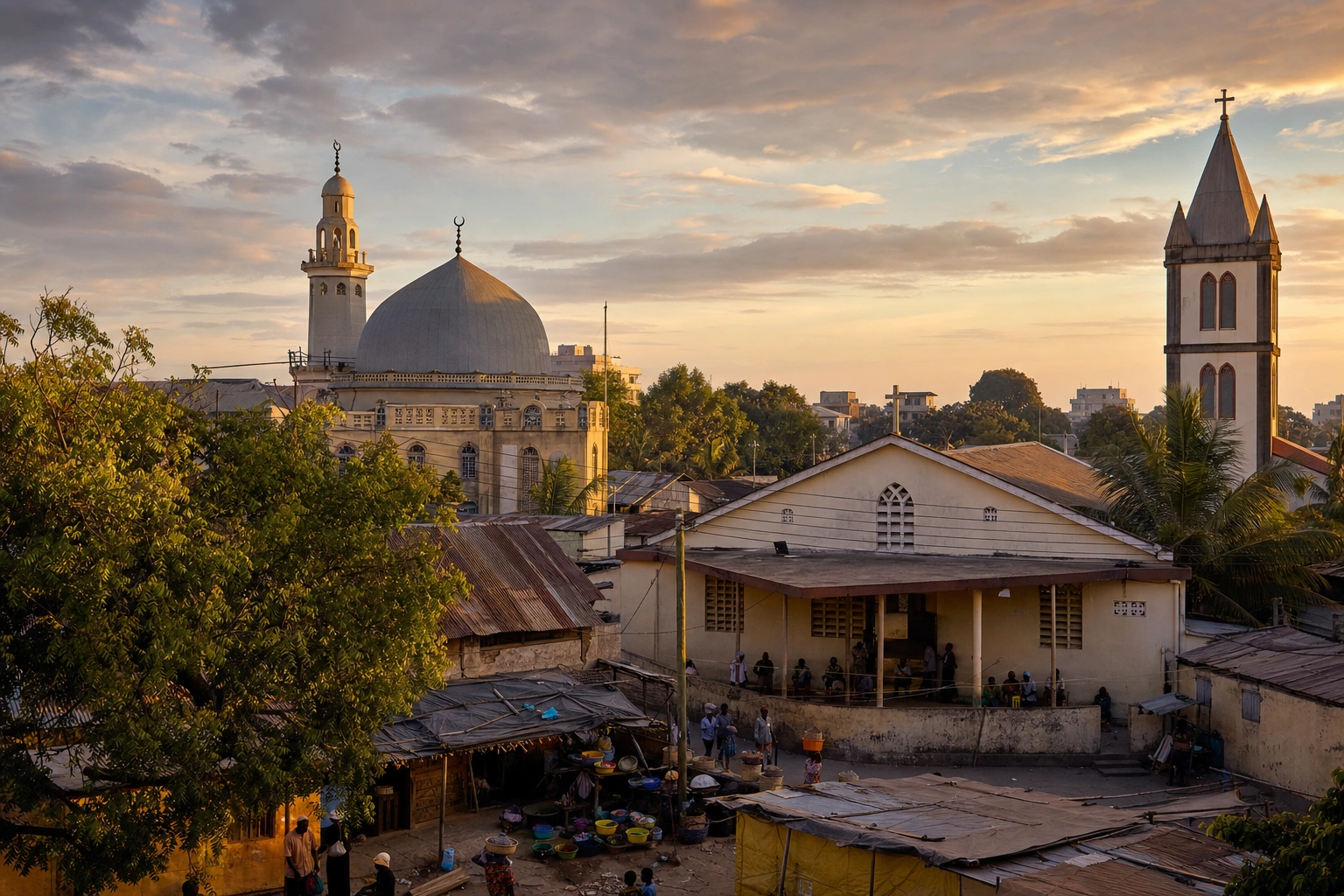
Africa is not religiously uniform. Across the continent, people practise Christianity, Islam, Indigenous African religions, Judaism, Hinduism, Sikhism, the Bahá’í Faith and other traditions, while some identify as non-religious. In many communities, religion influences family life, moral reasoning, festivals, education, politics, healing, art and relationships with ancestors and the natural world.
Religious diversity in Africa is best understood as both historical and lived. It reflects ancient civilisations, migration, trade, scholarship, colonial encounters and modern global connections. It also appears in everyday choices: how a family marks birth or marriage, how a community responds to illness, how a business observes religious commitments, or how neighbours share public spaces despite different beliefs.
What Religious Diversity Means
Religious diversity refers to the presence of different religions, denominations, schools of thought and spiritual practices within a society or region. It includes differences between major traditions, such as Christianity and Islam, but also differences within each tradition.
For example, Christianity in Africa includes Roman Catholic, Anglican, Orthodox, Pentecostal, Evangelical and African Initiated Churches, among many others. Islam includes Sunni, Shia and Sufi communities, as well as different legal, theological and cultural traditions. Indigenous African religions are also highly varied rather than belonging to one continent-wide system.
It is useful to distinguish four related ideas:
- Religious affiliation: the tradition or community with which a person identifies.
- Religious belief: ideas about God, gods, spirits, humanity, morality and the purpose of life.
- Religious practice: activities such as prayer, fasting, sacrifice, pilgrimage, worship, meditation or participation in festivals.
- Religious identity: the way religion connects with family, ethnicity, nationality, language, history and public belonging.
These elements do not always match perfectly. A person may identify with a formal religious tradition but practise selectively. Another person may attend a church or mosque while also respecting family customs associated with an Indigenous tradition. Such situations should be studied carefully rather than immediately labelled as contradiction or inconsistency.
Indigenous African Religious Traditions
Before and alongside the expansion of global religions, African societies developed diverse religious traditions. These traditions were usually transmitted through families, communities, oral teaching, ceremonies, stories, music, symbols and relationships with particular places. They were not always organised around a single sacred book or central institution.
Many Indigenous traditions recognise a supreme creator or high God, although ideas differ considerably between communities. They may also include relationships with ancestors, spirits, sacred powers and the natural environment. Ancestors are often understood not simply as objects of worship but as members of the moral and social community who remain connected to the living. The exact meaning of ancestor veneration varies, so it should not be reduced to one universal explanation.
Religious life may be connected to initiation, naming, marriage, burial, healing, agricultural cycles and community leadership. A ceremony can therefore have spiritual, social and educational functions at the same time. It may teach responsibilities, establish relationships or mark a person's transition into a new stage of life.
The phrase African traditional religion can be useful for comparison, but it can also hide important differences. Yoruba religious traditions in West Africa, Akan traditions in Ghana and Côte d’Ivoire, Dinka traditions in South Sudan, Maasai traditions in East Africa and many other systems have their own concepts, histories and practices. They should not be treated as one standard religion.
The Historical Presence of Christianity
Christianity has deep roots in Africa. Christian communities existed in North Africa during the early centuries of the Christian era, and Christianity became closely associated with the ancient kingdoms of Egypt and Ethiopia. The Ethiopian Orthodox Tewahedo Church and the Coptic Orthodox Church in Egypt are important examples of historic African Christian traditions.
Christianity later expanded in many other parts of the continent through missions, schools, trade networks, local evangelists and colonial-era institutions. The history was complex. Mission education and healthcare sometimes created opportunities that communities valued, while missionary activity could also challenge Indigenous institutions and become connected with colonial power. A balanced study recognises both the influence of Christianity and the agency of African converts, theologians and communities.
Today, African Christianity is internally diverse. Catholic and Anglican communities coexist with Orthodox churches, evangelical congregations, Pentecostal ministries and African Initiated Churches. African Initiated Churches developed under African leadership and often express Christian theology through local languages, music, symbols, forms of prayer and community organisation.
Pentecostal and charismatic Christianity has become particularly visible in many African cities and towns. It commonly emphasises the activity of the Holy Spirit, prayer, healing, spiritual gifts, conversion and personal transformation. However, Pentecostal churches are not identical. Their teachings, leadership structures, worship styles and views on social questions differ widely.
The Historical Presence of Islam
Islam has also been part of African history for many centuries. Its early expansion reached North Africa, while Muslim traders, scholars, rulers and communities contributed to the development of societies across the Sahara, the Sahel, the Horn of Africa and the East African coast. Islamic learning was connected to commercial networks, scholarship, law, literacy and political authority in different periods.
The spread of Islam was not a single event or process. In some places, rulers adopted Islam before large sections of the population. In others, merchants, teachers, Sufi communities or local leaders played important roles. Conversion could take place gradually, and Islamic practice often developed in interaction with existing cultural customs.
Muslim communities in Africa are diverse in language, ethnicity, history and interpretation. Sunni Islam is widespread, but there are also Shia communities and different Sufi traditions. Muslims may differ in views about religious education, dress, gender roles, law, politics and the relationship between religious and secular institutions.
The Swahili coast provides a useful example of historical interaction. Towns such as Mombasa, Lamu and Zanzibar became connected to Indian Ocean trade and Islamic scholarship. Coastal Muslim culture developed through local African histories as well as links with Arabia, Persia, India and other regions. This does not make coastal Islam less African; it shows how religious traditions develop through movement and exchange.
Other Religious Communities
Although Christianity, Islam and Indigenous traditions are numerically and historically prominent in many parts of Africa, they do not represent every African religious experience. Jewish communities have long histories in North Africa and Ethiopia, and Jewish life continues in several African countries. Hindu, Sikh and Jain communities are especially associated with migration and commercial histories in parts of eastern and southern Africa, although their presence and size vary by country.
The Bahá’í Faith has communities in several African countries, while Buddhist and other religious communities may be found in urban areas through migration and international connections. Some people identify as agnostic, atheist or non-religious. Others may not use a formal religious label but still observe family rituals, ethical traditions or cultural ceremonies.
These smaller or less visible communities matter when studying religious diversity. A national picture based only on the largest religions can overlook the experiences of minorities and the importance of freedom of conscience.
Regional Patterns and Local Variation
Religious patterns differ between and within African regions. North Africa has a strong Islamic majority in many countries, alongside historical Christian, Jewish and Indigenous influences. West Africa includes large Muslim and Christian populations, as well as Indigenous traditions and communities that practise more than one religious identity across family or cultural settings.
East Africa includes Muslim communities along the coast and in parts of the interior, historic Christian traditions in Ethiopia and Eritrea, large Christian populations in countries such as Kenya and Uganda, and many Indigenous religious heritages. Southern Africa contains diverse Christian traditions, African Initiated Churches, Indigenous practices, Muslim and Hindu communities, Jewish communities and non-religious people.
Regional descriptions are useful starting points, not complete explanations. A country can contain major differences between its capital city, rural areas, coastal communities, borderlands and regions associated with particular ethnic or linguistic groups. Even within one town, schools, workplaces, markets and neighbourhoods may bring several religious communities into regular contact.
Religious Mixing and Lived Religion
In academic study, terms such as syncretism, religious blending or lived religion may describe how people experience and practise faith in everyday settings. For instance, Christian or Muslim communities may retain cultural forms of music, family authority, naming customs or approaches to communal responsibility that predate conversion or developed alongside formal religious teaching.
However, it is important not to assume that every African religious person combines traditions in the same way. Some Christians or Muslims strongly reject Indigenous practices they consider incompatible with their faith. Others interpret family customs as cultural rather than religious. Some people participate in ceremonies mainly because they value family relationships, while others understand the same ceremony as explicitly spiritual.
The best approach is to ask how practitioners themselves explain their beliefs and actions. External observers should avoid describing African religious life as confused, primitive or automatically mixed. Religious change can involve debate, resistance, reinterpretation and deliberate choice.
Religion in Public and Social Life
Religious diversity affects public life in several ways. Religious organisations often provide education, healthcare, charity, counselling, youth activities and support during crises. Mosques, churches, temples, synagogues and community associations may function as places of worship and as important social institutions.
At the same time, diversity can create difficult questions. Schools and workplaces may need to consider prayer times, religious holidays, dietary requirements, clothing, burial practices and the use of shared facilities. Families may negotiate marriage across religious boundaries. Public officials and business leaders may need to serve people whose beliefs differ from their own.
Respecting diversity does not require agreeing with every religious belief. It requires distinguishing between a person’s dignity and the truth claims of a tradition. A respectful society protects people from discrimination and allows informed discussion, while also recognising that religious freedom includes the right to practise, change, interpret or decline a religion within the law.
How to Compare Religions Responsibly
Comparative religion is not a competition to decide which tradition is “most African” or “most advanced”. Its purpose is to understand similarities, differences, histories and meanings accurately.
- Define the unit of comparison. Decide whether you are comparing beliefs, rituals, institutions, historical periods or lived experiences.
- Use precise names. Distinguish between a broad religion and its denominations, schools or local expressions.
- Study sources and practitioners. Sacred texts, oral histories, community leaders, academic research and personal accounts can each reveal different dimensions.
- Separate description from judgement. First explain what a practice means within its tradition before evaluating it from another viewpoint.
- Notice internal diversity. Avoid statements such as “Christians believe” or “Africans practise” when a more specific description is possible.
- Consider historical power. Ask how trade, migration, colonialism, education, state policy and urbanisation shaped religious change.
Applying This in Practice
When encountering religious diversity at work, in education or in community life, begin with curiosity rather than assumptions. If a colleague requests time for worship or observes a fast, ask respectfully about practical arrangements instead of guessing what every member of that religion requires.
When studying a country such as Kenya, map several layers: major religious communities, Indigenous traditions, regional differences, urban and rural experiences, and the distinction between official affiliation and everyday practice. A discussion of Christianity should include denominational diversity; a discussion of Islam should recognise different communities; and a discussion of Indigenous traditions should identify particular peoples and practices rather than treating them as a single system.
For entrepreneurs and professionals, this understanding has practical value. Inclusive services should not assume one religious calendar, one dietary preference or one model of family life. Clear policies, respectful questions and flexible communication can prevent avoidable misunderstanding. For learners, the most useful habit is to replace broad labels with careful questions: Who practises this tradition? In which place? During which period? What does the practice mean to the people involved?
Key Takeaways
- Africa contains many religions and spiritual traditions, and each major tradition includes significant internal diversity.
- Indigenous African religions are varied systems connected to community, ancestors, moral life, ceremonies and the natural world.
- Christianity and Islam have deep African histories shaped by local communities, trade, scholarship, migration and political change.
- Religious identity may overlap with culture, ethnicity, language and family life, but these categories should not be treated as identical.
- Everyday religious practice can involve adaptation or interaction, yet individuals and communities explain these relationships differently.
- Responsible comparison uses precise language, listens to practitioners and separates description from judgement.
No comments yet.