
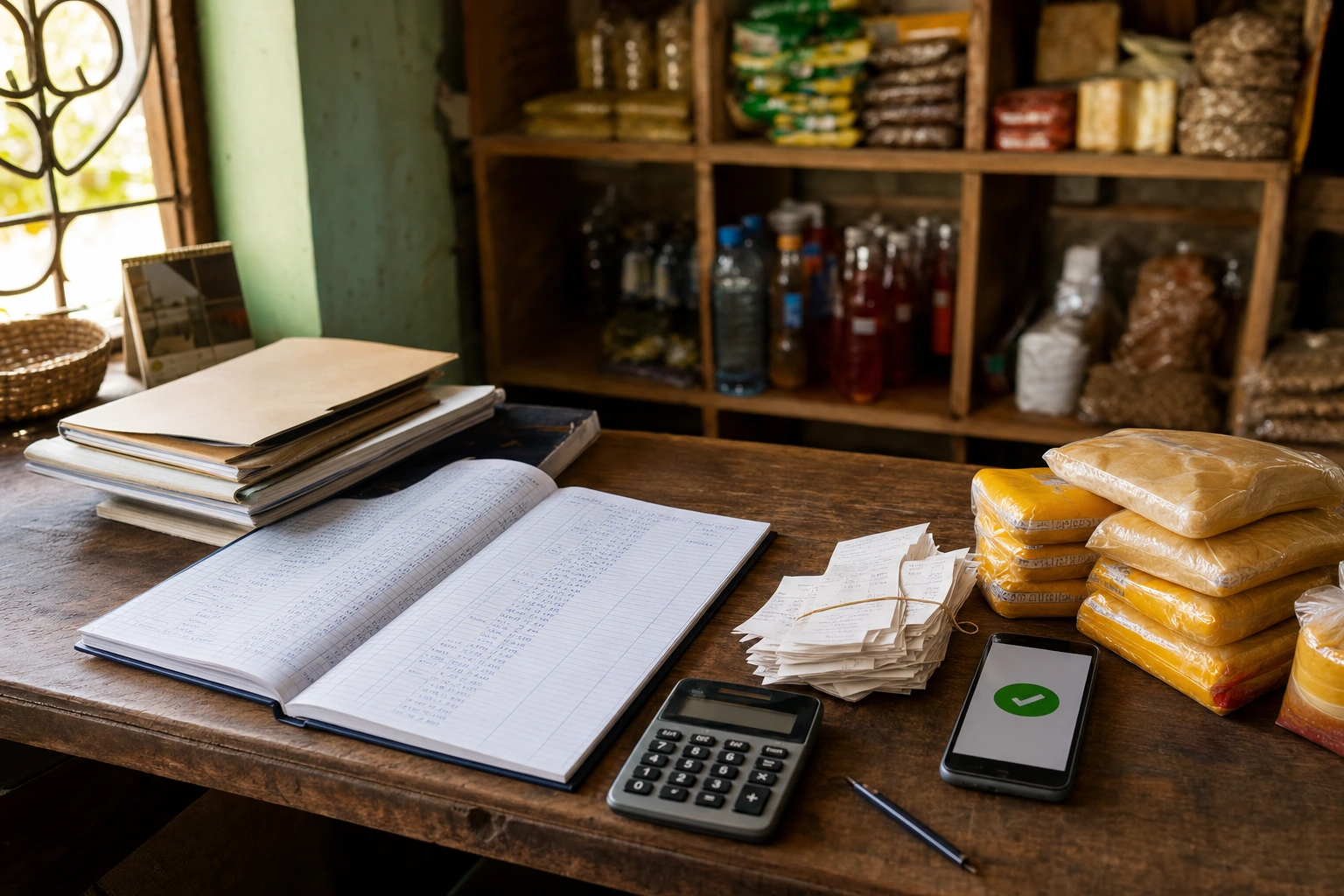
Record keeping is one of the most important management disciplines in a small business. It involves collecting, organising, checking and storing information about sales, purchases, money received, money paid, assets, employees, customers and suppliers. These records are not merely paperwork; they provide the evidence a business owner needs to understand what is happening and decide what to do next.
A business can appear busy and still struggle financially. Sales may be increasing while expenses, unpaid customer invoices or stock losses grow even faster. Reliable records make these patterns visible. Whether you run a kiosk in Kisumu, a consultancy in Nairobi, an online shop in Accra or a small manufacturing business elsewhere, a consistent record-keeping system can improve control and reduce avoidable surprises.
Why Record Keeping Matters
The first purpose of record keeping is to show the financial position of the business. Proper records help you identify how much money came in, how much went out, what customers owe you and what you owe suppliers. They also help distinguish profit from cash. A business may make a sale on credit and record income, but it will not have the cash until the customer pays.
Records also support day-to-day decisions. For example, sales records can show which products move quickly, expense records can reveal rising delivery costs, and customer payment records can identify accounts that regularly pay late. Without this information, owners often rely on memory or the amount currently visible in a bank or mobile money account.
There are several practical benefits:
- Better planning: past income and expenses provide a basis for budgets and cash-flow forecasts.
- Improved control: regular checking can reveal errors, duplicate payments, missing stock or unauthorised transactions.
- Stronger customer and supplier relationships: invoices, receipts and payment histories help resolve disagreements professionally.
- Access to finance: lenders and investors commonly need evidence of sales, expenses, assets and repayment capacity.
- Tax and regulatory readiness: organised records make it easier to prepare accurate returns and respond to legitimate information requests.
- Business continuity: another person can understand the business if the owner is unavailable.
What Records Should a Small Business Keep?
The right records depend on the nature and size of the business, but most small businesses need a core set of financial and operational documents. Keeping everything without a system can become confusing, so focus on records that support transactions, decisions and accountability.
Sales and income records
Record every sale, including the date, description of the goods or service, quantity, price, customer details where relevant, payment method and whether the sale was paid immediately or on credit. Keep copies of invoices, receipts, delivery notes and online order confirmations.
A small catering business, for instance, might record the client, event date, menu, deposit received, balance due and final payment. This is more useful than recording only the total amount deposited into a bank account because it connects the money to a specific customer and service.
Purchases and expense records
Keep supplier invoices, till slips, receipts, transport documents, utility bills, rent records, payroll documents and other evidence of business spending. Each expense should be described clearly. A note such as “cash used” is not enough; “purchase of packaging materials from supplier” is more useful for review.
Separate business expenses from personal spending as far as possible. If the owner uses personal funds for the business, record it as money introduced by the owner or as a business expense supported by evidence, depending on the circumstances and accounting treatment. Mixing the two makes it difficult to measure the real cost of operating.
Cash, bank and mobile money records
Maintain a cashbook showing money received, money paid and the balance remaining. If the business uses bank accounts or mobile money services, retain statements and record transfers, fees and withdrawals. A transaction appearing on a statement is not automatically clear; it should be matched to a sale, expense, transfer or owner transaction.
Do not treat every movement of money as income or an expense. A transfer from the business bank account to its mobile money account is usually a movement between business accounts, not new revenue. Similarly, money borrowed by the business is not sales income, although it creates a liability that must be tracked.
Stock and asset records
Businesses selling physical goods should keep records of stock purchased, stock sold, damaged items, returns and stock remaining. A simple stock sheet can include the item name, opening quantity, additions, sales or issues, losses and closing quantity.
Also record significant assets such as equipment, furniture, vehicles and computers. Include the purchase date, cost, location, person responsible and condition. These records help with maintenance, insurance, budgeting and the investigation of missing or damaged property.
Debtors and creditors
A debtor is a customer who owes the business money. A creditor is a supplier or other party to whom the business owes money. Maintain a separate list for each, showing the transaction date, amount, due date, payments made and balance outstanding.
This information supports timely follow-up. Instead of asking a customer vaguely about an unpaid bill, you can refer to the invoice date, amount and agreed payment date. Similarly, a supplier record helps you avoid duplicate payments and plan which obligations must be settled first.
Employee and operational records
Depending on the business, useful records may include employment agreements, attendance, leave, payroll, training, work schedules, customer complaints, delivery logs and maintenance checks. Access to sensitive employee and customer information should be limited to people who need it for legitimate work.
Choosing a Record-Keeping Method
A record-keeping method should be simple enough to use consistently and strong enough to support decisions. The best system is not necessarily the most expensive software. It is the one that captures complete information, reduces errors and can be maintained when the business is busy.
Paper records
Paper notebooks, receipt books and labelled files can work for a very small operation with few transactions. Use numbered receipts, write clearly and store documents in date order. Paper systems become risky when pages are lost, calculations are inconsistent or several people need access at the same time.
Spreadsheets
A spreadsheet is useful for a cashbook, sales analysis, expense list, stock register and debtor schedule. Use one workbook with clearly named sheets, consistent date formats and protected formula cells. Avoid changing past figures without leaving a note explaining the correction. Save regular copies in a secure location.
Accounting software
Accounting software can automate invoices, reports, bank matching, expense categories and reminders. Before choosing a product, consider the number of transactions, the availability of internet access, mobile use, user permissions, data export, backup arrangements and the ability to produce reports relevant to the business.
Technology does not remove the need for judgement. A system may record a transaction accurately as entered, but it cannot know whether a purchase was personal, whether a customer payment was allocated to the correct invoice or whether an unusual transaction should be investigated.
How to Build a Simple Record-Keeping System
- List the transactions you handle. Identify your income sources, common expenses, payment channels, stock movements, credit sales, loans and owner withdrawals.
- Choose clear categories. Group similar items, such as sales, transport, rent, utilities, wages, advertising, supplies and bank or mobile money charges. Categories should be detailed enough to guide decisions but not so numerous that staff use them inconsistently.
- Set a recording routine. Record transactions as they happen or at a fixed time each day. Delaying entries for weeks increases the chance of forgotten sales, misplaced receipts and inaccurate balances.
- Collect supporting evidence. Attach or link invoices, receipts, delivery notes and payment confirmations to the relevant transaction. For paper documents, use folders by month or transaction type. For digital files, use consistent names such as date, supplier and amount.
- Assign responsibility. Decide who records sales, approves purchases, deposits cash and reviews reports. In a very small business one person may perform several tasks, but the owner should still review the records regularly.
- Reconcile regularly. Compare the cashbook with physical cash, bank statements and mobile money statements. Investigate differences rather than simply changing the balance to make it agree.
- Review reports. At least monthly, examine sales, expenses, gross margin where relevant, unpaid invoices, supplier balances, stock and available cash. Use the results to decide what needs attention.
- Back up and protect the information. Keep copies in a separate secure location. Use strong passwords, limit access and avoid sending sensitive files through unsecured channels unnecessarily.
Understanding Common Financial Reports
Good records become valuable when they are converted into useful information. A profit and loss report compares income with expenses over a stated period. It helps answer whether the business generated a surplus or loss, but it does not show exactly how much cash is available.
A cash-flow report tracks cash entering and leaving the business. It can show why a profitable business is short of money, perhaps because customers have not paid, stock purchases were large or loan repayments are due. A cash-flow forecast looks ahead and estimates expected receipts and payments.
A statement of financial position, sometimes called a balance sheet, presents assets, liabilities and the owner's equity at a particular date. It helps show what the business owns, what it owes and the net value remaining after liabilities.
Reports are only as reliable as the records behind them. If sales are omitted, personal transactions are mixed with business transactions or stock is not counted, the reports can give a misleading picture.
Controls That Prevent Errors and Fraud
Small businesses can introduce basic controls without creating unnecessary bureaucracy. Number receipts sequentially and investigate missing numbers. Require evidence before reimbursing expenses. Count cash at the end of a shift and record who completed the count. Deposit business cash promptly where practical, and review unusual discounts, refunds and stock adjustments.
Where more than one person works in the business, separate duties when possible. The person who receives cash should not be the only person who checks the records and approves corrections. If staffing makes separation impossible, the owner can perform an independent weekly review.
Use reconciliations as a detective control. If the recorded mobile money balance differs from the provider statement, check transaction dates, fees, reversals, transfers and failed payments. A difference is not proof of wrongdoing, but ignoring it allows small errors to become larger problems.
Privacy, Storage and Retention
Business records may contain names, contact details, identification information, salaries, account details and commercially sensitive prices. Store them securely, restrict access and dispose of unnecessary copies safely. Digital devices should be protected with passwords and updated security software, while paper files should be kept away from moisture, theft and unauthorised access.
Retention requirements vary according to the country, industry, tax rules and type of document. Check the requirements that apply to your business and keep records for at least the required period. Do not destroy records simply because a filing deadline has passed if they relate to an unresolved dispute, audit, loan or legal matter.
Applying This in Practice
Imagine a small clothing retailer that receives payments through cash, bank transfer and mobile money. At the start of each day, the owner records opening cash. During the day, each sale receives a receipt and is marked with its payment method. Supplier purchases are entered into the expense and stock records, and credit sales are added to the customer balance list.
At closing, the owner counts cash, checks the payment confirmations and compares the totals with the sales record. Each week, bank and mobile money statements are reconciled. At month-end, the owner reviews total sales, product margins, unpaid customer balances, stock levels and major expenses. If transport costs have risen sharply or a popular item is frequently out of stock, the records provide a basis for action.
Start with the smallest workable system. Create a daily sales record, an expense file, a cashbook, a list of amounts owed and a monthly review routine. Improve the system as the business grows. Consistency is more valuable than a complicated process that nobody follows.
Key Takeaways
- Record sales, expenses, cash movements, stock, assets, debtors and creditors in a consistent way.
- Keep supporting evidence such as invoices, receipts, delivery notes and payment confirmations.
- Separate business and personal transactions so that performance and cash needs can be measured accurately.
- Reconcile cash, bank and mobile money records regularly, and investigate differences.
- Use monthly reports to review profit, cash flow, unpaid balances, stock and major expenses.
- Protect records with controlled access, secure storage and reliable backups.
No comments yet.