
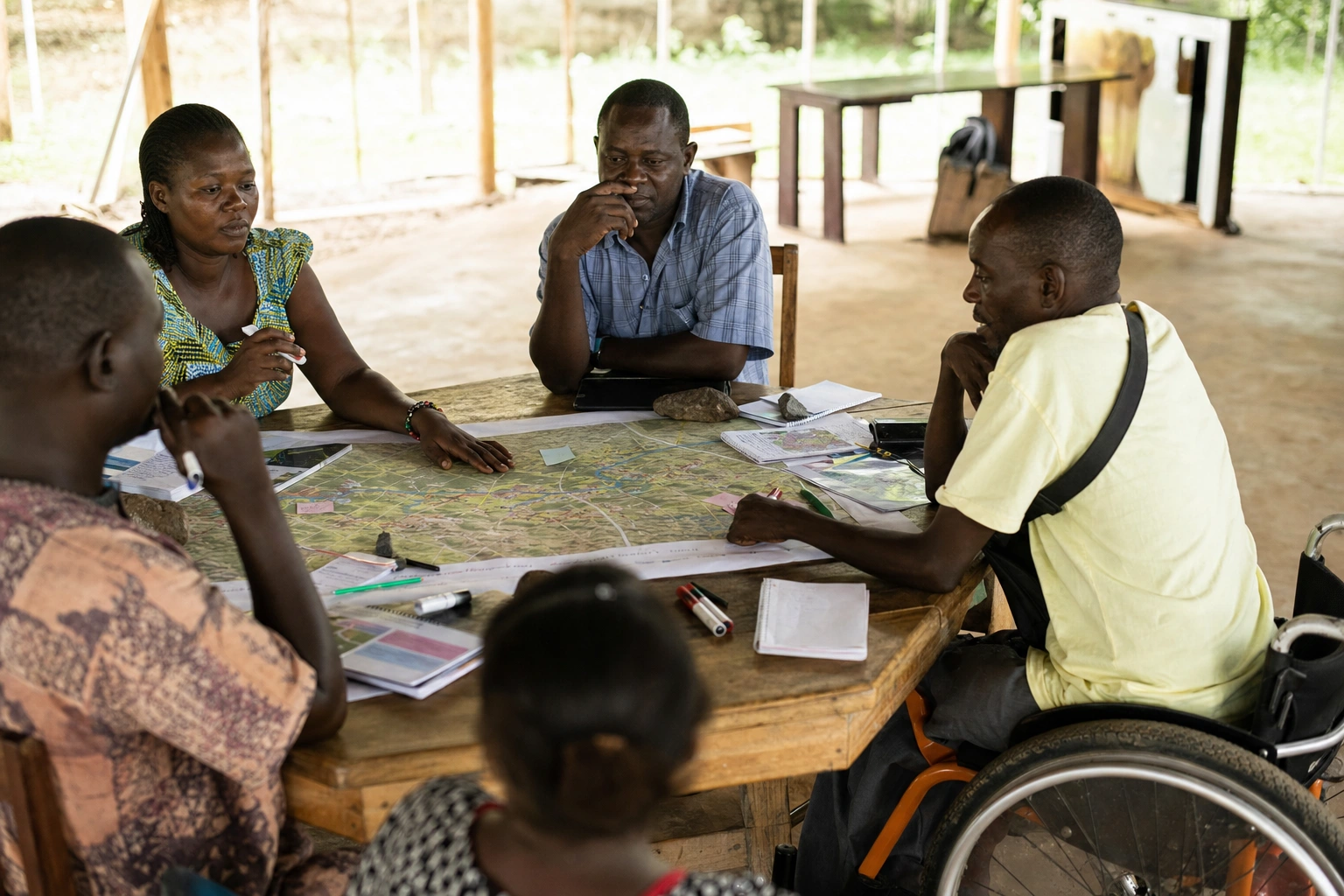
Good governance is not only about whether an institution has rules, offices and procedures. It is also about how decisions are made, who gets heard, whose interests are considered and whether leaders can be held responsible for the results. Participation and inclusion are therefore central to building institutions that people can trust.
In a community, county, organisation or national government, inclusive governance means creating fair opportunities for people to contribute to public decisions. It does not mean that everyone will agree, or that every suggestion will be adopted. It means that affected people can access relevant information, express their views safely, understand how decisions are reached and challenge decisions through appropriate channels.
What Participation Means in Governance
Participation is the involvement of people in decisions, planning, implementation and evaluation. It can take many forms, from attending a public meeting to helping design a service, monitoring a project or serving as an elected representative.
Participation has different levels. At the simplest level, people may receive information about a decision. A stronger form allows them to give feedback before a decision is made. More meaningful participation involves dialogue, negotiation and shared responsibility. In some situations, communities may help set priorities, allocate resources or monitor whether promises have been fulfilled.
The quality of participation matters more than the number of meetings held. A gathering where people are invited but cannot ask questions, access documents or influence outcomes may create the appearance of consultation without providing genuine public involvement.
Information, consultation and collaboration
- Information: People are told what is being planned, why it matters and how it may affect them.
- Consultation: People are invited to share opinions, concerns, evidence or alternatives before a decision is finalised.
- Collaboration: Officials, organisations and communities work together to define problems, develop options and review results.
- Shared decision-making: Authority and responsibility are distributed more directly among the people and institutions involved.
Each form can be appropriate in different circumstances. Emergency action may require rapid information and limited consultation, while long-term development planning usually benefits from deeper collaboration. The important question is whether the chosen approach is proportionate to the decision and honest about how much influence participants actually have.
What Inclusive Governance Adds
Participation is not automatically inclusive. A meeting may be open to everyone but still be dominated by people with more time, money, education, confidence or political connections. Inclusive governance deliberately identifies and reduces barriers that prevent some groups from taking part.
These groups may include women, young people, older people, persons with disabilities, people living in remote areas, low-income households, minority communities, migrants, informal workers and people who speak less widely used languages. Inclusion also requires attention to people whose views are easily overlooked within families, workplaces or local associations.
Inclusion has at least three dimensions. First, people must have a genuine opportunity to be present or represented. Secondly, they must be able to participate safely and meaningfully. Thirdly, their contributions must be considered rather than dismissed because of identity, poverty, disability, location or social status.
Representation is not the same as inclusion
A person from a particular group does not automatically speak for every member of that group. For example, one young representative may not understand the experiences of young people in informal employment, rural areas and higher education in the same way. Similarly, one woman leader cannot be expected to represent all women across different ages, occupations and communities.
Good governance combines representation with wider listening. Leaders and institutions should create several ways for people to contribute, while being clear about the limits of individual representatives. This reduces the risk of treating a small committee as though it reflects the entire population.
Why Participation and Inclusion Matter
Better decisions
People who use a service or live with the consequences of a policy often possess practical knowledge that officials and technical experts may not have. Residents can identify unsafe routes, unsuitable service hours, hidden costs, language barriers or maintenance problems that may not appear in formal reports.
For example, if a local authority is planning a market improvement project, traders can explain how construction would affect deliveries, storage, customer access and informal selling spaces. Their knowledge can help planners avoid a design that looks efficient on paper but disrupts livelihoods in practice.
Fairer distribution of resources
Public resources are limited, so choices must be made. Inclusive processes help decision-makers understand which needs are urgent, which areas are underserved and how proposed investments may affect different groups. Participation does not guarantee equal outcomes, but it makes distributional choices more visible and open to challenge.
Greater legitimacy and trust
People are more likely to accept difficult decisions when the process is transparent and respectful, even when the final outcome is not their preferred option. Trust is strengthened when institutions explain what they heard, what they changed and why some proposals could not be adopted.
Accountability and reduced abuse of power
Participation creates opportunities for people to question leaders, examine plans and monitor implementation. When information is available and communities can raise concerns without intimidation, it becomes more difficult for poor performance or misuse of authority to remain hidden.
Social cohesion
Inclusive forums can help groups with different interests understand one another. They do not remove disagreement, but they provide peaceful ways to negotiate competing priorities. This is particularly important where decisions involve land use, public facilities, environmental protection, local businesses or access to shared resources.
Principles of Meaningful Participation
Several practical principles distinguish meaningful participation from a symbolic exercise.
- Accessibility: Meetings, documents and feedback channels should be reachable and understandable. Consider location, timing, transport, disability access, childcare responsibilities, language and digital connectivity.
- Early involvement: Invite participation while alternatives are still open. Asking for views after a decision has effectively been made weakens public influence.
- Clarity: Explain the purpose of the process, the decisions within scope, the decision-maker and the timetable. Participants should know whether they are advising, negotiating, approving or monitoring.
- Safety and respect: People should be able to disagree without threats, humiliation or discrimination. Moderators need to prevent intimidation and ensure that less powerful participants can speak.
- Evidence and openness: Share relevant information in plain language, including constraints, costs, risks and competing options. Selective information prevents informed participation.
- Responsiveness: Record contributions and explain how they influenced the outcome. If a proposal is rejected, provide a clear reason rather than ignoring it.
- Representation: Check who is absent, not only who is present. Use targeted outreach where ordinary invitations repeatedly fail to reach particular groups.
- Continuity: Participation should not end when a plan is approved. Communities need ways to track implementation, report problems and review results.
Common Forms of Inclusive Governance
Different issues require different participation methods. A single large public meeting can be useful for sharing information, but it is rarely enough for detailed discussion or confidential concerns.
- Public forums: Open meetings allow officials to present proposals and receive questions. They work best when documents are shared beforehand and the discussion is fairly moderated.
- Community dialogues: Smaller discussions encourage people who may not speak in large gatherings to explain experiences and priorities.
- Focus groups and listening sessions: These can explore the needs of particular groups, such as persons with disabilities, traders, caregivers or young people.
- Participatory planning: Communities help identify problems, rank priorities and design practical responses.
- Citizen monitoring: Residents track whether projects, services or commitments are being delivered and report evidence through agreed channels.
- Digital engagement: Online surveys, messaging platforms and virtual meetings can widen access, but they should complement rather than replace offline options where internet access is unequal.
- Advisory committees: A representative committee can provide ongoing input, provided its membership, mandate and reporting duties are transparent.
Participation in the Kenyan and African Context
Across Kenya and other African countries, participation may take place through community organisations, faith-based groups, professional associations, residents’ groups, cooperatives, public meetings and devolved or local government processes. These structures can connect formal institutions with everyday experience, but their effectiveness depends on openness and accountability.
For instance, a county planning process may benefit from hearing not only established organisations but also small-scale farmers, transport workers, market traders, people in informal settlements and residents of remote areas. If meetings are held only in administrative centres during working hours, many affected people may be excluded even when the process is officially public.
Local knowledge is especially valuable in decisions involving water access, roads, waste management, health services, agricultural support, education facilities and environmental protection. However, community participation should not be used to transfer government responsibilities unfairly. People may help identify priorities and monitor projects, while public institutions remain responsible for lawful decisions, professional standards and delivery.
Barriers That Weaken Inclusion
Understanding barriers is necessary before designing a better process. One barrier is practical exclusion: a meeting may be too far away, held at an inconvenient time or conducted in a language that some participants cannot follow. A second is informational exclusion, where people receive invitations but not the documents needed to form an informed view.
Power differences can also distort participation. Wealthier or more influential participants may speak for longer, control the agenda or pressure others. Some people may remain silent because they fear retaliation, social conflict or the loss of access to services. Gender norms, disability stigma and age-based assumptions can further limit participation.
Digital tools create opportunities but also risks. Online engagement can reduce travel and allow quick feedback, yet people without reliable devices, data, electricity or digital skills may be left out. A process that relies only on an online form may therefore appear modern while becoming less representative.
Participation fatigue is another problem. Communities may be repeatedly asked for views without seeing visible action. Over time, people may conclude that meetings are symbolic or that their contributions disappear into reports. Feedback on outcomes is essential for maintaining credibility.
How Institutions Can Improve Participation
- Map affected groups: Identify who will experience the decision directly, who may face particular risks and who is normally absent from public processes.
- Choose suitable methods: Combine public meetings with smaller dialogues, written submissions, accessible digital channels and direct outreach where appropriate.
- Prepare participants: Share plain-language information, explain technical terms and give people enough time to review proposals.
- Design fair facilitation: Use clear speaking rules, manage dominant voices, invite quieter participants and provide ways to submit views privately when necessary.
- Document the process: Keep an accurate record of attendance, issues raised, responses and agreed actions. Protect personal information where confidentiality is required.
- Close the feedback loop: Publish or communicate what was accepted, changed, deferred or rejected, and explain the reasons.
- Monitor implementation: Set responsibilities, timelines and indicators that allow participants to see whether commitments are being met.
Institutions should also evaluate participation itself. Useful questions include: Who took part? Who did not? Which contributions changed the proposal? Were barriers addressed? Did participants understand the outcome? Evaluation should lead to adjustments rather than becoming another paperwork exercise.
Applying This in Practice
Imagine that a community organisation wants to improve access to a public learning centre. A weak approach would be to ask a few leaders to approve a preferred location and then announce the plan. A more inclusive approach begins by identifying users and non-users, including learners, caregivers, persons with disabilities, nearby residents, facilitators and people who work during the centre’s usual hours.
The organisation could then collect information through short interviews, a community discussion, an accessible questionnaire and a site walk. Participants might identify transport difficulties, safety concerns, opening-hour problems, limited lighting or barriers at the entrance. The planning team should explain which changes are affordable, which require approval and which cannot be completed immediately.
After selecting priorities, the organisation should publish an action plan with responsibilities and dates. A small monitoring group could review progress, while regular updates show what has been completed and what remains unresolved. If the final plan differs from the community’s preferred option, the reasons should be explained clearly.
This example demonstrates a broader lesson: inclusion is not a single event. It is a cycle of listening, decision-making, explanation, implementation and review.
Questions to Consider
- Who is affected by this decision, and who is likely to be missing from the discussion?
- What information do participants need before they can contribute meaningfully?
- Which barriers could prevent people from attending, speaking or submitting their views?
- How much influence can participants realistically have?
- Who will record and respond to the issues raised?
- How will the institution show what changed as a result of participation?
- What mechanism will allow people to monitor implementation or raise a complaint?
Key Takeaways
- Participation means more than informing people; meaningful participation gives them a fair opportunity to influence decisions.
- Inclusive governance actively removes barriers related to access, language, disability, time, location, income and social power.
- Good processes involve people early, provide understandable information and explain how contributions affected the outcome.
- Representation should be combined with wider listening because one representative cannot speak for every member of a group.
- Public meetings, community dialogues, digital tools and citizen monitoring serve different purposes and work best when combined thoughtfully.
- Participation becomes credible when institutions report back, accept accountability and continue engagement during implementation.
No comments yet.