
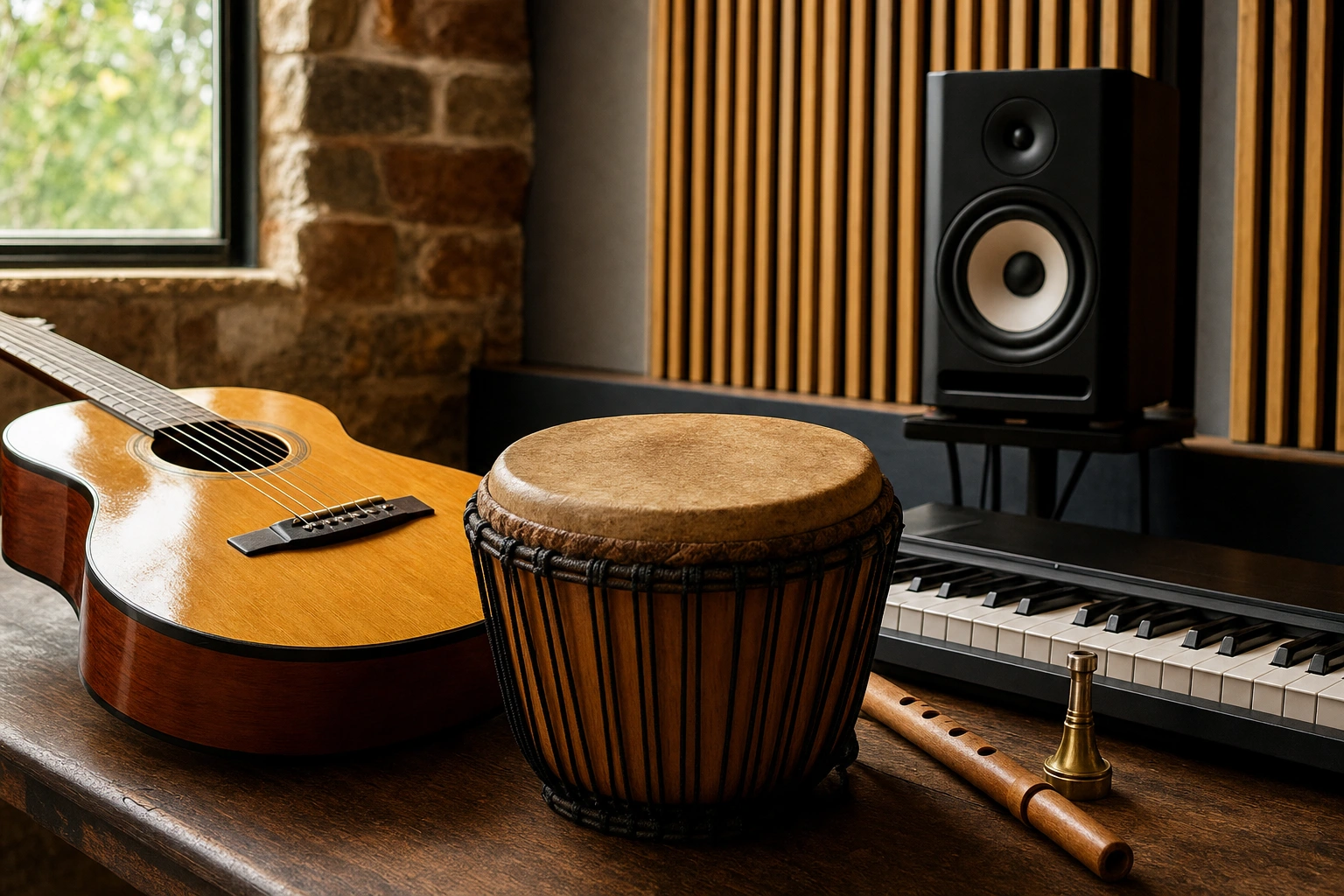
Every musical instrument begins with movement. A string is plucked, a drumhead is struck, air is blown through a tube, or an electronic circuit generates a changing signal. These actions create vibrations, and the vibrations travel through a medium such as air until they reach a listener’s ears. The brain interprets those patterns as musical sound.
Understanding how instruments produce sound helps musicians play with greater control and helps listeners hear more than just a melody. It also explains why a violin and a guitar can play the same note but sound different, why tightening a drumhead changes its tone, and why a small change in a trumpet player’s lips can alter pitch. The central process is simple: an energy source causes something to vibrate, and the instrument shapes that vibration into an audible and useful sound.
The basic science of musical sound
Sound is produced when an object vibrates. A vibrating object pushes and pulls on nearby air particles. Those particles pass the disturbance to neighbouring particles, creating a travelling pattern called a sound wave. The wave eventually reaches the ear, where it causes the eardrum to vibrate. The brain then identifies features of the vibration as pitch, loudness and tone quality.
Sound needs a medium to travel through. In everyday musical situations, that medium is usually air, although sound can also travel through liquids and solids. Sound does not travel through a complete vacuum because there are no particles to carry the vibration.
An instrument does not merely create vibration; it controls it. The player controls the starting energy, while the instrument’s materials, shape and construction influence how the vibration develops. This is why instruments are designed with particular strings, membranes, tubes, cavities, bridges, keys, valves and resonating bodies.
Four important qualities of musical sound
Pitch: how high or low a sound seems
Pitch is mainly related to frequency, which is the number of complete vibrations made each second. Frequency is measured in hertz, abbreviated as Hz. Faster vibrations generally produce a higher perceived pitch, while slower vibrations produce a lower one.
For a string instrument, shortening the vibrating length of a string usually raises its pitch. Tightening the string also raises its pitch, while adding mass or using a thicker string generally lowers it. This is why a guitarist presses a string against a fret: the fret shortens the portion of string that vibrates.
In a wind instrument, pitch is controlled largely by the length of the air column. Opening or closing holes, changing valves or moving a slide changes the effective length of that column. A shorter air column tends to produce a higher note, while a longer one tends to produce a lower note.
Loudness: how strong a sound seems
Loudness is associated mainly with the amplitude, or size, of a vibration. Striking a drum harder transfers more energy to the drumhead, producing a larger vibration and usually a louder sound. Plucking a guitar string more forcefully has a similar effect.
Loudness is also affected by the instrument’s design and by the listening environment. A hollow guitar body can move more air than a bare string alone. A trumpet’s bell helps project sound forward. A room with hard surfaces may make music seem louder or more sustained than a room containing carpets and curtains.
Timbre: why instruments sound different
Timbre is the quality or character of a sound. It allows listeners to distinguish a flute from a clarinet even when both play the same pitch at a similar loudness. Timbre is shaped by the mixture of the fundamental frequency and additional frequencies called harmonics or overtones.
A real musical note is rarely a perfectly pure single frequency. It normally contains a fundamental, which gives the note its main pitch, together with other frequencies. The relative strength of those additional frequencies creates the instrument’s characteristic colour. The way a sound begins and ends also matters. A piano note has a different attack and decay from a bowed violin note, even when the two instruments play the same pitch.
Duration: how long a sound lasts
Duration is the length of time a sound continues. It depends on how long the instrument’s vibrating part remains active and how quickly energy is lost. A cymbal may continue shimmering after it is struck, while a muted drum stops almost immediately. A violinist can sustain a note with a bow, whereas a pianist cannot keep a single struck string vibrating indefinitely without repeating the action or using the sustain pedal.
How string instruments produce sound
String instruments produce their initial sound through the vibration of one or more strings. The strings may be plucked, bowed or struck. Examples include the guitar, violin, cello, harp, piano and many traditional instruments such as the West African kora and the East African nyatiti.
A vibrating string by itself moves very little air, so its sound may be quiet. The string’s energy is transferred through a bridge to another part of the instrument, often a soundboard or hollow body. This larger surface vibrates and moves more air, making the sound stronger. The shape and material of the body also filter the harmonics, giving the instrument its timbre.
In a violin, the bow creates friction that keeps the string vibrating. The player changes pitch by pressing the string against the fingerboard, altering its vibrating length. In a guitar, the fingers or a pick disturb the strings, while frets provide fixed positions for changing pitch. In a piano, pressing a key causes a felt-covered hammer to strike a string. The key mechanism also allows the player to control how forcefully the hammer hits.
String instruments illustrate the relationship between tension, length and mass. A short, thin, tightly stretched string tends to vibrate quickly and produce a higher pitch. A long, thick or less tightly stretched string tends to vibrate more slowly and produce a lower pitch. Instrument makers combine these variables to provide a practical range of notes.
How wind instruments produce sound
Wind instruments use vibrating air. The player supplies energy by blowing, buzzing the lips or using a reed. The air inside the instrument then vibrates in patterns determined by the tube’s length, shape and openings.
In brass instruments such as the trumpet and trombone, the player’s lips vibrate against the mouthpiece. This buzzing sets the air column into vibration. Valves on a trumpet or a slide on a trombone change the length of the tubing, allowing different notes. Skilled players can also adjust lip tension and air pressure to reach different resonances within the same tube.
Woodwind instruments use an edge or a reed to start the vibration. In a flute, the player directs air across an opening, causing the air at the edge to oscillate. In a clarinet or saxophone, a single reed vibrates against the mouthpiece. In an oboe or bassoon, two reeds vibrate against each other. Opening and closing tone holes changes the effective length of the air column.
Traditional African instruments demonstrate the same physical principles in varied forms. A simple flute made from wood or reed uses a vibrating air column, while a horn made from an animal horn or another tube uses the player’s buzzing lips. The materials and construction influence the instrument’s range and tone, but the underlying process remains the conversion of breath into controlled vibration.
How percussion instruments produce sound
Percussion instruments are sounded by striking, shaking, scraping or otherwise disturbing a material. Their vibrating parts may be stretched membranes, solid bars, plates, strings or groups of small objects.
In a drum, the player strikes a stretched membrane. The membrane’s vibration is transferred to the air inside the shell and outside the drum. The tension of the membrane, its size, the shell’s shape and the striking position all affect the result. Striking near the centre often produces a different tone from striking near the edge.
Some percussion instruments have a clearer sense of pitch than others. A xylophone uses tuned wooden bars, each designed to vibrate at a particular frequency. Metal bars in a glockenspiel create a bright, high sound. A marimba uses resonator tubes beneath its bars to strengthen selected frequencies. By contrast, a shaker or cymbal contains many irregular vibrations, so it produces a complex sound rather than one clearly defined pitch.
Instruments such as the Kenyan ngoma drum or West African djembe can support both rhythm and expressive changes in tone. Players vary hand position, striking technique and force to create contrasting sounds. The instrument is therefore not just a source of beats; it is a responsive system in which technique shapes vibration.
How keyboard instruments create sound
A keyboard is a control system rather than one single sound-producing method. The keys may activate strings, air, vibrating metal parts or electronic signals.
In an acoustic piano, a key activates a hammer that strikes one or more strings. The strings transfer energy to a soundboard, which amplifies and colours the sound. The damper controls how long a string continues vibrating. Pressing the sustain pedal lifts selected dampers, allowing notes to continue after the keys are released.
In a pipe organ, keys open valves that allow air to pass through pipes. Each pipe has an air column with a particular pitch, and the pipe’s material and shape contribute to its timbre. An electronic keyboard may use recorded samples or synthesised waveforms. Its speakers convert electrical signals into movements of a speaker cone, which then creates sound waves in the air.
Resonance: how instruments strengthen and shape sound
Resonance occurs when an object responds strongly to a vibration that matches one of its natural frequencies. Musical instruments are designed to use resonance rather than allowing energy to disappear quickly.
For example, a guitar’s body resonates in response to the vibrating strings. A violin’s wooden body, air cavity and sound post work together to project the sound. In a drum, the shell and the enclosed air respond to the vibrating head. In a wind instrument, the air column resonates at particular frequencies, helping the player produce stable notes.
Resonance does not simply make an instrument louder. It also selects and reinforces some frequencies more than others. That selection is a major part of timbre. Two instruments made from different materials may respond differently even when their dimensions are similar. This is one reason musicians and makers pay close attention to wood, metal, membranes, reeds and construction techniques.
From physical vibration to electronic sound
Electronic instruments may create sound without a traditional vibrating string, membrane or air column at the starting point. An electronic circuit can generate an electrical signal that represents a repeating waveform. The signal may then be modified to change its frequency, amplitude and harmonic content.
A loudspeaker converts the electrical signal into physical movement. Its cone moves backwards and forwards, pushing air and creating sound waves. In this sense, even an electronic instrument ultimately needs a vibrating surface to produce audible sound in a room.
Digital instruments can imitate acoustic instruments by storing recordings or calculating sound mathematically. They can also create sounds that have no direct acoustic equivalent. However, the listener still experiences changes in pitch, loudness, timbre and duration, because these are fundamental features of how sound is organised and heard.
How musicians control sound
Players control an instrument through several connected actions:
- They supply energy. This may come from a finger, bow, breath, mallet, keyboard mechanism or electronic control.
- They select a vibrating system. They choose a string, key, hole combination, drum area, reed or electronic setting.
- They adjust the vibration. Pressure, speed, tension, embouchure, touch and timing influence the result.
- They shape the sound over time. They may begin gently, increase loudness, add vibrato, mute the sound or release it suddenly.
- They use the instrument’s resonating parts. Position, posture and technique can help the sound project clearly and retain its desired tone.
This explains why two musicians can play the same instrument differently. The instrument provides possibilities, but the performer determines how energy enters the system and how the vibration is controlled.
Applying This in Practice
You can investigate sound safely with simple observations. Pluck a rubber band stretched over a box and notice how changing its length or tension changes the pitch. Tap glasses containing different amounts of water and compare their sounds. Cover and uncover the holes of a recorder or similar wind instrument to observe how the effective air-column length changes.
When listening to a piece of music, choose one instrument and ask four questions: What is vibrating? What starts the vibration? Which part amplifies or resonates with it? Which features make its sound recognisable? For a guitar, the answers might be the string, the finger or pick, the body and bridge, and the combination of harmonics and attack.
Musicians can apply this knowledge when choosing equipment or solving performance problems. If a guitar sounds weak, the issue may involve string condition, the bridge, the body or the playing technique. If a drum sounds dull, head tension, striking position and shell resonance may all be relevant. If a wind instrument produces unstable notes, breath support, embouchure, reed condition and the instrument’s air column should be considered together rather than treated as unrelated problems.
Instrument making also depends on balancing these factors. A designer must decide how much vibration to allow, which frequencies to reinforce and how the instrument should respond to the player. Good design is therefore both an artistic and a physical discipline: it connects materials, geometry, craftsmanship and human control.
Key Takeaways
- Musical sound begins when an object or air column vibrates and transfers energy to the surrounding medium.
- Pitch mainly relates to vibration frequency, while loudness is mainly related to vibration amplitude.
- Timbre comes from the mixture of harmonics and from how a sound begins, develops and ends.
- Strings, membranes, air columns, solid bars and electronic signals can all serve as starting points for musical sound.
- Resonating bodies and cavities strengthen selected frequencies and help give instruments their distinctive tone.
- Players shape sound by controlling energy, vibrating length, tension, breath, touch, timing and release.
No comments yet.