
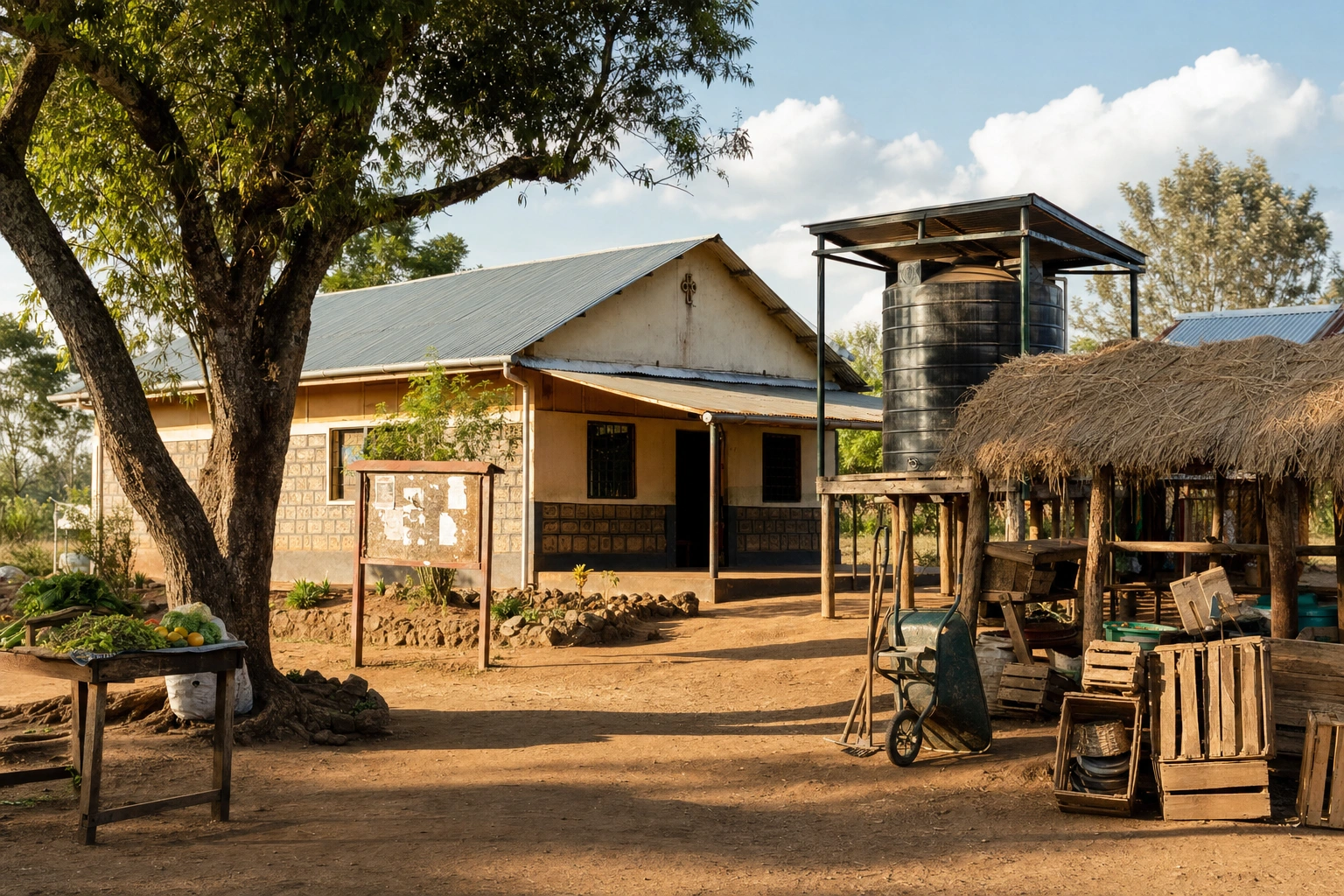
Local development is often discussed in terms of needs: unemployment, poor roads, limited services, weak markets or inadequate housing. These concerns matter, but a community is more than a list of problems. Every neighbourhood, village or town also contains assets—people, relationships, knowledge, buildings, natural resources, businesses and cultural practices—that can contribute to solving local challenges.
Understanding and using these assets is at the heart of community-led development. Rather than waiting for an outside organisation to provide every solution, residents identify what they already have, decide what matters most and combine their resources with appropriate external support. This approach does not ignore poverty or inequality. It creates a stronger foundation for addressing them in a practical, inclusive and locally relevant way.
What Are Community Assets?
Community assets are the resources and strengths available within a local area that can support the wellbeing, resilience and development of its residents. An asset may be physical, social, economic, cultural, environmental or human. Some assets are easy to see, such as a health centre or a market. Others are less visible, such as trust between neighbours, traditional knowledge or the ability of local artisans to repair equipment.
A community asset is not valuable merely because it exists. Its value depends on whether people can access it, organise around it and use it responsibly. For example, a borehole may be an important physical asset, but it will only support development if the community can maintain it, manage access fairly and collect enough revenue for repairs.
Common types of community assets
- People and skills: teachers, farmers, health workers, craftspeople, entrepreneurs, caregivers, young people, elders and residents with professional or technical knowledge.
- Associations and institutions: savings groups, cooperatives, faith-based organisations, schools, local authorities, youth groups, women's groups and community-based organisations.
- Physical infrastructure: roads, water points, schools, clinics, community halls, markets, workshops, storage facilities, telecommunications equipment and public spaces.
- Economic resources: local enterprises, farms, livestock, financial savings, customer networks, trading links and opportunities for employment or value addition.
- Cultural assets: languages, history, music, ceremonies, traditional skills, local stories, food practices and systems of mutual support.
- Natural assets: land, rivers, forests, grazing areas, fisheries, wildlife, soil, rainfall and other resources that can support livelihoods when managed sustainably.
- Relationships and networks: trust, cooperation, information-sharing, mentorship, partnerships and connections with people or institutions outside the community.
How Community Assets Support Local Development
Community assets contribute to development in several connected ways. Their influence is strongest when different assets are combined instead of being treated as separate resources.
1. They help communities define realistic priorities
Residents who understand their own circumstances can identify priorities that may be missed by outsiders. A village may decide that repairing a feeder road is more urgent than constructing a new office, or that improving storage is more useful than increasing production. Local knowledge helps people connect a proposed project with everyday realities such as seasonal weather, transport costs, household responsibilities and existing work patterns.
This does not mean that every local decision is automatically fair or correct. It means that planning begins with people who experience the issue directly. Their knowledge can then be combined with technical assessments and wider development information.
2. They reduce dependence on outside assistance
External funding can be useful, but projects that depend entirely on donors, government programmes or short-term experts may struggle when support ends. Using local assets can reduce this vulnerability. A community that contributes labour, locally available materials, management skills or a small maintenance fund has greater capacity to continue operating a project.
For instance, a community library may be supported by donated books from outside, but its long-term success may depend on local volunteers, a secure room, a timetable, electricity and a committee that manages borrowing. The outside contribution is valuable, but local assets make the service sustainable.
3. They strengthen local ownership and accountability
People are more likely to protect and improve a project when they have participated in deciding its purpose and design. Ownership is not simply a feeling of pride. It involves responsibility for decisions, finances, maintenance and results.
Clear local roles also make accountability more visible. Residents can ask who is responsible for collecting fees, purchasing supplies, keeping records or reporting problems. Transparent procedures help prevent a small group from controlling a community resource for private benefit.
4. They create livelihoods and circulate value locally
Local development is closely connected to economic opportunity. Skills, land, networks, tools and local demand can support businesses and employment. A farming group might combine production with collective purchasing, storage, processing and marketing. This can create more value than selling raw produce individually, although the group still needs sound financial management and access to reliable markets.
Local enterprises also keep some spending within the area. A school that buys services from local repairers, caterers or suppliers can support household incomes, provided quality and fair pricing are maintained.
5. They build resilience
Resilience is the ability to prepare for, withstand and recover from difficulties. Strong relationships, diverse livelihoods, local knowledge and functioning institutions can help communities respond to drought, floods, economic shocks, public health problems or conflict.
A community with only one source of income may be highly exposed to a market or climate shock. A community with different skills, savings groups, food production, social support networks and communication channels may have more options. Resilience does not remove risk, but it improves the ability to respond.
6. They preserve identity while enabling adaptation
Cultural assets can strengthen cooperation and belonging. Local languages and traditions may carry knowledge about farming, conflict resolution, food preservation, environmental care or community responsibility. At the same time, culture should not be treated as unchangeable or used to exclude particular groups. Development works best when communities preserve valuable knowledge while examining practices that limit safety, equality or opportunity.
Asset-Based Community Development
Asset-based community development, often abbreviated as ABCD, is an approach that begins with strengths rather than deficiencies. It asks questions such as: What can residents do? Which relationships already work? What spaces and organisations exist? Which local resources are underused? How can these strengths be connected to address a shared priority?
This approach differs from a needs-only model. A needs assessment may identify unemployment, poor sanitation or limited access to finance. An asset-based process adds another layer: which skills, groups, spaces and local economic activities can help address these issues? Both perspectives are useful. Focusing only on assets can hide serious problems, while focusing only on needs can portray residents as dependent recipients rather than capable participants.
ABCD is therefore not a refusal of external support. Communities may still need public investment, specialist expertise, regulation, infrastructure or finance. The key principle is that outside support should strengthen local capacity instead of replacing it wherever possible.
A Practical Process for Mobilising Community Assets
Step 1: Agree on the issue and the area
Begin by defining the development concern clearly. “Improve the community” is too broad for effective action. A more useful focus might be reducing post-harvest losses among small farmers, improving access to safe water or creating work opportunities for young adults.
Also define the community. It may be a village, urban settlement, ward, market area, school catchment or group connected by a common livelihood. A clear boundary helps identify who should participate and what resources are relevant.
Step 2: Map the assets
Asset mapping is a structured way to record local strengths. It can include public meetings, household conversations, walking observations, interviews, participatory maps, community noticeboards or simple inventories. Ask residents to identify people with useful skills, active organisations, available buildings, natural resources, local businesses, transport options, communication channels and sources of knowledge.
Do not record only formal assets. An older person who knows local water patterns, a mechanic who can maintain a pump, a group that organises emergency support or a trader who connects producers to buyers may be highly important even without an official title.
Step 3: Examine access, power and gaps
An asset map should show who can use a resource and who cannot. A public space may be formally open to all but feel unsafe for women at certain times. A cooperative may exist but exclude small producers. A digital service may be available but inaccessible to people without smartphones, data or digital skills.
Ask whose voices are missing from meetings. Include women, young people, older residents, people with disabilities, minority groups, tenants, informal workers and residents in less visible areas. Inclusion improves the quality of the asset map and reduces the risk that development benefits only those who already have influence.
Step 4: Connect assets around a specific opportunity
Listing assets is not enough. The next task is to connect them to a practical objective. Suppose farmers have production skills, a youth group has digital and record-keeping abilities, a local carpenter can make storage shelves, and a cooperative has relationships with buyers. Together, these assets might support a small aggregation and storage initiative.
The plan should specify the activities, responsible people, required resources, risks, timeline and indicators of progress. It should also distinguish between contributions that are voluntary and work that should be paid. Community participation should not become a reason to exploit unpaid labour.
Step 5: Build partnerships carefully
External partners can provide finance, equipment, training, legal guidance or technical expertise. Before accepting support, the community should discuss its conditions and long-term implications. Who will own donated equipment? Who will pay for fuel, repairs or insurance? Does the technology suit local conditions? What happens if the project manager leaves?
A good partnership respects local decision-making while maintaining professional standards. Written agreements, open budgets and regular reporting can protect both the community and the partner.
Step 6: Review and adapt
Local development rarely follows the original plan exactly. Monitor both outputs and wider effects. Outputs might include the number of training sessions held or facilities repaired. Wider effects might include lower transport costs, improved attendance at school, increased income or fairer access to services.
Review meetings should be used to learn, not merely to defend a plan. If an activity is not reaching the intended group, change the method. If maintenance costs are higher than expected, revise the budget or design. Adaptation is a sign of responsible management.
Example: Linking Local Assets to Food Security
Consider a semi-arid community where households experience food shortages during a difficult season. A needs-only response might request food aid or a new irrigation scheme. Those interventions may sometimes be necessary, but an asset-based assessment could reveal additional options.
Residents may identify farmers with knowledge of drought-tolerant crops, a women's group with savings, a school kitchen with unused storage space, a local artisan who can repair water tanks, and a community radio programme that shares agricultural information. A local authority or development partner might add agronomic advice and financing for appropriate equipment.
The resulting project could combine demonstration plots, collective purchasing, improved storage, repair training and market information. It would still require careful analysis of water availability, land rights, costs and environmental risks. The example shows the central principle: development becomes more practical when external resources are connected to existing local capacity.
Challenges and Safeguards
Community assets can be misused or overstated. Local leaders may claim to represent everyone while excluding women, young people or minority groups. A community contribution may be counted without considering whether households can afford it. Natural resources may be treated as unlimited, creating environmental damage. Informal knowledge may be valuable but still need to be tested against safety and technical requirements.
Several safeguards are important:
- Use open and understandable criteria for selecting beneficiaries and projects.
- Publish budgets, responsibilities and maintenance arrangements.
- Provide safe ways for residents to raise concerns or report misuse.
- Check that participation is inclusive and does not place unfair burdens on caregivers or low-income households.
- Assess environmental effects before using land, water, forests or other natural resources.
- Separate community leadership from financial control where possible, with more than one person reviewing records.
- Measure whether benefits reach the people the project is intended to support.
Applying This in Practice
If you are part of a residents' association, social enterprise, local government team or community organisation, start with a small and specific exercise. Choose one shared issue and invite a diverse group to answer four questions:
- What strengths, skills, relationships and facilities already exist here?
- Who can access these assets, and who is currently left out?
- Which two or three assets could be combined to address the chosen issue?
- What support is genuinely needed from government, funders, experts or businesses?
Record the answers in a simple asset register. For each asset, note its location, custodian, potential use, access conditions and risks. Then select one achievable action, agree responsibilities and set a review date. A modest project with clear ownership often teaches more than an ambitious plan that has no maintenance strategy.
For professionals and entrepreneurs, the same method can improve programme design. Before introducing a service or product, study existing capabilities, trust networks, purchasing habits and local constraints. This can reveal partnership opportunities, reduce duplication and make an intervention easier to adopt.
Key Takeaways
- Community assets include people, skills, organisations, infrastructure, culture, natural resources, businesses and relationships.
- Local development is stronger when residents help define priorities and combine existing assets around practical goals.
- Asset-based development complements external support; it does not deny the need for public investment, expertise or finance.
- Asset mapping must examine access, power and exclusion, not simply list resources that exist.
- Successful projects clarify responsibilities, budgets, maintenance arrangements and measures of progress.
- Local assets should be used sustainably and inclusively so that development benefits are shared and lasting.
No comments yet.