
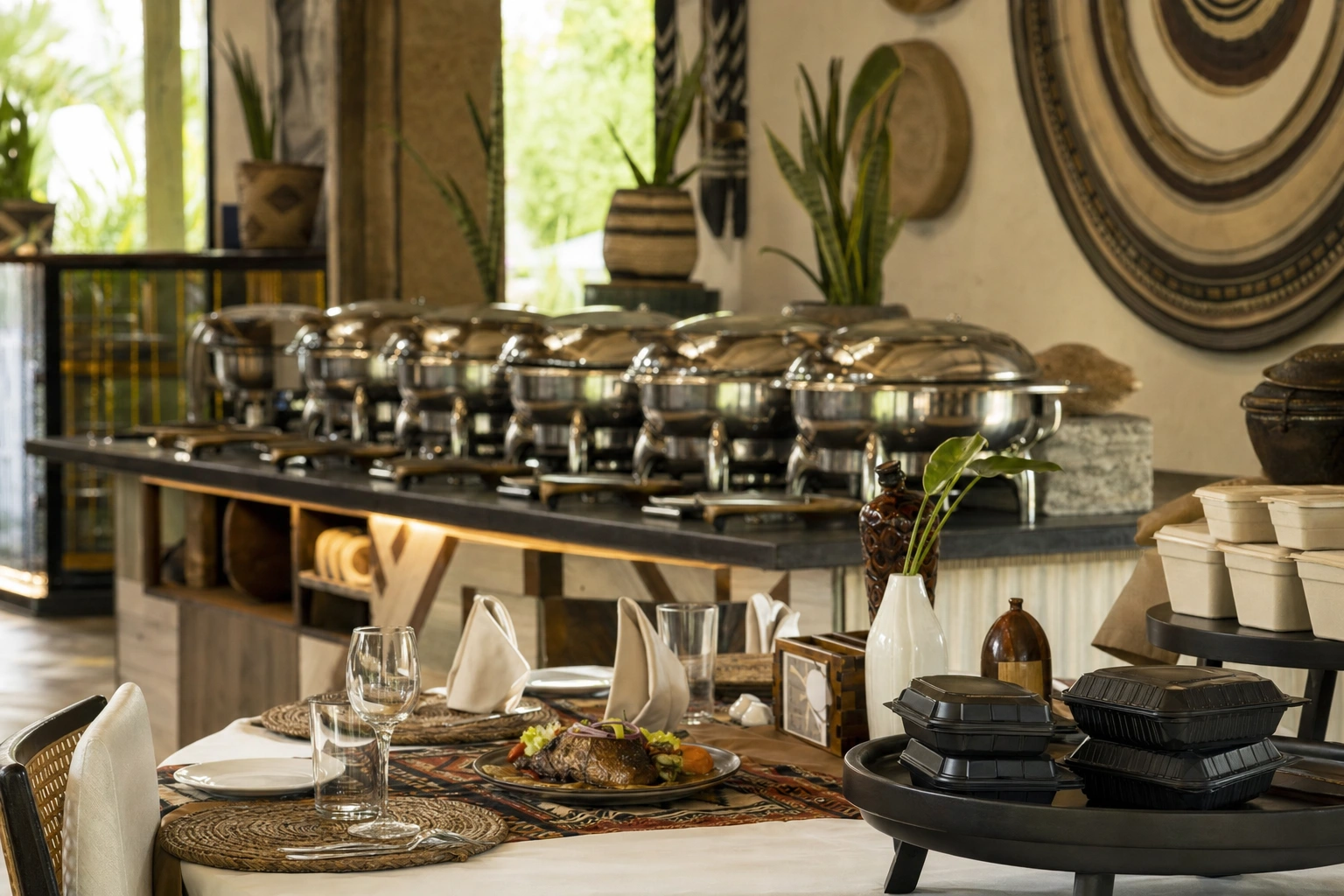
Food and beverage service is the process of presenting, preparing, delivering and supporting food and drinks for customers. It includes far more than carrying a plate from a kitchen to a table. The service format influences the customer journey, the skills required from employees, the amount of equipment needed, the speed of delivery and the way a business controls costs.
Understanding the different types of food service is useful for hospitality students, restaurant owners, hotel managers, caterers and anyone planning a food business. A small café in Nairobi, a hotel restaurant in Mombasa, a school dining hall and a formal banquet may all serve meals, but their systems, customer expectations and staffing patterns are very different.
What determines the type of food service?
A food service operation usually chooses its format according to several practical factors:
- Customer expectations: A business lunch may require speed, while a special dinner may prioritise attention and atmosphere.
- Menu complexity: Simple pre-prepared meals can support self-service, whereas delicate dishes may require trained table servers.
- Price and positioning: A premium restaurant can justify a higher labour cost through personalised service; a budget outlet may focus on volume and efficiency.
- Available space and equipment: Kitchen layout, dining-room size, counters, trays, trolleys and refrigeration affect what is possible.
- Customer volume: High-volume operations need a system that moves people and food smoothly without creating long queues.
- Occasion: Weddings, conferences, airline meals, family celebrations and everyday dining each require different levels of organisation.
These factors often overlap. For example, a hotel may offer table service in its main restaurant, buffet service at breakfast, room service for sleeping guests and takeaway service for customers leaving the property.
1. Table service
Table service is a format in which customers are seated and employees take responsibility for receiving orders, serving food and drinks, clearing used items and often presenting the bill. It remains one of the most recognisable forms of food service.
How it works
The typical sequence begins with greeting and seating, followed by menu presentation, order-taking, service of drinks, delivery of food, checking customer satisfaction, clearing, billing and farewell. The exact sequence varies according to the restaurant and meal.
Table service may be informal or highly formal. In a casual restaurant, a server may take an order using a point-of-sale system and deliver plated meals. In fine dining, staff may explain ingredients, coordinate several courses, recommend drinks and use specialised serving techniques.
Strengths and limitations
The main advantage is personal attention. Staff can answer questions, manage special requests and identify problems before they damage the customer experience. Table service also supports a more relaxed and social meal.
However, it requires more labour, training and coordination than many self-service formats. Errors in order-taking, delays between courses or poor communication with the kitchen can affect both satisfaction and profitability. Restaurants must balance hospitality with efficient table turnover, especially during busy periods.
2. Counter service
In counter service, customers place orders and usually pay at a counter before collecting their food or receiving it at a table. This is common in cafés, bakeries, quick-service restaurants, food courts and many small takeaway businesses.
The process may involve a displayed menu, a cashier, a kitchen or preparation area behind the counter, and a collection point. Some operations give customers a number or electronic notification when an order is ready.
Counter service can reduce the number of dining-room employees and make payment easier to control. It is suitable for customers who want a reasonably quick meal, such as workers buying lunch in a commercial district or travellers stopping at a busy transport centre.
Its main challenge is managing queues and collection areas. Clear menus, accurate order recording, good preparation planning and visible communication are essential. If customers cannot tell where to order, pay or collect food, even a simple service model can feel disorganised.
3. Self-service
Self-service requires customers to collect some or all of their food and drinks themselves. The business may provide attendants for payment, portioning, replenishment, cleaning and assistance, but customers do not receive every item directly from a table server.
Self-service is found in cafeterias, workplace canteens, hospitals, schools, universities and some casual restaurants. A customer might choose a dish from a serving line, receive a portion from an attendant, add side dishes independently and pay at the end.
This approach can serve many people efficiently because customers move through the operation in a controlled sequence. It can also make food choices visible, which helps customers decide quickly. Nevertheless, the layout must support safe movement and hygiene. Serving utensils should be appropriate, hot and cold food should be managed correctly, spills should be dealt with promptly, and the business should consider how customers with disabilities or limited mobility will use the area.
4. Cafeteria service
Cafeteria service is a structured form of self-service, normally involving a service counter or line where customers select food from a range of prepared items. Food may be priced by portion, item or weight, depending on the operation.
A cafeteria is particularly useful where customers need a choice of meals within a limited time. For example, a college dining facility may offer rice, vegetables, meat, beans, fruit and drinks along one service route. The system allows customers with different preferences and budgets to make individual choices.
Successful cafeteria service depends heavily on layout. Popular items should not create bottlenecks at the beginning of the line, drinks and condiments should be positioned sensibly, and payment should occur at a point that does not obstruct customers still choosing food. Menu labelling, allergen information and portion control also require attention.
5. Buffet service
In buffet service, food is displayed in serving dishes and customers usually choose and collect their own portions. Staff may replenish dishes, carve or portion selected items, clear tables and provide drinks or special assistance.
Buffets are common at hotel breakfasts, conferences, celebrations and large family events. They offer variety and allow guests to control portion size. They can also help a caterer serve a large group without taking individual orders for every dish.
Buffet service is not automatically cheaper or easier than table service. It requires careful forecasting, attractive presentation, replenishment, temperature control, queue management and waste monitoring. Food displayed for long periods may lose quality, while excessive quantities can create waste. A good buffet therefore combines choice with disciplined production planning.
6. Family-style service
Family-style service places shared dishes on the dining table, allowing customers to serve themselves and pass food around the group. It is common at social events, informal restaurants and some traditional dining settings.
The format encourages conversation and shared participation. It can work well for groups that want to taste several dishes, such as a Kenyan family ordering shared stews, vegetables, rice and chapati, or a group dining at an African, Asian or Mediterranean restaurant.
Portion planning is important. The business must estimate how much of each dish is needed, provide suitable serving utensils and manage replenishment without interrupting the meal. Family-style service may be less suitable for customers with strict dietary requirements unless dishes and ingredients are clearly identified.
7. Room service
Room service, sometimes called in-room dining, delivers food and drinks to a guest’s hotel room or accommodation unit. Orders may be placed by telephone, through a digital system, or using a menu provided in the room.
The operation requires accurate communication between the guest, order-taking staff, kitchen, service team and billing system. Food must be packaged or arranged so that it remains attractive during transport. Staff may deliver a tray or trolley, explain the order, set up the meal and later collect used items according to the property’s procedure.
Room service provides privacy and convenience, but it is operationally demanding. Delivery time, food temperature, tray presentation, lift access and the recovery of equipment all affect performance. Hotels may limit the menu at certain times so that the kitchen can maintain quality and reasonable delivery times.
8. Takeaway and delivery service
Takeaway service prepares food for customers to collect and eat elsewhere. Delivery service adds the movement of food to a home, office, hotel room or another location. These formats are used by restaurants, cafés, supermarkets, caterers and specialised delivery kitchens.
Packaging is central to quality. Containers must protect the food, reduce leakage and preserve texture as far as reasonably possible. Fried foods, sauces, hot drinks and delicate desserts may each need different packaging solutions. Businesses should also consider portion accuracy, labelling, cutlery requests and the separation of hot and cold items.
Delivery introduces extra risks: traffic delays, incorrect addresses, unavailable customers and food arriving in poor condition. Reliable order confirmation, clear collection procedures and realistic preparation times are more valuable than promising a speed the operation cannot consistently achieve.
9. Drive-through service
Drive-through service allows customers to order and collect food without leaving their vehicles. It is designed for convenience and speed, usually using an ordering point, payment window and collection window.
Because customers cannot easily browse a dining room or wait comfortably, the system must be simple. Menus should be readable, orders should be repeated for confirmation, and staff must coordinate preparation with the vehicle queue. A drive-through is most effective when the menu is suitable for rapid production and packaging.
Its limitations include dependence on suitable site design, vehicle access and traffic flow. It may not suit meals that require extensive preparation or presentation. Businesses also need an alternative service route for pedestrians, cyclists and customers who are not using vehicles.
10. Banquet and function service
Banquet service is organised food service for a planned group occasion, such as a wedding, conference, graduation celebration or business dinner. The menu, seating plan, timing and number of guests are generally agreed in advance.
Common approaches include plated service, where each guest receives a prepared course; buffet service; family-style service; and reception service, where small portions are passed or collected. The right choice depends on the event’s formality, venue, budget, kitchen capacity and schedule.
Banquet service requires detailed coordination. Staff need a guest count, menu information, table plan, dietary requirements, service timetable and clear responsibilities. For a conference in Kisumu, for example, the caterer may need to serve refreshments during a short break and lunch to hundreds of delegates. Timing and replenishment can matter as much as the recipes.
11. Specialised and assisted service
Some operations use specialised forms of service to create a particular experience. Examples include gueridon service, in which certain preparation or finishing takes place beside the guest’s table; silver service, where food is transferred from a service dish by trained staff; and wine or beverage service led by knowledgeable servers.
These methods can demonstrate skill and add theatre, but they also require training, space, equipment and careful safety controls. They should be used because they improve the intended experience, not simply because they appear luxurious. A technique that slows service without adding value may be unsuitable for a busy casual operation.
Commercial and non-commercial food service
Food service can also be classified by its purpose. Commercial food service operates primarily to generate revenue. Restaurants, hotels, cafés, bars, caterers and takeaway outlets fall into this group.
Non-commercial food service provides meals as part of another institution’s main activity. Examples include school meals, hospital catering, workplace canteens, prison catering and meals served in some care settings. These operations still need financial control, but their priorities may include nutrition, regular schedules, dietary suitability and institutional policy rather than customer choice alone.
The two categories can use similar service styles. A hospital may use a tray delivery system, while a workplace canteen may use cafeteria service. Classification by purpose therefore complements, rather than replaces, classification by service method.
Choosing the right service type
There is no universally best type of food service. A business should match the format to its promise and resources. The following questions provide a practical starting point:
- Who is the customer? Identify whether customers are tourists, families, office workers, students, event guests or residents requiring regular meals.
- What experience is being promised? Decide whether the priority is speed, convenience, personal attention, variety, affordability or celebration.
- How complex is the menu? Consider preparation time, cooking methods, portion control, dietary requests and the ability to maintain consistent quality.
- What level of staffing is affordable? Include kitchen staff, servers, cashiers, cleaners, delivery personnel and supervisors rather than considering only the visible service team.
- How will food safety and quality be protected? Plan for holding, transport, serving utensils, cleaning and the separation of raw and ready-to-eat food.
- How will performance be measured? Useful measures include order accuracy, waiting time, waste, complaints, repeat business and the cost of labour and packaging.
Applying This in Practice
Imagine an entrepreneur opening a small lunch outlet near offices. A full table-service model may create unnecessary labour costs and slow the lunchtime flow. Counter service combined with a short menu could be more appropriate. If the business later adds corporate catering, it might use buffet or individually packed meals for office events. If it opens a larger evening restaurant, table service could support a more relaxed experience.
A manager should map the complete customer journey: arrival, menu choice, ordering, payment, preparation, collection or delivery, eating, clearing and feedback. At each stage, ask where delays, errors or waste might occur. Then test the selected service method during a quiet period before introducing it at full volume.
Training should cover more than politeness. Employees need product knowledge, order accuracy, safe food handling, complaint response, payment procedures and communication with colleagues. Consistent service is created by clear standards and sensible workflows, not by friendliness alone.
Key Takeaways
- Choose a food service type according to customer expectations, menu complexity, space, staffing and occasion.
- Table service offers personal attention but normally requires more labour and coordination.
- Counter, cafeteria, buffet and self-service formats can handle volume efficiently when layout and queue flow are well planned.
- Takeaway, delivery and room service depend heavily on accurate orders, suitable packaging and reliable timing.
- Banquet and function service require advance planning of menus, guest numbers, seating, dietary needs and service schedules.
- Commercial and non-commercial operations may use similar service methods but often have different priorities.
- The best service system is one that delivers the promised experience consistently while protecting quality, safety and financial control.
No comments yet.